At MCP Dev Summit, AWS senior principal engineer says that MCP is still by far the most popular way to connect agents at Amazon. Skills aren't replacing it but combined in "agent configurations" that are distributed across the company. News of MCP death is greatly exaggerated .
Best explanation I've heard for when to use sub-agents, from @trq212 Agent SDK workshop on YouTube: "when you need to do a bunch of work and return an answer to the main agent." Particularly when you need to process a lot of data that you don't want cluttering up the main context window. He gives the example of asking a question about a spreadsheet and just needing the result, but the use case I'm experimenting with is a research agent that has subagents create summaries of longer articles.
I wrote about a workflow for combining language models like Gemini or Claude with Nano Banana Pro to create much better landing pages than just a coding agent would. Nano Banana is a huge step up in image model's ability to design. https://t.co/B5kUurnHOZ
Here is a great workflow for doing landing page design with Nano Banana Pro, which is MUCH better than previous image models at details like text and layout, making it an amazing UI tool.
1) Use a system design prompt that encourage design thinking, committing to a unique creative aesthetic, making one aspect of the design unforgetabble
2) Make a user prompt for a landing page plan that includes color palette, hierarchy, typography, grid system, etc. You can also include reference images, either other landing pages you like or just cool photography that's aesthetic inspiration
3) Iterate on the page mocks with ASCII until you're happy with the basic concept, layout, and copy
4) Paste this plan into Nano Banana pro and ask for a few iterations on the design
5) It'll probably generate a few unique image assets that will be difficult to code. You want to ask Nano Banana to remove other elements to isolate specific assets
6) Now you have a design system plan, an image mock you like, and invidiaul assets. You can now go back to your favorite coding agent and get it built with the reference image and assets
Nano Banana Pro is one of the best UI design tools ever created. The trick is to COMBINE code/text models with image models, work with Claude / Gemini to come up with a design plan (aesthetic, typography, hierarchy), iterate on ASCII Mocks, then feed that plan to Nano Banana for creative assets, then use that as a reference image while coding.
This morning I very reliably reproduced this Claude Code issue where Skills don't activate, but then I upgraded to the latest CC version and now my test skills seem to almost always activate. I suspect Claude Code team quietly fixed some bugs around skills.
One problem with Claude Skills is they don't always reliably activate, I found this blog post about using Hooks to make them activate much more reliably, very interesting read! https://t.co/Ulp7dg8gbK
One problem with Claude Skills is they don't always reliably activate, I found this blog post about using Hooks to make them activate much more reliably, very interesting read! https://t.co/Ulp7dg8gbK
@GergelyOrosz Yeah ironically the most obvious AI writing use case - churning out text - is its worst. Its great at outlining and helping you analyze what pieces of your own writing work, but if you let it write the main text, you will sound like a "Hello, fellow Human" bot.
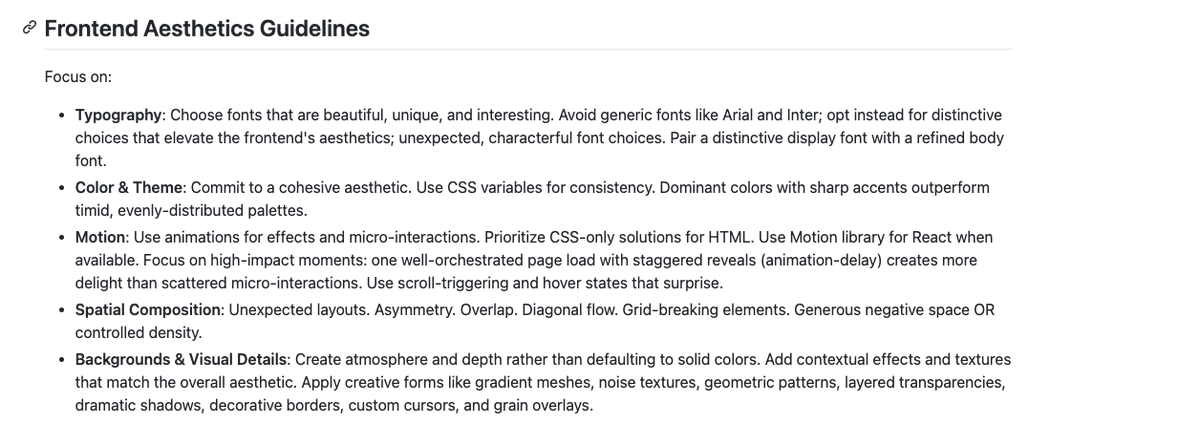
The "frontend design" Claude Code skill by @AnthropicAI is fascinating because its tiny and doesnt provide many specifics. Instead it tells Claude to make "distinctive choices" and "commit to a cohesive aesthetic" and that small guidance massively improves the UI designs created.
@dvassallo@AnthropicAI The skill is mandatory if youre doing UI design with Claude. My early experiments have "Claude + frontend skill" > Gemini but still playing around myself :) Also, maybe worth trying using the Claude skill as a Gemini prompt.
@swyx@simonw@MaheshMurag Skills might be a bigger deal than MCP because they might make MCP completely obsolete. Yeah they’re “just a markdown” bit turns out LLMs can do quite a bit with a just a markdown
A simple use of Claude Code Hooks is to get a desktop notification whenever Claude is done thinking/working. You want to add a hook on the Stop and Notification events. On MacOS can use osascript and afplay as the notification command. Here's what my ~/.claude/settings looks.
Lots of people talk about how using AI to code too much will make you worse at coding.
But AI is also one of the best ways to get better at coding. It knows many best practices and can explain how the most complex codebases work.
It's a net positive if you want it to be.
The Claude Code tip I discovered way to late is --resume which lets you pick a recent convo to resume (or --continue to pick the most recent). Lost a few terminal tabs and didn't know I could recover. Whats also useful to know is all these convos are in JSONL in ~/.claude/projects which lets you archive or run scripts on your conversations after the fact.
Agreed, at a BigCo a product prob has a lot of eyes on it and a major issue will be noticed fast. A small indie product could be broken and the potential user base is small enough people just leave, think your product sucks , and don’t tell you. Tests are to move faster otherwise you’re doing it wrong.
My current favorite use of Claude Code has nothing to do with code. I'm organizing all my life + business goals, context, and metrics into a big sets of markdown files and working on turning Claude Code into Claude Life Coach. Pretty fun!