Yo @davidgokhshtein
Down to run a space Thursday or Friday?
Been a minute and i saw you were open to hearing more about $KAS, the community is awesome.
@PoW_Odie Support #KUDOS to go to the Imperial College London!
kaspa:qrryda035xkx02l7yg7lx65ct89zk6ku2greszt475rvn80z6ydkyy9q3zl8r
There is also a big fundraiser on the Kaspa Discord in support of this effort, that is to be announced soon. (tomorrow?)
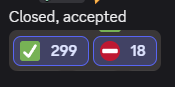
The Fundraising vote has been closed and it is accepted by a wide margin 299 vs 18!
Next and final step is the official fundraiser by the Kaspa Discord: https://t.co/NnehY5AGfi
They will offer both KAS and USD options afaik.
Once it starts, we will also post about it here on X and on our own KUDOS Discord: https://t.co/SxMVPRwrBW
Aside from the above, there is also a KUDOS wallet for direct donations that also will be used for the event at the Imperial College London.
Simple math: if the people who voted on average pitch in $85 this marketing campaign will happen in full scale. Stag hunt at its finest!
kaspa:qrryda035xkx02l7yg7lx65ct89zk6ku2greszt475rvn80z6ydkyy9q3zl8r
#Kaspa $KAS #KUDOS
KIP-21 matters because it gives Kaspa the missing commitment structure between raw blockDAG ordering and future verifiable execution. Without it, sequencing commitments behave too much like a single global stream: every accepted transaction contributes to one shared historical surface, which is fine for proving total network order, but hostile to app-local ZK proving. If a future DEX, stablecoin system, covenant market, or vProg only cares about its own state transitions, it should not be forced to carry the weight of unrelated network activity through its witness. That is the bottleneck KIP-21 cuts through.
The design partitions sequencing into lanes, where lane identity is derived from transaction subnetworks. Each active lane maintains its own recursive lane commitment through values like "lane_tip_hash" and "last_touch_blue_score". Those active lane tips are then inserted into an active-lanes sparse Merkle tree, producing a compact commitment that rolls upward into the broader sequencing commitment while still fitting inside Kaspa’s existing header commitment structure. So Kaspa keeps one global proof-of-work anchor, but the proof burden becomes local. That is the important architectural move.
This is not Ethereum-style global state. It is not “smart contracts on Kaspa” in the lazy EVM sense. It is closer to proof-indexed settlement: many isolated execution lanes, each proving the activity that touched it, all inheriting the same PoW-backed DAG ordering. Inactive lanes can be purged after enough blue-score time, which prevents the system from turning into permanent historical garbage collection for dead applications. The inactivity shortcut then lets proofs skip empty spans instead of walking every irrelevant block.
That makes KIP-21 one of the quietest but most important pieces of Toccata. Covenants define constrained UTXO behavior. ZK verification proves external computation. Native covenant IDs preserve lineage. KIP-21 gives all of it a scalable anchoring map. It is how Kaspa begins moving from fast money into sovereign execution infrastructure.
Kaspa Toccata mainnet process update:
Today we plan to publish the v1.3.0 mainnet pre-release, without activation, for 1–2 days of broader network sanity testing.
Assuming everything looks good, the following release will be v2.0.0, with activation planned for June 30, 4 weeks from today
Dear $ETH, $SOL, $SUI developers:
Why should you build on $KAS ? -
Kaspa is built to fix what’s broken in every other chain you’re already shipping on.
Ethereum forces you into L2 fragmentation, bridges, and fees.
Solana gives speed but still fights congestion and validator centralization.
Sui is elegant, but it’s another PoS system competing in the same crowded lane.
Kaspa is different.
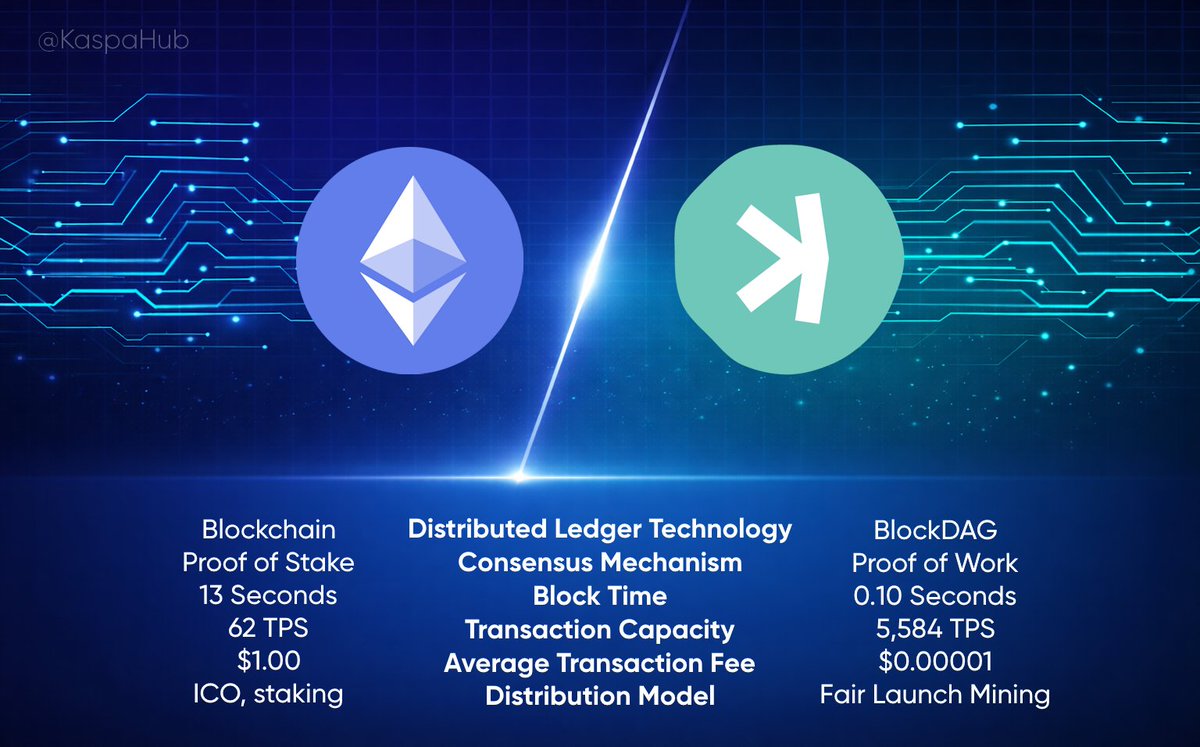
It runs a BlockDAG with GHOSTDAG — not a linear chain. Blocks are produced in parallel (currently 10 blocks per second). All honest work counts. No orphans. We’ve already hit real-world peaks above 5,500 TPS with sub-second to few-second finality — all on pure L1 Proof-of-Work.
That means:
• No L2 tax
• No sequencer risk
• No sharding complexity
• Bitcoin-grade security that actually
gets stronger as throughput increases
Programmability is here and getting better fast.
Right now you can deploy full EVM dApps on Kasplex or Igra Labs — Solidity + MetaMask, but settled on Kaspa’s fast, cheap, secure L1.
In the next few weeks (Toccata hard fork, June 2026), $KAS is activating native L1 covenants via SilverScript + ZK primitives directly on the DAG. You’ll get powerful on-chain logic and verifiable computation without bloating the base layer.
For builders this means:
• Port your existing EVM code easily today
• Build new apps that feel instant and cost almost nothing
• Ship on a chain where MEV and front-running are structurally harder
• Be early on the fastest, most decentralized PoW programmable platform
$KAS has solid tooling (WASM SDK, Rusty Kaspa, gRPC/REST) and a technical community that actually cares about the protocol.
If you’re tired of trading off speed for security, or security for decentralization, or decentralization for usability — stop compromising.
Build on $KAS.
The base layer finally scales. The security model is sound. The developer path is open.
The window to be early is right now.
$KAS Toccata Hard Fork Explained like you are a kid:
Imagine Kaspa is like your super-fast toy race car track with many lanes to drive on 🚗💨 Right now, it’s awesome because the cars zoom around really quick and safe — way faster than other tracks like Bitcoin’s slow one lane road. But the cars can mostly just go zoom and deliver money from one friend to another.
The Toccata hard fork is like a big magic upgrade coming in June 2026. It’s like adding new Lego pieces and special rules to the track so you can build way cooler stuff!
What it adds, super simple:
• Magic rules for the money (called “covenants”): Now your toy money can have special instructions. Like “This coin can only be given to your best friend if they promise to share their snacks” or “This money stays locked until you finish your chores.” It makes smart games and safe boxes possible.
• New toys to create (native tokens): You can make your own special coins or stickers (like KRC-20 tokens) right on the fast track. Think custom Pokémon cards or game points that everyone can use without slowing everything down.
• Secret spy proof stuff (ZK proofs): Super cool privacy magic where you can prove something is true without showing all your secrets. Like proving you have enough allowance without telling how much.
• A new shiny tool (Silverscript): This is like a special easy-to-use magic wand for grown-up builders to make fun apps, games, lending toys, or treasure hunts — all while the cars keep zooming super fast.
It’s not turning it into a complicated robot brain like some other blockchains. It keeps Kaspa light, fast (still zooming at 10 blocks per second or more later), and super secure like a strong castle.
After Toccata, Kaspa can do more fun things like:
• Digital collectibles (NFTs)
• Little banks for lending
• Special wallets that follow rules
• And lots of apps and games
Your old Kaspa coins stay exactly the same — no change needed! The whole track just gets better and more exciting!
why I’m personally excited about Kaspa’s upcoming Toccata covenants
- for the first time, I can build creative, complex apps directly over infrastructure I helped design and build
- we designed under architectural constraints, but the result came out surprisingly expressive and powerful
- Silverscript is cool as hell
- I can literally open a *.sil file and write a complex contract that will be fully verified on Kaspa L1
- (nottoself: create a 10-minute video showing the building of such an app e2e)
- I can design my own vaults and safeguards, and manage funds securely without risking a heart attack each time I touch a wallet
- covenant ids, contract templates, and inter-covenant communication (ICC) feel like a new set of axioms, or a new algebra to work with and discover
- sig verify from stack / sighash anyone-can-pay + covenant ids can allow interesting shared-state covenants (requires a non-consensus miner policy; kudos to @maxibitcat for pushing this line of thinking)
- complex contract systems can be deployed in one spk hash. no storage rent, no deployment tax; users pay only the transient mass for tx data as they use it
- as I’ve mentioned in the past, this becomes especially interesting for AI/agentic environments, where bots could cheaply create one-time agreements between themselves
- I didn’t even mention based apps yet. That’s a whole vertical that isn’t ready for exploration yet, but will be very soon
The suppression of Kaspa is not just a Kaspa problem. It exposes a deeper rot in the broader crypto industry: the market still pretends to be decentralized while price discovery, liquidity access, and legitimacy are filtered through centralized gatekeepers.
That matters because CEXs do not simply “list assets.” They manufacture visibility. They decide which coins get the easy retail buy button, which coins get deep liquidity, which coins get market-maker support, which coins get institutional routing, and which coins remain fragmented across smaller venues. In theory, crypto is supposed to route around permissioned finance. In practice, most users still discover assets through the same centralized funnels.
This creates a distorted incentive system. Fair launches are punished because there is no insider allocation to distribute, no VC inventory to monetize, no foundation treasury to negotiate with, and no easy promotional machine behind the asset. Meanwhile, weaker projects with better insider economics can receive cleaner access because they fit the exchange business model better. The result is not meritocratic capital formation. It is liquidity favoritism disguised as market neutrality.
Kaspa threatens that model because it represents something crypto was originally supposed to protect: open proof-of-work issuance, no premine, no insider launch, no committee, no sequencer, no foundation-controlled float. If that kind of asset can be delayed while more centralized or venture-shaped tokens receive smoother access, the industry has to confront an ugly truth: much of crypto’s “decentralization” is downstream of centralized distribution.
The implication is bigger than price. If exchanges can suppress, delay, or derivative-wrap genuine open networks while accelerating assets with cleaner insider monetization, then crypto becomes a permissioned casino wearing cypherpunk clothing. The assets that survive anyway become more important, not less, because they prove that neutral monetary infrastructure can still emerge without begging the gatekeepers for validation.
Bitcoin was supposed to change everything.
It did. In 2009.
Now it's a 16-year-old relic running on 1 block every 10 minutes while the world burns for faster, scalable PoW.
Kaspa ships 10 blocks per SECOND.
Same UTXO model. Same proof-of-work. Zero excuses.
Bitcoin's problem isn't its enemies. It's the linear chain. One block at a time. No parallelism. No throughput. No evolution. Just vibes and laser eyes.
Bitcoiners love to call everything else a scam — but what do you call a system that deliberately stays slow and calls it a feature?
GHOSTDAG doesn't orphan blocks. It incorporates them into the DAG. Every valid block counts. Meanwhile Bitcoin throws away work like it's 2009 and bandwidth doesn't exist.
Dr. Yonatan Sompolinsky — the man who designed the architecture Bitcoin wished it had — just won Binance's Top 100 Blockchain People.
Not a VC. Not a influencer. A researcher who actually solved what Bitcoin couldn't.
10 blocks/sec vs 1 block/600 sec.
Same security model. Completely different reality.
Keep holding your digital gold.
We'll be over here building the future Bitcoin was too rigid to become.
kaspa:native bitcoin:native ripple:native ethereum:native binancecoin:native solana:So11111111111111111111111111111111111111112 tron:native dogecoin:native cardano:native
📊 Kaspa Network Daily Activity — May 27, 2026
Node count hits 359 — ANOTHER all-time tracking high! Kasplay climbs to 67. Igra L2 holds 1,822. The decentralization story keeps writing itself.
⚡ Core Network Metrics
TPS: 16 (1h avg 16.4) — pullback from yesterday's 25 (-36%), calm rhythm
BPS: 9.6 (1h avg 10.0) — block production steady at target
Public Nodes: 359 📈🏆 — NEW ALL-TIME TRACKING HIGH! Up from 358
Active Miners: 172 — virtually flat from 174
Network Hashrate: 402.0 PH/s 📈 — recovery from 392.2 (+2.5%)
Mempool: 7 transactions waiting — exceptionally clean
📦 Supply & Emissions
Circulating Supply: 27.47B KAS (95.69% mined) — +0.01% mined since yesterday
Block Reward: 2.75 KAS
Next Reduction: 2.60 KAS in ~8 days, 21 hours ⏳🔥
📈 On-Chain Activity
Transactions (last hour): 29,395 — major pullback from yesterday's 59,117 (-50%)
All-time Transactions: 2,168,300,203 — +2M since yesterday
Active Addresses (last hour): 611 — slight gain from 587 (+4%)
All-time Active Addresses: 96,149,400 — STABLE for the SIXTH consecutive update ✅
A noticeably quieter mid-week session on the base layer — transactions per hour dropped sharply while address count edged up modestly. Transaction chart shows a continuous gradual decline throughout the day from ~75K down to ~40K, suggesting demand simply tapered without any major spikes. The DAG is in deep cruise mode.
🧩 Layer-2 & Ecosystem Activity (Last Hour)
Igra L2: 1,822 🔥🔥🔥🔥 — slight ease from 1,895 (-4%), still firmly elite 👑
Kasplex L2: 42 — virtually flat from 46
Kasplay: 67 🔥 — strong jump from 34 (+97%) 📈
Kasia: 18 — uptick from 2 (+800%)
KRC-20: 10 — solid recovery from 1 (+900%)
KRC-721: 1 — small heartbeat
KNS: 0 — third day on the dashboard
K-Social: 0
Kaspeak: 0
👉 Key Highlight:
NODE COUNT NEW HIGH — 359! Yet another all-time tracking record, the FIFTH new high in the last seven updates. The trajectory continues to amaze: 311 → ... → 342 → 336 → 346 → 358 → 359. While today's increment is just +1, the persistent climb is what matters. Decentralization deepens nearly every single update. 🏆
KASPLAY DOUBLES TO 67 — a clean +97% surge from yesterday's 34. The protocol is now back testing its recent breakout zone (May 18 ATH of 99, May 22 ATH-match of 71). The Kasplay trajectory continues to follow the textbook Igra L2 early-phase pattern: breakouts followed by consolidations, each new run-up testing a slightly higher base. Triple digits remain within clear striking distance. 🎯
Igra L2 eases slightly to 1,822 — a small 4% pullback from yesterday's strong 1,895, but still comfortably in the 1,800+ zone. The protocol just keeps running. Today's reading represents nearly nine consecutive weeks of uninterrupted four-digit dominance. 👑
Kasia returns to double-digit territory at 18 — small but meaningful uptick after yesterday's 2. The wave-pattern protocol continues to oscillate predictably.
KRC-20 recovers to 10 from yesterday's deep low of 1 — the token layer ticking back up after the post-surge consolidation phase.
Combined L2 top 4: Igra (1,822) + Kasplay (67) + Kasplex (42) + Kasia (18) = 1,949 transactions per hour. Six protocols showing some activity (Igra, Kasplex, Kasplay, Kasia, KRC-20, KRC-721) — solid breadth.
📊 Market Snapshot
Price: $0.033 (−2.0%) 🔴 — continued mild pullback
Rank: #62 — UNCHANGED for the FOURTH consecutive update
Market Cap: $901.04M — slipped from $917M
Fully Diluted: $943.35M — drifting further below $1B
🧠 Daily Insight
A quietly significant day. Surface-level metrics show a calm Wednesday, but the underlying infrastructure narrative continues to set new records, and Kasplay is showing classic breakout-rebuild behavior.
What changed since yesterday?
Infrastructure (record-setting continues): Node count NEW ATH at 359, hashrate recovered to 402 PH/s (+2.5%), miners flat — all three core metrics moving in the right direction
L2 side (Kasplay rebuilds, Igra anchors): Kasplay +97%, Igra -4% (still elite), KRC-20 and Kasia both recovering from deep lows
Base layer (quiet mid-week): TPS -36%, hourly transactions -50%, but active addresses +4% — fewer wallets driving fewer transactions, simple Wednesday cooldown
Market side (continued softness): Price -2.0%, market cap -2%, fully diluted at $943M — gentle giveback continues, but rank locked at #62 for FOURTH update in a row
Address counter: STABLE for the SIXTH consecutive update at 96,149,400 ✅
The Kasplay rebuild story is gaining momentum. Looking at the protocol's recent pattern: 71 (ATH-match May 22) → 50 → 44 → 37 → 34 → 67 (today). After a four-day pullback that briefly threatened the structural narrative, today's clean doubling to 67 reaffirms the breakout thesis. The protocol is now testing its recent highs again, and given how textbook this trajectory has been (matching Igra L2's early phase almost note-for-note), the next several updates could be pivotal. A clean break above 99 would mark a new all-time high; failure to do so would suggest a longer consolidation phase. Either way, Kasplay remains the most interesting "next breakout" story in the ecosystem. 🎯
The node count milestone deserves continued recognition even when the daily increment is small. 359 today, 358 yesterday — only one new node, but the SUSTAINED climb is what matters. Five new all-time highs in the past seven updates means decentralization is in active acceleration mode. Each new node represents independent infrastructure commitment. The numbers may seem modest in absolute terms, but the consistency is exceptional. 🏗️
The pre-reduction countdown is now under 9 days. With the next block reward cut to 2.60 KAS arriving on roughly June 5, expect continued miner positioning and possibly increased on-chain activity in anticipation. The hashrate climbing back above 400 PH/s today (after dipping to 349 earlier this month) suggests miners remain confident heading into the third reduction of our tracking period.
Igra L2's slight pullback to 1,822 is barely worth mentioning except that it continues the eight-plus week streak of dominance. Nothing breaks. Nothing falters. The protocol has now sustained four-digit hourly transaction output through three reward reductions, multiple market cycles, dashboard recalibrations, and even one mysterious one-day apparent outage that turned out to be a display glitch. The reliability is now legendary. 👑
The base layer's quiet day (TPS down to 16, transactions per hour at just 29K) is the lowest reading we've seen in some time. This isn't concerning — it simply reflects normal mid-week demand patterns combined with the broader market's choppy mood. The mempool at 7 confirms the network is running in deep efficiency mode, not stress.
Market-side delivered another -2% session, with price slipping to $0.033, market cap to $901M, and fully diluted to $943M. The FD has now retreated steadily from the May 22 peak of $1.01B. Importantly, the rank held at #62 for the fourth straight update, reaffirming that Kaspa is moving with the broader market rather than underperforming it. The relative stability matters even as the absolute numbers soften.
Nearly three months of tracking now. The grand pattern remains crystal clear: short-term market noise, long-term infrastructure deepening. Today: another node record, another L2 protocol pushing toward breakout, another stable address counter, another flawless mempool. Brick by brick. 🧱
#Kaspa #KAS #KaspaBuilders #Layer2 #IgraL2 #Kasplay #Nodes359 #Decentralization #CryptoData
KasKad are honestly doing insanely well already and I can see why.
Extremely easy to use and extremely useful. I’ve been waiting for a borrowing and lending platform for ages because I don’t want to sell my KAS but I do want to unlock some liquidity at times and now we have it!
Awesome job @AppKaskad 🔥
$KAS #Kaspa