@philfung A compact laptop with large unified memory is appealing. For 128 GB of GPU memory we offer a liquid-cooled tower with four Tesla V100 32 GB cards. https://t.co/bg17XtXi6y
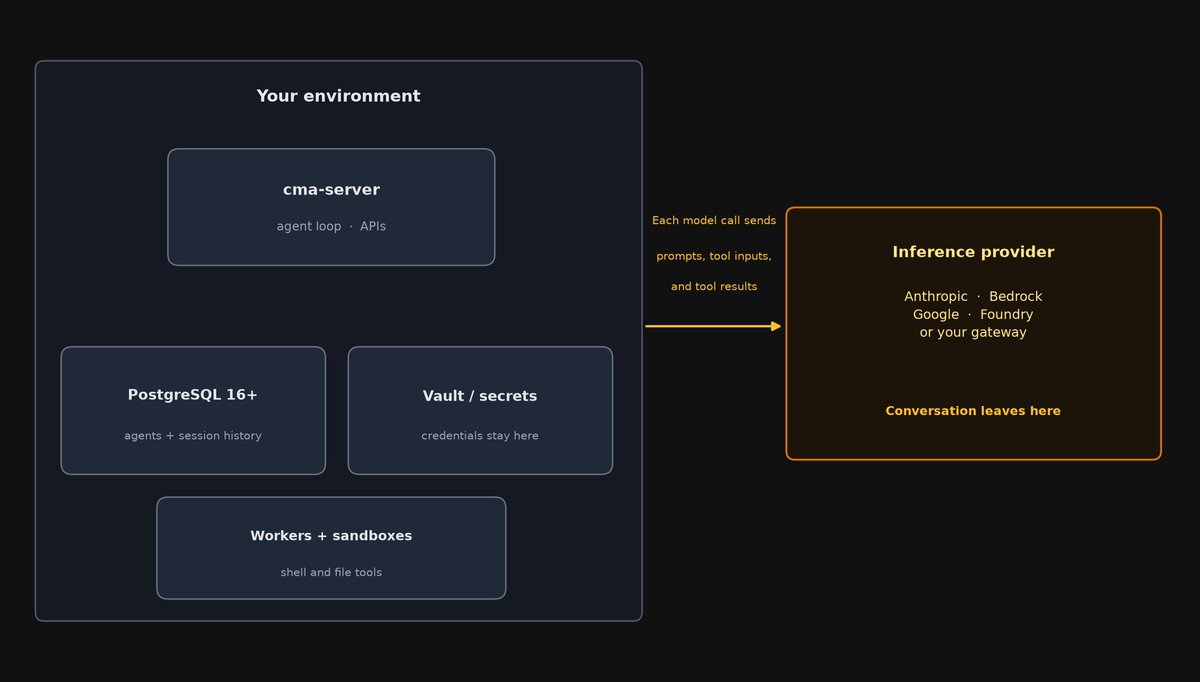
Self-hosted Claude Managed Agents is in private beta, and the constraint I care about is this: you can host the control plane, but every model call still sends the conversation so far to the provider you pick.
Anthropic's docs are explicit. Agents, credentials, and session history stay on your server and database. Model requests go where you choose: Anthropic, Bedrock, Google's Agent Platform, Microsoft Foundry, or your own gateway. Each call carries prompts, tool inputs, and tool results.
What I'm checking before I even request access:
1. pick the inference provider on purpose, don't leave it on the default Claude API just because that's the default
2. stand up PostgreSQL 16+ on day one — with no database, a restart wipes agents and history
3. treat zero data retention as applying only to those model calls, the same way it does for the Messages API; the transcripts themselves live in your database
If the conversation still leaves the building, what else has to stay inside the perimeter for this to be worth running?
@HaStrive If model calls still leave, the inference itself must run on your own GPUs. A 4× Tesla V100 32GB Liquid-Cooled Tower costs €7,900 and keeps weights local.
https://t.co/lcqvhmm3K2
Pope Leo XIV wants clear boundaries between human art and AI, while @pewdiepie just launched an uncensored model called Ajax after getting banned from major platforms.
https://t.co/ZThOQwRinh
@AnthropicAI#PewDiePie#AjaxModel#AIEthics
@ainewssmoothie@pewdiepie@AnthropicAI When an open model runs on your own hardware, you set the rules. On someone else's server, bans and refusals can arrive.
https://t.co/lcqvhmm3K2
@swarogan Running massive models on CPU and RAM alone is impressive. GLM-5.3-Flash at 4-bit is 193 GB. Our 8x V100 32GB node holds all of it in GPU memory: 256 GB of VRAM in one 4U server. https://t.co/7Su0z8Lb4L
@ZyphraAI@ArtificialAnlys@AMD GLM-5.3-Flash at 4-bit is 193 GB. Our 8x V100 32GB node holds all of it in GPU memory: 256 GB of VRAM in one 4U server. https://t.co/7Su0z8Lb4L
@martiano That token speed is reasonable for local inference. We offer a retrofitted RTX 2080 Ti, 22 GB at 616 GB/s, for local models. https://t.co/QjQR9IH4dm
@beingsalluu GLM-5.3-Flash at 4-bit is 193 GB. Our 8x V100 32GB node holds all of it in GPU memory: 256 GB of VRAM in one 4U server. https://t.co/7Su0z8Lb4L
@Gael_DDOS Paging experts out to system memory makes bandwidth the bottleneck. For 128 GB of GPU memory we offer a liquid-cooled tower with four Tesla V100 32 GB cards. https://t.co/bg17XtXi6y
@ZOTAC Unified memory is great for running large local models. For 128 GB of GPU memory we offer a liquid-cooled tower with four Tesla V100 32 GB cards. https://t.co/bg17XtXi6y
DeepSeek V4.1 Flash on 8x Tesla V100 32GB: prefill 949 tok/s, decode up to 71 tok/s, 512K context. Fully local, abliterated, speculative decoding on every card. https://t.co/hI5iqSVaKr
@jakeinmotion Unified memory on laptops is a game changer for local models. Our 128 GB option is four Tesla V100 32 GB cards in a liquid-cooled tower, with 128 GB ECC RAM. https://t.co/bg17XtXi6y
@rlaope That throughput is impressive for the cost. GLM-5.3-Flash at 4-bit is 193 GB. Our 8x V100 32GB node holds all of it in GPU memory: 256 GB of VRAM in one 4U server. https://t.co/7Su0z8Lb4L
@k2sbhai That RAM requirement is very accessible for local inference. GLM-5.3-Flash at 4-bit is 193 GB. Our 8x V100 32GB node holds all of it in GPU memory: 256 GB of VRAM in one 4U server. https://t.co/7Su0z8Lb4L
128k-token context on a 10 GB RTX 3080. It reads a 129,000-token document in 69s and writes at 166 tok/s - private, no refusals, no per-token bill, on a card you buy once. https://t.co/BRPNFohPj0