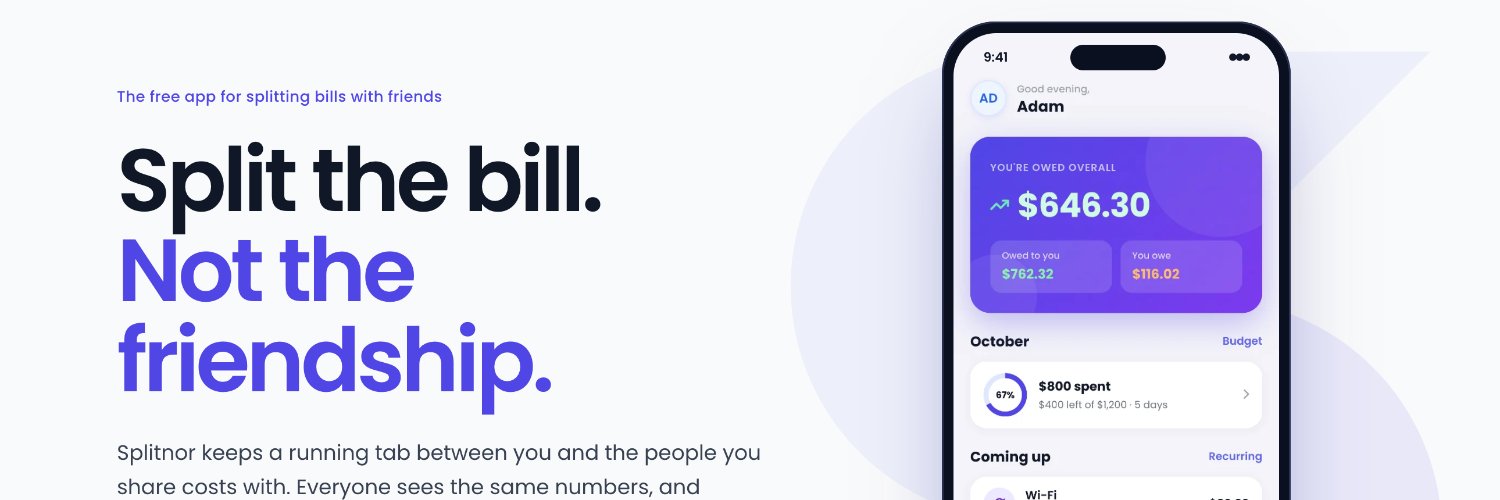
Download Splitnor a alternative of Splitwise 🎉
It's free. I'd love for you to try it and tell me what you think 🙏
Download Now - https://t.co/kFg4oFxuGb
#Splitnor#SplitBills#SplitExpenses#ExpenseTracker#BillSplitter#MoneyManagement#GroupExpenses#SharedExpenses #SplitTheBill #TravelWithFriends #GroupTrip #RoommateExpenses #ExpenseSharing #PersonalFinance #TravelExpenses #MoneySavingTips #BudgetingApp #Fintech #AppLaunch #NewApp
Hey! 👋 Download Splitnor a alternative of Splitwise 🎉
It's free. I'd love for you to try it and tell me what you think 🙏
Download Now - https://t.co/GU7YGDLSNN
https://t.co/GWpgeb6q3Y
#Splitnor#SplitBills#SplitExpenses#ExpenseTracker#BillSplitter#MoneyManagement #GroupExpenses #SharedExpenses #SplitTheBill #TravelWithFriends #GroupTrip #RoommateExpenses #ExpenseSharing #PersonalFinance #TravelExpenses #MoneySavingTips #BudgetingApp #Fintech #AppLaunch #NewApp
Microsoft 365 going down on a Thursday afternoon taught every small SaaS founder the same lesson for free:
Your uptime is only as good as the dependency you never think about.
Email, auth, push, payments. Pick one and ask: if it vanished for 6 hours, what would my users actually see?
@simonw At ~4 cents and 19 seconds vs ~20 cents and 4 minutes, Hydrogen is a different tool, not a cheaper Carbon. The Dec 1 price doubling is what will make people figure out which tasks actually need the big model.
@AravSrinivas@OpenRouter Returning character offsets is the underrated part, since you can check the evidence span against the source instead of trusting a paraphrase. Does locate hold up on long documents, or does accuracy drop as context grows?
@steipete Yolo for reads and drafts, a checkpoint for anything that spends money, sends a message, or deletes. The risk isn't autonomy, it's irreversible actions with no confirm step.
@theo The 2.5x claim is measured against 3.8 Flash, not against the rest of the market, and the rest of the market is the comparison that matters when you're picking a model for an agent loop.
@sundarpichai The real test for live translation on glasses is latency in the middle of a conversation. How much of it runs on-device vs. round-tripping to the cloud?
@Google@antigravity Curious how the recalculation works here. Is every frame a full-sheet recalc, or did Hydrogen work out how to touch only the cells that change? That's the part that would carry over to real dashboards.
@claudeai Was the code generating the animation live inside the installation, or was it used to render a fixed piece? Code that keeps running and producing new frames is where "AI wrote the code" gets genuinely interesting for art.
The idea from Matt Huang's "swarm riders" post that stuck with me: the job shifts toward defining reward functions and evals, not writing code.
For a small team that gets practical fast:
- a test suite the agent can't argue with
- seeded SQL data that reproduces your real edge cases
- a clear definition of done in the task itself
If you can't verify it, you can't delegate it, whether that's to one agent or sixteen.
Two agent launches this week said the same thing: software has to live where people already talk. Slack for engineering teams. Text, email and phone for everyone else.
For hourly teams that's even more true. Nobody opens a dashboard to swap a Saturday shift. They text.
Working on scheduling software, I keep coming back to this: for a lot of users the notification is the interface, and the app comes second.
[fill in: a real AtlasRoster detail, e.g. how shift swaps or clock-in reminders actually reach your users]
@theo For agent work, wall-clock time can matter more than price per token. A run that takes 2x longer is 2x longer that someone waits before they can review it, so the cheap model has to be fast enough to stay in the loop.
The vibe coding debate skips the boring middle.
AI can build a bill-splitting screen in an afternoon. What it won't handle unless you ask:
- $100 split 3 ways is 33.33 + 33.33 + 33.34. Who gets the extra cent?
- Money stored as decimal, never float
- The same expense edited on two phones at once
- Mixed currencies on a trip
That's where [fill in: what you actually spent time on] went while building Splitnor. The screen was the easy part.
@jasonfried That's why a founder at $1K MRR is often a better source than a unicorn CEO: they still remember the exact wall you're hitting, before hindsight turned it into a clean story.
@perplexity_ai Makes sense that the CTF framing misleads: hand an agent a flag and it optimizes for the flag, not the isolation boundary you meant to test. Did the security-tuned models fall behind because they reached for familiar exploit patterns instead of probing the host-guest boundary?
@OfficialLoganK@GoogleAIStudio Handling up to 1K questions in one call is the interesting part: triage and classification jobs that used to be a loop of prompts could become a single request. How consistent are the answers across a batch that size?
@BoboLinNotes Agreed. That's the problem with "passed the tests, still rejected": the tests only measured the output, not which of those three skills got you there. Score them separately and the candidate at least knows what fell short.
Hiring take after reading the Bloomberg AI codebase interview story:
Huge unfamiliar codebase. AI allowed, rules unclear. 30 minutes left after behavioral. Passed the tests, still rejected.
If you let candidates use AI, say exactly what you're grading. Reading code? Steering the agent? Catching its mistakes? Otherwise it's LeetCode with extra fog.
What I'd want to see in that round: [fill in: the one thing you'd actually grade]
AI coding agents love writing 60 lines of JavaScript for things the browser already does.
Worth putting in your agent rules file before it touches the UI:
- <dialog> for modals
- the popover attribute for menus and tooltips
- <details> for accordions
- CSS :has() instead of toggling parent classes
- container queries instead of resize listeners
Fewer lines for the agent to get wrong. Fewer lines for you to review.
@lennysan FDE and security both near the top while overall engineering demand stalls reads to me like one story: writing code got cheaper, so the scarce work is fitting it into a real customer's mess and keeping it from leaking.