Friends and colleagues often ask, “What are the top 100 important "AI in Biology" papers that provide broad insights into the field?” 📚🔬 While narrowing it down to exactly 100 is no small feat, I’ve curated a list of foundational and impactful #BioAI papers. I'm sure the list would exceed more than 100 given the relentless expansion of this thrilling field! Please follow this thread for key insights, and please feel free to suggest any papers I may have missed!
With my background and interests, I prioritize papers in #AgingBiology, #CellBiology, and #Neuroscience. I’ll keep this thread pinned to my profile and update it regularly. I encourage everyone to add more papers from their own expertise—let’s make this interactive and foster engaging discussions! Here is a collection of essential #AIbio papers. #100_AIBio_Papers #AIBio_papers #AIBio_Chat #AIneuro_papers #AI_AgingBio_papers
It’s not just graduate school admissions that have been affected. Faculty hiring, academic promotions, and research career advancement are feeling the impact as well. The challenges extend across the entire academic pipeline—from trainees entering the system to established researchers seeking faculty positions and promotion.
The number of students admitted to top Ph.D. programs this fall dropped 15% from the previous year, after dropping 11% the previous year.
The nation’s top research universities are shrinking doctoral programs because of uncertain federal funding raising fears that the nation’s capacity to produce new science could be diminished.
“It’s a loss for the nation,” she said. “When you shrink the pipeline of basic discovery research, you choke off the flow of future solutions, innovations and cures — and you shrink the supply of future scientists.”
The current administration is creating complete chaos for grant funding that is damaging a generation of new scientific talent. https://t.co/3alhgqQ8Yf
Last year I wrote "Defunding the world’s leading scientific community is akin to performing a prefrontal lobotomy on the nation—you are effectively severing the connections between the most innovative ideas and its citizens." We are only starting to see the effects of that now. https://t.co/KRBcQaQIIJ
New Anthropic research: A global workspace in language models.
Of everything happening in your brain right now, only a tiny fraction is consciously accessible—thoughts you can describe, hold in mind, and reason with.
We found a strikingly similar divide inside Claude.
@AnthropicAI has shared research suggesting a global workspace-like organization in language models, I summarized Global Workspace Theory (GWT) as a blog article: https://t.co/KtDtWBiX7D
The connection between neuroscience and artificial intelligence is becoming increasingly tangible, bringing us closer to understanding how principles of neuroscience may inform the next generation of AI systems. 🧠🤖
🧠 #NeuroAI #GlobalWorkspaceTheory #ArtificialIntelligence #Neuroscience #CognitiveScience #FoundationModels #LLMs #BrainInspiredAI #ConsciousnessResearch #BioAI
Neural network #journal_club of this week
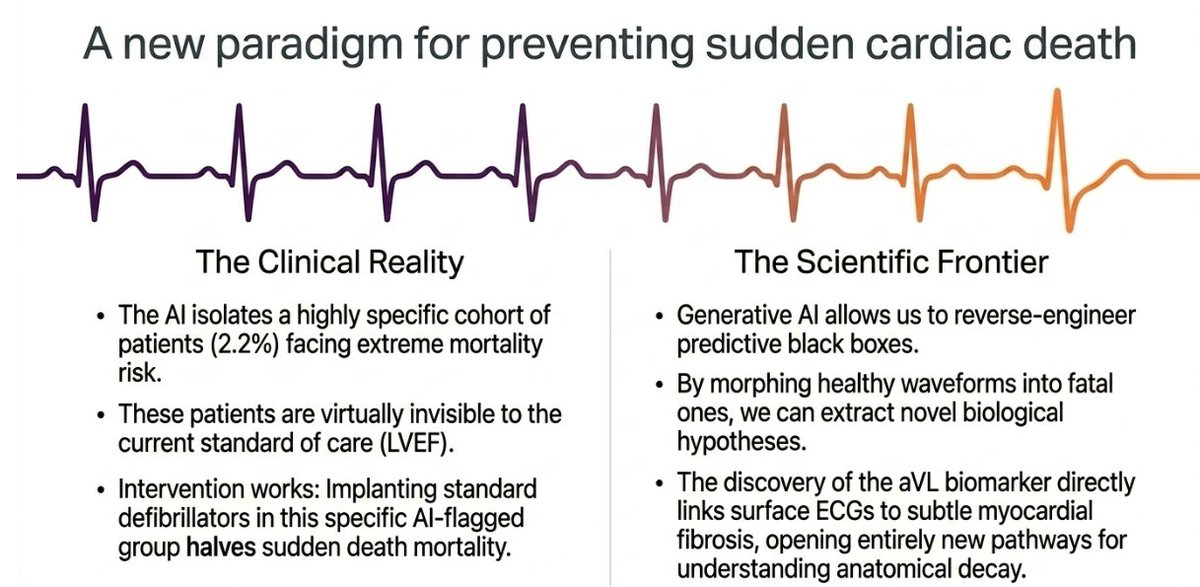
Summary: In this study, Obermeyer et al., have developed a deep-learning model to identify a novel ECG biomarker for sudden cardiac death, outperforming the current medical standard of left ventricular ejection fraction. By analyzing massive datasets from Sweden, the USA, and Taiwan, the study isolates a high-risk group that frequently goes undetected by traditional clinical screenings. This group experiences significantly higher rates of lethal arrhythmias, yet observational data suggests they may gain a substantial mortality benefit from implanted defibrillators. To understand the model's logic, the authors paired it with a generative model to visualize the specific waveform changes associated with high risk. These visualizations revealed a previously undescribed slurring of the QRS complex, potentially linked to diffuse myocardial fibrosis. This discovery offers a scalable tool for preventative cardiology and provides new mechanistic insights into a widespread medical problem.
Summarized this paper with slides in the thread.
#Bioelectricity #Cardiology #AIinHealthcare #DeepLearning #ECG #Electrophysiology #Electrocardiogram #SuddenCardiacDeath #MedicalAI #ClinicalAI #HealthcareInnovation #BioAI
Neural network #journal_club of this week
Summary: In this study, Obermeyer et al., have developed a deep-learning model to identify a novel ECG biomarker for sudden cardiac death, outperforming the current medical standard of left ventricular ejection fraction. By analyzing massive datasets from Sweden, the USA, and Taiwan, the study isolates a high-risk group that frequently goes undetected by traditional clinical screenings. This group experiences significantly higher rates of lethal arrhythmias, yet observational data suggests they may gain a substantial mortality benefit from implanted defibrillators. To understand the model's logic, the authors paired it with a generative model to visualize the specific waveform changes associated with high risk. These visualizations revealed a previously undescribed slurring of the QRS complex, potentially linked to diffuse myocardial fibrosis. This discovery offers a scalable tool for preventative cardiology and provides new mechanistic insights into a widespread medical problem.
Summarized this paper with slides in the thread.
#Bioelectricity #Cardiology #AIinHealthcare #DeepLearning #ECG #Electrophysiology #Electrocardiogram #SuddenCardiacDeath #MedicalAI #ClinicalAI #HealthcareInnovation #BioAI