A VPN connection that works well on one network can be slow, restricted, or unusable on another.
Sentinel avoids depending on a single connection method. Nodes can support WireGuard, V2Ray, OpenVPN, Xray, AmneziaWG, and Hysteria2 across the same decentralized bandwidth network.
That gives applications more flexibility across different devices, networks, firewalls, and operating conditions.
A protocol suited to one environment may not be the best option in another, so applications can work with the connection methods available on each node rather than relying on a separate infrastructure stack for every protocol.
The result is a more adaptable network for teams building dVPN products on Sentinel. Protocol choice can evolve at the application layer while the shared node infrastructure underneath remains the same.
Users still get the simple experience they expect from a VPN app. The additional complexity stays in the infrastructure, where it belongs.
Explore dVPN applications built on Sentinel:
https://t.co/yK9zavfM1l
Build with Sentinel:
https://t.co/8tgw8Nbr2h
Host a dVPN node:
https://t.co/UfuQh9k3jL
Sentinel has now passed 2 million total unique users across the network!
That is a major milestone for a decentralized bandwidth network built around independently developed applications, independent node operators, and open infrastructure.
This growth hasn't come from one app or one distribution channel. Multiple dVPN products are serving different users, platforms, and markets while connecting to the same shared Sentinel network underneath.
As Sentinel prepares to move to @solana, that scale becomes even more important.
The migration is not bringing an empty protocol into a new ecosystem. It is bringing more than 2 million unique users, active applications, established node infrastructure, and a network already generating real consumer demand.
For Sentinel, Solana opens access to a much larger environment of developers, payments, liquidity, applications, and onchain infrastructure.
For Solana, Sentinel brings a growing consumer network with real usage from day one.
Two million users is not the end goal. It is the scale Sentinel is carrying into its next phase.
Explore dVPN applications built on Sentinel:
https://t.co/yK9zavfM1l
Build with Sentinel:
https://t.co/8tgw8Nbr2h
Open-source ecosystem:
https://t.co/ot5PHTxQWQ
Independent dVPN has now spent months operating at consumer scale on the Sentinel Network.
The app has 500K+ downloads on Google Play, a 4.6 rating from around 7,000 reviews, access to nodes across more than 300 cities, and support for both WireGuard and V2Ray.
That matters because @Independentdvpn is not a Sentinel-owned application. It is an independently built consumer product that runs on Sentinel’s decentralized bandwidth infrastructure.
The team controls the app, brand, user experience, distribution, payments, and customer relationship. Sentinel provides the shared network of independently operated nodes that enables global connectivity.
Independent dVPN also shows how decentralized infrastructure can sit behind a familiar consumer experience. Users do not need to understand node markets, chains, routing, or network architecture.
They open the app, choose a location, and connect.
For Sentinel, this is one of the clearest examples of the network model working as intended: independent applications building their own products while sharing the same decentralized bandwidth layer.
As Sentinel prepares to move to @solana, applications like Independent dVPN are important because they bring existing users and real consumer activity into the ecosystem from day one. The migration is not starting from zero. It is carrying established applications and demand into a much larger environment for developers, payments, and onchain infrastructure.
Try Independent dVPN:
https://t.co/ASpWhyxZgN
Explore more dVPN applications built on Sentinel:
https://t.co/yK9zavfM1l
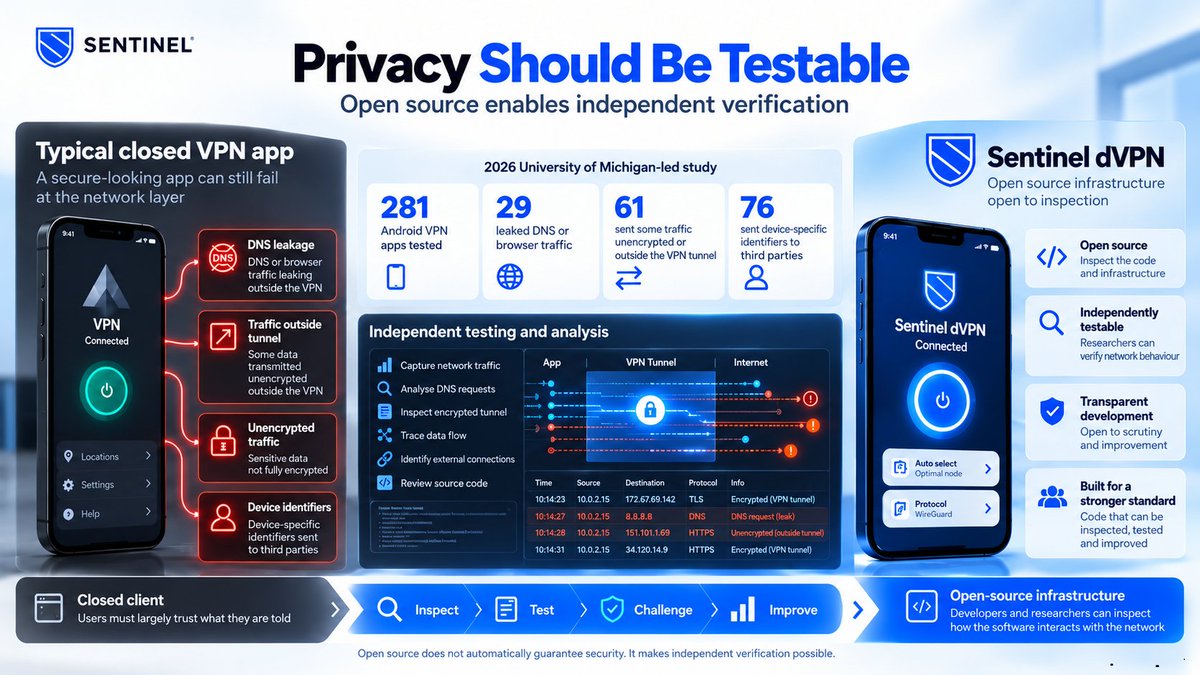
A VPN app can look secure and still fail at the network layer.
A 2026 University of Michigan-led study tested 281 Android VPN apps and found 29 leaking DNS or browser traffic, 61 transmitting some data unencrypted or outside the VPN tunnel, and 76 sending device-specific identifiers to third parties.
Those findings remind us that privacy claims should be testable, not simply accepted.
Sentinel’s Android infrastructure is open source, allowing developers and researchers to inspect how the application interacts with the network rather than relying entirely on a closed client and privacy policy.
Open source does not automatically guarantee security, but it enables independent verification.
The stronger standard for privacy infrastructure is code that can be inspected, tested, challenged, and improved.
Explore Sentinel’s open-source ecosystem:
https://t.co/ot5PHTxQWQ
Explore dVPN applications built on Sentinel:
https://t.co/yK9zavfM1l
Most people using internet infrastructure do not know who built the routing layer underneath the application they are using.
The same should be true for decentralized infrastructure.
A user opening a VPN app built on Sentinel does not need to understand the chain, node marketplace, payment rails, or network architecture. They need the application to connect quickly, work reliably, and give them access to the internet.
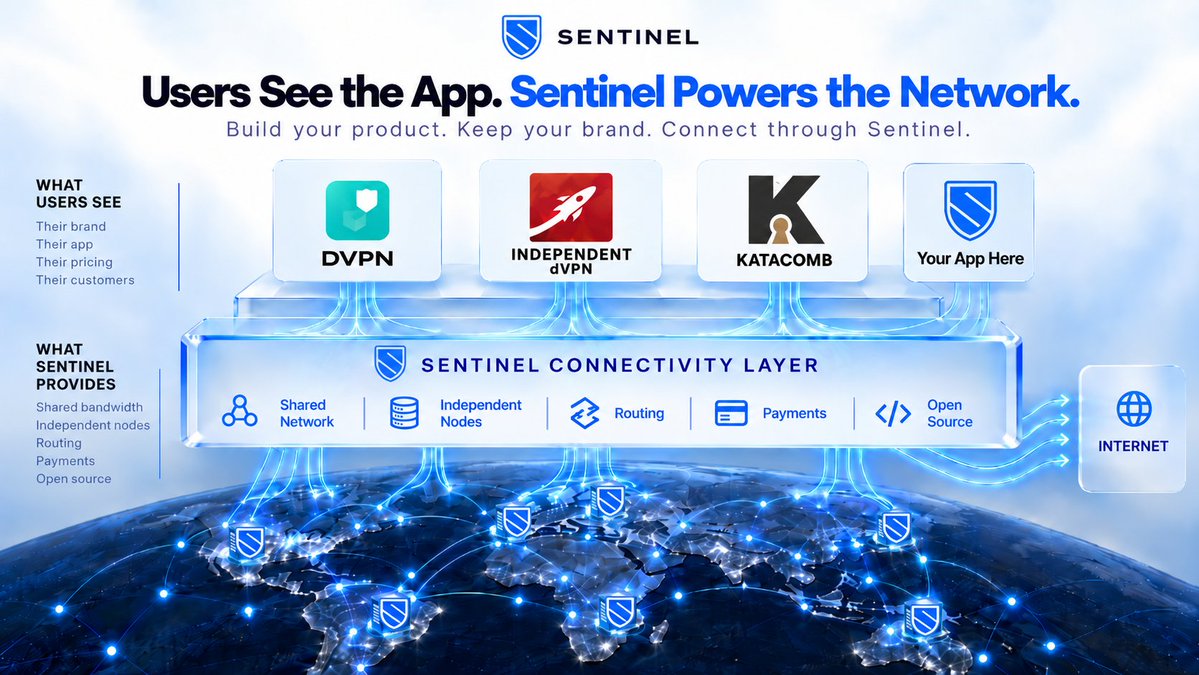
Sentinel sits underneath that experience. Independent teams can build their own applications, brands, payment models, and customer relationships while connecting to the same shared network of independently operated dVPN nodes.
That separation matters because it lets Sentinel grow through many different products rather than depending on one official application. Some users may discover Sentinel directly, while others may use the network every day without ever knowing the infrastructure powering their VPN.
For developers, that creates a much larger opportunity than building for an existing crypto audience. Sentinel can provide the connectivity layer for consumer products that reach users through normal app stores, subscriptions, integrations, and distribution channels.
The infrastructure can remain decentralized even when the user experience feels completely familiar.
Explore applications built on Sentinel:
https://t.co/yK9zavfM1l
Build with Sentinel:
https://t.co/8tgw8Nbr2h
Open-source ecosystem:
https://t.co/ot5PHTxQWQ
Two days ago we shared a first look at the completely rebuilt Sentinel dVPN.
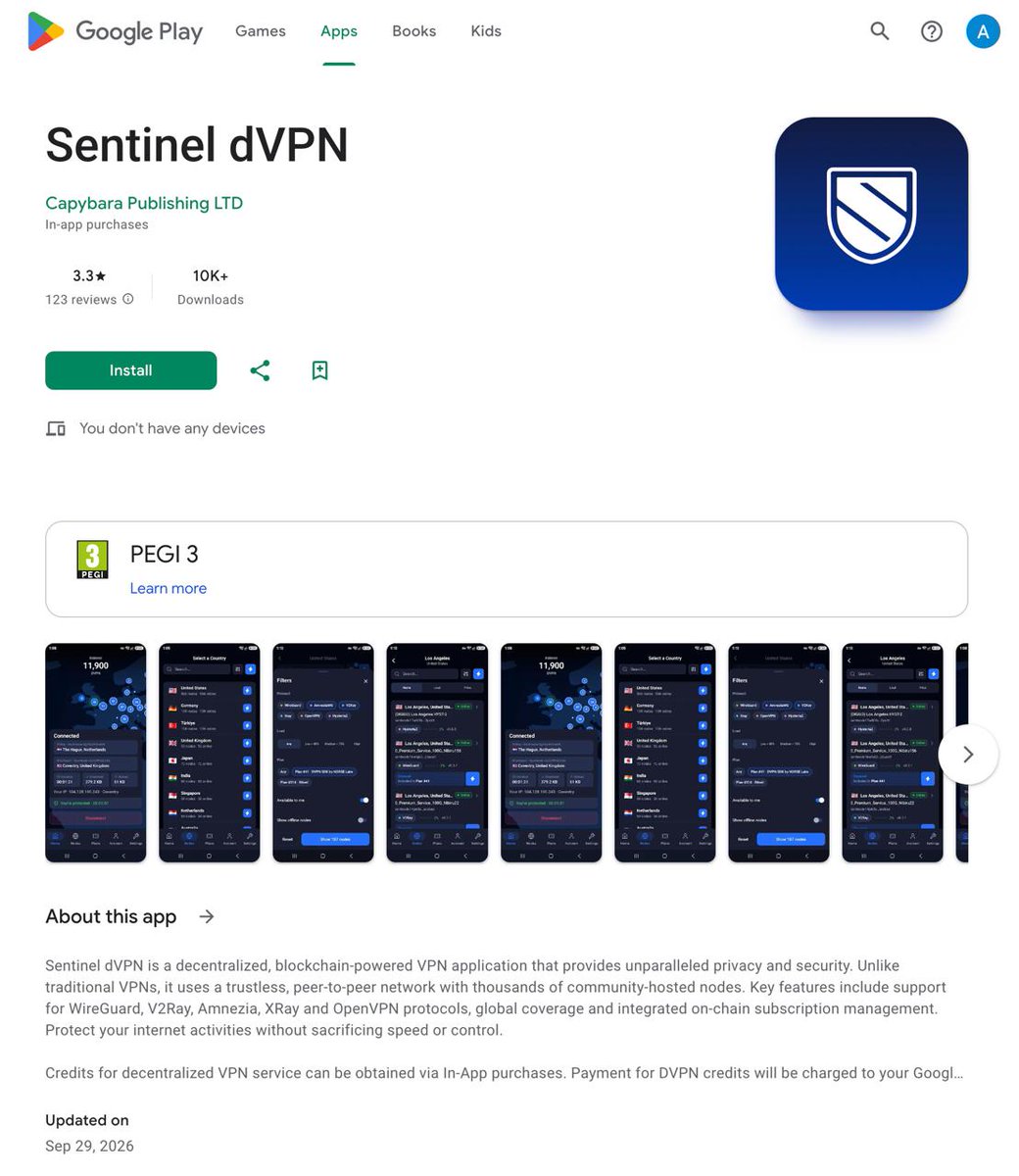
Today, the Android version is live on Google Play.
The move from a web-based client to a fully native app was a major effort by @norselabs, and testing quickly led to a public release.
Android users can now start using the new client, with Apple App Store availability still to come.
A lot more of the new app will be shown over the coming days.
Download the new Sentinel dVPN on Google Play and try it for yourself:
https://t.co/tFAosd23f2
A first look at the new Sentinel dVPN app, currently in development by @norselabs
This is a significant rebuild rather than a visual refresh. The new client moves away from a web-based stack to a fully native application, with native gestures, adaptive layouts, orientation support, and better compatibility across different devices and screen sizes.
The rebuild also introduces major changes to how the app interacts with the Sentinel Network:
• Subscriptions to both individual nodes and plans, including multiple subscriptions on one account
• Direct communication with blockchain RPCs and dVPN nodes, removing third-party and centralized service dependencies
• Local node discovery with incremental updates for faster startup and reduced network traffic
• Support for WireGuard, AmneziaWG, Xray, OpenVPN, and Hysteria2
• Handshake DNS support
• Detailed node and plan information
• Advanced filtering by load, protocol, plan, and user access
• Session reconnection for recently paused connections
• Clearer information around funds locked for node leases and early unsubscribe refunds
Testing has progressed well, and the app is currently awaiting approval from Google Play and the Apple App Store.
The video is an early preview of the new opening and login experience, with more of the rebuilt client to be shown as development continues.
NorseLabs: https://t.co/VqYqGE7rwe
Explore dVPN applications built on Sentinel:
https://t.co/yK9zavfM1l
Sentinel is not limited to standalone VPN apps.
Developers can integrate decentralized connectivity directly into applications, services, agents, and other internet products while keeping control of the product, pricing, user experience, and distribution.
The stack is already there:
• Plan Manager for creating and managing subscription-based VPN services
• x402 for programmable access and machine payments
• Open-source components and developer tooling
• Node deployment and management infrastructure
• Independent dVPN apps already using the network across multiple platforms
The opportunity is to use Sentinel as a connectivity layer, not just as a consumer VPN network.
Build with Sentinel: https://t.co/8tgw8Nbr2h
Plan Manager: https://t.co/3PcLbmldtv
x402: https://t.co/O6DQmxjVMs
Open-source ecosystem: https://t.co/ot5PHTxQWQ
Node Deployer: https://t.co/RsCvwIr6oL
Explore applications: https://t.co/yK9zavfM1l
Decentralized infrastructure needs visibility, not just nodes. For a dVPN network to scale, operators and builders need clear data on health, coverage, performance, connectivity, and network activity.
Sentinel already has that operational layer. SentNodes, SuchNode, P2PScan, node testing utilities, and CQAP reporting help operators monitor infrastructure, evaluate performance, and understand how the network is being used.
The numbers are increasingly meaningful. More than 800,000 people have used a Sentinel-powered dVPN in 2026 alone. SentNodes is currently showing around 10,000 users per day, while SuchNode shows Sentinel infrastructure across 232 cities.
Encrypted dVPN sessions recorded during 2026 are also close to exceeding the combined total from 2023, 2024, and 2025.
As Sentinel prepares to migrate to Solana, it is bringing that existing activity with it: active applications, independent node infrastructure, real users, and tooling that already measures what is happening across the network.
The migration is not about starting again on a new chain. It is about plugging an already-used decentralized bandwidth network into Solana’s larger ecosystem of applications, developers, payments, liquidity, and infrastructure.
For Solana, that means new users and existing real-world activity arriving from day one. For Sentinel, it means a much larger environment to build, integrate, and grow within.
Sentinel is bringing usage to Solana, not waiting for @solana to create it.
Explore Sentinel infrastructure and applications:
https://t.co/yK9zavfM1l
Node tools and ecosystem resources:
https://t.co/YBDosDJiEp
https://t.co/52RAnZaaz2
https://t.co/cLOjJJbgD6
Sentinel x402 lets AI agents and automated systems purchase dVPN access directly, without creating accounts, managing subscriptions, holding P2P for gas payments, or relying on human setup.
Using USDC on Base, with Solana support upcoming, an agent can request access, receive HTTP 402 payment instructions, authorize the payment, and receive the connection details needed to use Sentinel dVPN infrastructure.
Most VPN infrastructure was designed around a human user opening an app, entering payment details, choosing a location, and pressing connect. Autonomous systems need a different model, where connectivity, routing, and privacy-preserving access can be requested, paid for, and used programmatically.
Sentinel’s architecture makes this practical because nodes can be discovered, authenticated, and accessed through on-chain infrastructure, RPC access, and CLI-based workflows. That gives software a direct path to find available dVPN nodes and connect without manual setup.
For developers, the opportunity isn't just to build another VPN app. It is building products, agents, APIs, and services that can use decentralized bandwidth as a programmable resource, with access available from as low as $0.033 per day.
Check out Sentinel x402:
https://t.co/O6DQmxjVMs
Build with Sentinel:
https://t.co/8tgw8Nbr2h
A traditional VPN company usually measures scale by its server fleet size. Sentinel uses a different model: independent node operators provide bandwidth to applications using the network.
Those operators form the supply side of the Sentinel Network. They run nodes, contribute bandwidth, expand geographic coverage, and create the connectivity layer that decentralized VPN apps can use without each builder operating a global server network from scratch.
For users, the experience can remain simple. Open an app, connect, and use the internet. Underneath, connectivity is supplied by independent peer-to-peer nodes rather than a closed server fleet owned and controlled by one VPN provider.
The distinction matters as privacy tools face pressure from platform rules, app stores, payment systems, datacenter policies, and jurisdiction-specific regulation. A traditional VPN company still depends on its own corporate structure and server relationships, while Sentinel distributes participation across operators, applications, and builders.
Sentinel is not a single VPN provider operating a closed server fleet. It is shared decentralized bandwidth infrastructure where applications, node operators, and developers can participate in the same network.
Explore decentralized VPN applications built on Sentinel: https://t.co/yK9zavfM1l
Most people think VPN privacy starts and ends with encryption. The harder question is who controls the network your connection moves through.
A VPN can reduce what your ISP sees, but it also introduces a new trust layer. The provider, app, server network, analytics stack, payment system, and operating model all shape the privacy outcome.
Many VPN products look similar from the outside. Users open an app, press connect, and expect private internet access, but the infrastructure model underneath can be very different.
Sentinel separates the application layer from the decentralized bandwidth network underneath. Multiple independently built VPN applications can use shared infrastructure powered by independent peer-to-peer node operators, rather than relying on one company’s closed server network.
For users, the product can still feel simple. For builders, Sentinel provides open-source infrastructure, developer integrations, and a network model that can be inspected and built on rather than accepted as a marketing claim.
VPN privacy is not only about whether the tunnel is encrypted. It is also about who operates the network, what data the app collects, and how much control sits with one provider.
Explore decentralized VPN applications built on Sentinel: https://t.co/yK9zavgjQT
Launching your own VPN no longer starts with owning servers. It starts with a product, an audience, and access to a network that already provides decentralized bandwidth.
Most creators, communities, businesses, and app teams can reach users. The hard part is running the network behind the VPN: nodes, uptime, bandwidth, payments, subscriptions, access control, and coverage across different markets.
Sentinel turns that into a builder layer.
Teams can launch VPN products on top of independent peer-to-peer nodes instead of building a global server network from scratch. They can control the brand, user experience, pricing, payment flows, subscriptions, and customer relationships while using shared decentralized bandwidth underneath.
Plan Manager helps teams create and manage VPN plans. Node deployment and testing tools help expand and improve the network. Open-source components and developer integrations give builders a foundation for creating their own dVPN applications.
The value is simple: Sentinel lets builders focus on the product and users, while the network provides the decentralized connectivity layer.
Build your own VPN product on Sentinel:
https://t.co/8tgw8Nbr2h
Three new VPN applications have launched on the Sentinel Network in recent weeks, as the ecosystem passes 1.9 million unique users and closes in on 2 million.
More applications mean more ways for users to access Sentinel's decentralized infrastructure.
Recent launches include:
ChibaTunnel
Open-source desktop dVPN for Windows, macOS and Linux developed by @TkdAxel
VeilDVPN
Android dVPN from @Bitveilofficial with multi-hop, subscriptions and direct $P2P payments.
Katacomb VPN
Open-source Linux client from long-time Sentinel community member @proofoftrinity supporting six protocols, multi-hop and on-chain payments.
Three different teams, building three different products on the same network of independently operated nodes.
And with Sentinel preparing for its move to Solana, the ecosystem enters its next phase with new applications already arriving and user adoption approaching another major milestone.
More applications. More ways to access the network. More users.
Explore applications built on Sentinel:
https://t.co/yK9zavfM1l
@telegram Aye-aye, captain! We’ve made a cool mini-app for decentralized VPN inside @Telegram.
Just open the bot, pick a country & location, and get connected to any @SentinelP2P dVPN server with a tiny helper app.
https://t.co/8qgwI4t6wG
Sentinel's growth depends on the # of successful dVPN apps built on its protocol and Sentinel is migrating to the chain which has all of the consumer app builder mindshare.
Download the ChibaTunnel decentralized VPN app built on Sentinel on your Windows, Mac or Linux device and connect to 3 new protocols supported by dVPN nodes on Sentinel!
https://t.co/PlPGbG7qJY
The explosion of new apps built on Sentinel will go exponential on Solana.
AI agents with 0 revenue potential generated billions of $ in volume on platforms like Virtuals.
Get ready for decentralized VPN coins that represent real functioning products that provide utility on a daily basis. Any builder will be able to launch their own and get bootstrapped by the community for marketing expense and bandwidth payments.
Building a dVPN app is already easy but Sentinel is going to make it much easier with a complete web interface guiding users in the process of building their own app.
What happens if your VPN company disappears?
BulletVPN ceased operations, leaving its "lifetime" subscriptions without a service.
VPNSecure canceled thousands of lifetime subscriptions after changing ownership.
With a traditional VPN, users depend on one company's infrastructure and decisions.
Sentinel separates the infrastructure from the application. Independent teams can build, maintain, and improve their own decentralized VPNs while sharing the same underlying network.
That's one of the advantages of open, decentralized infrastructure.
Learn more:
https://t.co/yK9zavfM1l
The Sentinel ecosystem is approaching the 2 million unique user count.
The protocol has proven its ability to handle infrastructure and user demand at scale. Now the focus moving forward is monetization avenues for builders on Sentinel.
Paid subscriptions/Ads/Proxy Pools