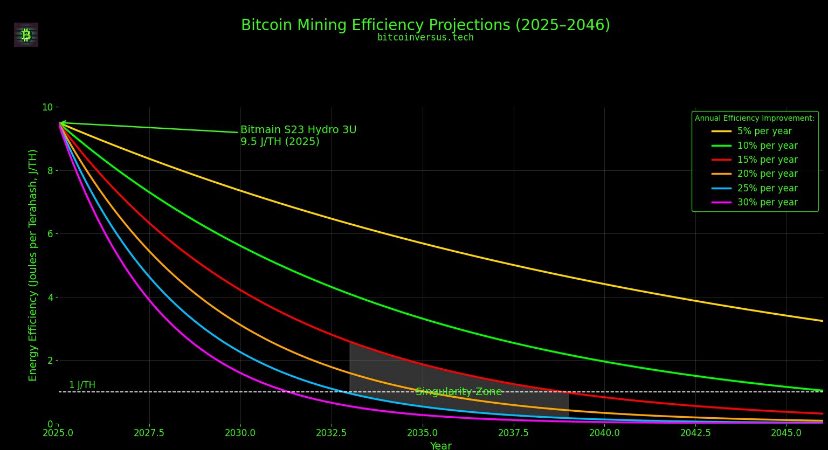
If we take the most efficient #bitcoin mining ASIC today and assume a (relatively) consistent rate of 15% - 25% improvement YoY,
it is likely that we will see a 1 J/TH bitcoin mining ASIC sometime in between 2033-2039.
#Energy#Efficiency#bitcoinmining
Yes, but the power and efficiency growth rate of the ASIC chip should be some sort of essential factor as well.
B/c it Wouldn’t make any sense if the protocol got more valuable if the latest chips/machines produced somehow became less efficient or less powerful over time.
Bitcoin has won. Global consensus is that $BTC is digital capital. The four-year cycle is dead. Price is now driven by capital flows. Bank and digital credit will determine Bitcoin’s growth trajectory. The biggest risk is bad ideas driving iatrogenic protocol changes.
Strategy's "bear case" of $3M is an order of magnitude more realistic and coincides extremely well with my "Power Efficency Theory" Models.
Read more about the great debate in bitcoin here: https://t.co/FUrmCYU0ea
Michael Saylor’s prediction of bitcoin reaching $13M per coin by 2045 is a bit too optimistic.
None of my models would assume anything over $3M.
At $3M per coin, #bitcoin would stand at a $63T Market Cap.
That's almost double the current total market cap of #gold ($34T).
To suggest that bitcoin will be worth twice as much as all the gold in the world today in about 19 years is a great brain exercise, but it's (probably) not feasible.
The premise is that Energy precedes value. So, capacity (an expression of energy) would precede value. Energy is ultimately the source of producing the capacity. The capacity is the "expression" of that energy, and then it is ultimately given a value based on the "expression."
It seems that Value (V) should be a consequence (f) of Energy (E).
Energy holds more precise data than price.
This (should) make Energy a more efficient common denominator when determining value.
Read more about this idea here: https://t.co/XmJ05tvC28
Not financial advice.
(1/6) Power Efficiency Theory states that the value of a thing at a future time t, written as V(t), is determined by how fast its performance improves and how quickly its energy cost per unit output declines. https://t.co/QodR3NBXMu