It occurred to me that having totally written off the Tories and its latest placeholder leader, that write off is looking more wrong with each of Kemi Badenoch’s visits to the despatch box. So I dug deeper.
https://t.co/KM5NpRMAc9
The UK gets a new PM today. Again. Installed under scrutiny unheard of in modern times. Nine years in Manchester, one finished achievement. Already disciplined once by bond markets, and he backed down. Correct instincts, untested on funding any of them. https://t.co/L9ALv8PYJP
Andy Burnham wants to bring utilities back into public ownership. Correct instinct, but this method has already failed once.
How to preserve this instinct and make it work for the long term - not just for political points, but for generations.
https://t.co/itTSTCknUR
An open letter to
@RayDalio
Ray, In May, you explained why central banks won't hold Bitcoin: "Transactions can be monitored and potentially controlled, which is why central banks aren't looking to hold it."
In case you repeat this claim publicly again, you should be aware that this claim is factually incorrect.
Context: for the last 2 years I've taught the ESG module on Cambridge's digital assets course for regulators.
Source: https://t.co/B21ECB9ajT
The regulators I teach are doing exactly what you claim they are not.
Further context:
In the 2 cohorts I taught, the attendees came from 24 central banks, several of them G20 monetary authorities, others from across the emerging world.
They enrolled, paid, and worked through 8 weeks of their own accord to understand digital assets properly.
More than a third were department heads or directors.
The rest were the supervisors and analysts who apply the rules. In short: the data says that the institutions many (including yourself) assume are asleep on this are quietly sending their staff to class.
A few have also moved past class.
For example: in November 2025 the Czech National Bank made its first Bitcoin purchase: a small test portfolio, explicitly a 2-year experiment before any decision on reserves. Its governor is openly making the case for it.
Source: https://t.co/QafLDsXoZg
In June 2025 Ukraine introduced a bill to let its central bank hold Bitcoin in reserves - permission rather than obligation. Source: https://t.co/3PK8yYQ438
There are a further two central banks now actively pursuing similar strategies (hold Bitcoin) that I cannot disclose publicly.
Granted, none of this means central banks are about to hold Bitcoin at scale, and you may be partially right that many never will. But "aren't looking" is a different claim, which the data already contradicts.
24 central banks are already looking into it, 1 already holds a test position, another has introduced a bill to allow it.
I have followed your work closely for many years. This is the first time I've seen you make a claim that is not well supported by the data.
You and I share a long meditation practice. The grounded clarity it brings has always been, to me, your hallmark. On this one claim, it is the exception.
I'd be happy to discuss this in further depth with you so that your public commentaries on the behaviors of Central Banks with respect to Bitcoin are well-supported by data in future.
Sincerely
Daniel
If you live in the UK and want to keep accessing the internet freely, please pay attention to this.
Get a good VPN now, learn how to use it, and if need be, learn how to build one yourself.
Labour are coming for your privacy, and we mustn't let them win
Instructions here 👇
If you live in the UK and want to keep accessing the internet freely, please pay attention to this.
Get a good VPN now, learn how to use it, and if need be, learn how to build one yourself.
Labour are coming for your privacy, and we mustn't let them win
Instructions here 👇
I had intended to put out this series of posts on @bitcoinpolicyuk’s Privacy Toolkit on a more regular basis, but I hope you’ll realise that I’ve been rather distracted on quite a relevant subject this week.
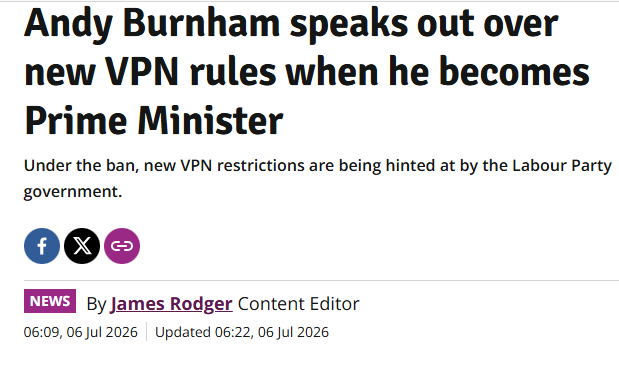
I was intending to review the section on VPNs, and if you’ve been paying attention to what’s been happening in the UK, you will know that VPNs are right in the cross hairs of the government and Parliament right now.
Since the Censorship/Personal Data Mining Act (aka the Online Safety Act) has proved to be an abject failure in either of its aims – preventing access to pornography and collecting data on anyone who tried – the government is now taking aim at the very tools which have been responsible for this failure, namely VPNs
What is a VPN?
Short for Virtual Private Network, it is quite simply a service that creates a secure tunnel between your device and the internet, hiding your IP address and routing your traffic through a remote server.
Why should you use one?
As you can choose the geographical location of that remote server, you are easily able to circumvent geoblocking as in the case of adult material accessed by people from the UK. Additionally, they should as a matter of good practice always be used when connecting to public wifi, to prevent bad actors from intercepting or viewing your traffic, and they improve your privacy even at home, by reducing the ability of your ISP to log the websites you visit (and then sell that data).
What’s been happening in the UK?
Quite a lot - @leicesterliz let us all know to expect VPN sanctions soon (details as yet undisclosed) and lawmakers are already tabling amendments to legislation that if enacted would require all VPN providers to age verify aka ID all their customers to ensure that children don’t get hold of one (see relevant posts in the thread); effectively banning kids from using one and requiring providers to identify you before you get one - something many providers do not do. Details in thread.
What can I do?
I strongly suggest that if you don’t already have one, you research, download and install a VPN on all your devices today, while you still can. I personally favour @mullvadnet, but there are many good alternatives – h/t to @roxananasoi for the very interesting comparison table that is linked below.
What if the government do ‘ban’ them or age gate access?
In short, don’t panic. Anyone is now able to code their own rudimentary VPN, as I did with my @openclaw agent as demonstrated in the thread. If you are able to go to the next level, you can even run one on your own router at home, so that all your family’s traffic is automatically protected – post from @ben_dewaal in the thread.
What does all this mean?
I am very much afraid that what we are seeing at the moment are symptoms of a system that is losing control of its ability to control what its populace thinks and says, and is lashing out like a wounded animal in response.
Governments across the world do not, bluntly, want a highly-informed, articulate and intelligent population, as such populations are harder to control and to coerce. Thus the global attempts to fetter access to the internet, to platforms that support free speech and open dialogue, to monitor, track and analyse the behaviour of every single one of us
This may seem like a dark time, but I have never been more confident that they will not win. Those of us who believe, like @halfin, that the computer can be a tool to liberate and protect people, rather than to control them, are many. We are motivated, and we will not give in.
And neither should you.
Yvette Cooper warns of an AI Hiroshima without global rules. Chatham House's own analysts say institutional consensus won't work without a crisis first. Both published today. Both correct. The Freedom Trilemma explains what actually resolves it.
https://t.co/1UETzR1bI4
@ThePenguinBTC AI forces a choice between Safety, Privacy and Freedom of Information. We can improve all three, but not maximise all three.
Whatever path we choose, shared reality becomes more important, not less.
Bitcoin is one of the few systems where “don’t trust, verify” scales globally.
@ThePenguinBTC Opaque AI + opaque money is the real danger.
When neither capability nor value can be independently verified, institutional mistrust grows and coordination breaks down.
Bitcoin matters because it gives us a monetary history that cannot be quietly rewritten.