🧠 Climate Quiz #10
The world threw away 1.05 billion tonnes of food in 2022 (UNEP).
Who wasted the most?
A) Supermarkets
B) Restaurants
C) Homes
Reply A, B or C.
Answer: C, about 80x more 🔥 Over the 20 years after it is released, methane traps about 80 times more heat than CO2, though it only lasts about a decade in the air. Source: UNEP
🌍 Climate 101 · #8: What is desertification?
Not deserts marching in. Good dryland running down, like a battery used faster than it recharges.
🏜️ 100M+ hectares lost a year, 2015-19 (UNCCD)
🌱 Botswana: 36% degraded → 17%
Next in Climate 101: regenerative farming
💡 Did you know?
Carbon removal takes 5 to 8 years to go from a first plan to a first delivered credit.
Microsoft, which has contracted 80M tonnes since mid-2023, calls it infrastructure.
Targets for 2035 are being decided now.
Follow for more.
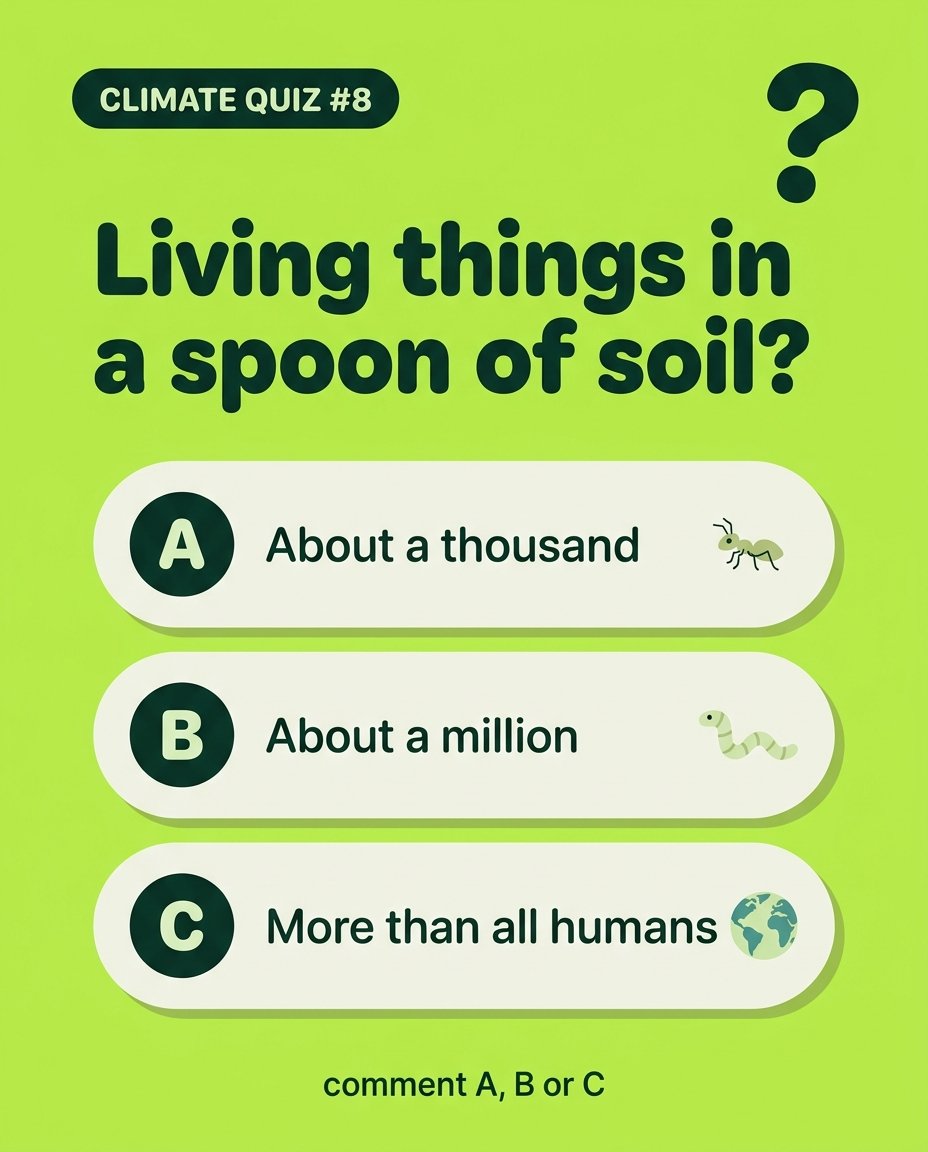
Answer: C, more than all humans 🌱 One tablespoon of healthy soil holds more living organisms than there are people on Earth, and soils host over 25% of all biodiversity. Source: FAO
🧠 Climate Quiz #8
How many living things fit in one tablespoon of healthy soil?
A) About a thousand
B) About a million
C) More than all humans
Reply A, B or C.
🌍 Climate 101 · #7: What are drylands?
Places where the air pulls more water out than the rain puts in.
🏜️ 40.6% of land
👥 2.3 billion people
💧 ~90% of rain evaporates
(UNCCD)
Next in Climate 101: land degradation & desertification
@sibandaronald5 $6.5M across nature-based solutions and climate-smart agriculture can spread thin fast, so where it lands first matters a lot. Do you know which provinces or watersheds are first in line?
@RWAFoundation_@solana@StellarOrg@BNBCHAIN@ethereum@Frax eurSAFO and EUTBL both making the list says euro-denominated yield is starting to pull real flow, not just USD treasuries. Is that new money coming onchain, or holders rotating out of dollar funds?
@namefi_io Settling in wholesale CBDC is the bigger detail than the tokenized bills themselves, since cash and asset finally move on the same ledger. Five banks is a small pool, so the real test is whether auction pricing holds once more bidders join.
@angegarrod Chop and drop plus a compost top-up on the first dry day is a good soil double. Do you leave the chopped material on the surface over winter, or tuck it under the fresh compost?
@sundarpichai If it holds, what would interest Riemann most is whether the proof explains why the zeros sit on that line, rather than only showing that they do.
@ipsnews@AGRA_Africa "Not a complete replacement" is the honest framing. In practice the weak link is often shelf life, since live inoculants can lose viability in hot storage before they reach the field. Does AGRA check viability at the point of sale, or only at manufacture?
@ethereum@arik_g@zama Encrypting amounts but not participants is the pragmatic call: it's what treasuries and payroll actually need, and selective disclosure keeps auditors in the loop. The real design question is who holds the decryption keys when a regulator asks.
💡 Did you know?
On 1 January 2027, companies get their first GHG Protocol rulebook for counting land emissions and CO₂ removals.
🌱 Soil and farmland carbon
🪨 Geologic storage
🎯 Removals in company targets
Rules usually come before the money.
@chainlink The biggest pool of assets already sits with custodians and CSDs like SIX, so scale comes from wiring tokenization into existing settlement rather than pulling assets out of it. Whoever connects the incumbents sets the pace.
@vickihird One in four falling short is worrying, but the threshold matters: organic matter targets are much harder to hit on light eastern sands than on heavier clays, so the same number means different things. Does the survey adjust for soil texture?
@climbingK "A limit I set" is the part that makes agent payments work. Machines don't hesitate, so the spending cap ends up being the whole trust model. On a TADA ride, who sets that limit, the rider or the app?
@CharmIndustrial Project risk getting its own panel next to engineered carbon applications says a lot about where biochar is right now. Was the risk discussion mostly about permanence and MRV, or about feedstock supply and offtake?