Bito’s AI Architect delivers a 39.4% higher task success rate on SWE-Bench Pro 🏆
• Higher success, faster execution
• Fewer tool calls, and no added cost
Validated by an independent evaluation with The Context Lab.
Swipe through for the key findings, or read the full evaluation report here: https://t.co/FgWxoJv1Zu
Conversational learning in Slack and Jira is live in AI Architect.
The decisions that shape your architecture live in Slack and Jira.
Why a service got split?
Why a migration stalled?
Why the workaround still exists?
Your team tags Bito with that reasoning, and it enters the knowledge graph as a durable rule that grounds every AI interaction across the team.
See how it works: https://t.co/iHmzSe9SyO
10 reasons engineering teams use Bito's AI Architect.
From technical design in Jira and Linear to grounded code generation in Cursor and Claude Code to codebase aware code reviews on every pull request.
Swipe through for the highlights.
Read the full post here: https://t.co/NEmJvuzoyY
Context exists everywhere in your engineering stack. Most of it stays locked in silos.
- Reasoning in commits.
- Intent in Jira and Linear tickets.
- Tradeoffs in Slack threads.
- Decisions in senior engineers' heads.
AI coding agents today see almost none of it, which is why their output falls short of what your team actually knows.
Bito's AI Architect is built for exactly this work.
It pulls that scattered context into one knowledge graph, so AI across design, coding, and review reasons from your real system.
Get up to speed on the context layer and the problem it solves below.
🔥 Three new capabilities in Bito's Slack Agent.
1. Code reviews from Slack:
- Paste an MR link, say "review this branch," or point to a specific commit. Bito runs a full review in the thread.
- Severity ratings, evidence quotes with file and line references, and cross repo impact analysis.
2. MR creation from Slack:
- Tell Bito "create an MR" and it handles title, description, and ticket references.
- Smart template detection and duplicate MR guards built in.
3. Workspace learnings:
- Correct Bito or teach it a team specific term. That knowledge sticks for everyone on the workspace.
- Teach once, Bito remembers for the whole team.
Try Bito's Slack Agent: https://t.co/0HioGh8R7F
Anthropic features Bito in its agents ecosystem.
We sit alongside the leading agents building on @claudeai, including Factory, Windsurf, GitHub Copilot, Cursor, and Augment Code.
Bito gives engineering teams deep system context, grounded in your code, commits, issues, docs, and past decisions, so agents and engineers reason against your actual system.
Thanks to the team at @AnthropicAI.
Learn more here: https://t.co/ANWt9xp7TI
Anthropic features Bito in its agents ecosystem.
We sit alongside the leading agents building on @claudeai, including Factory, Windsurf, GitHub Copilot, Cursor, and Augment Code.
Bito gives engineering teams deep system context, grounded in your code, commits, issues, docs, and past decisions, so agents and engineers reason against your actual system.
Thanks to the team at @AnthropicAI.
Learn more here: https://t.co/ANWt9xp7TI
Bito’s AI Architect reduces AI coding agent token cost per task by 47% on SWE Bench Pro.
Coding agents spend most of their steps on navigation.
File reads, grep, glob, git history, and re-reading the growing transcript on every step.
That is where the token cost comes from!
Deep codebase context changes that. AI Architect gives the agent a structured map of the codebase, so it skips discovery and goes straight to the files that matter.
Evaluated on substantial, multi-file tasks across production open-source codebases.
→ 47% lower token cost per task
→ Up to 68% on individual tasks
→ 60% fewer reasoning steps
→ 49% fewer agent actions
→ 62% fewer file reads
Read more about the evaluation. Link in comments.
Claude Code fixed every bug we asked it to on a SWE-Bench Pro task.
3 bugs, 5 edits, 3 files. TESTS STILL FAILED.
The local checkout had drifted from the reference architecture. 5 helper files, enum values, and interfaces were missing entirely.
With AI Architect, Claude Code made 15 calls comparing local files against the indexed reference
✅Surfaced all 5 missing pieces
✅25 operations across 8 files
✅All tests passing.
If your agents are shipping patches that look right but still break, the problem might not be the agent.
It might be what the agent can see!
Read the full case study [link in comments]
Introducing Bito's AI Architect in Linear for technical design and planning.
Same knowledge graph, same depth, now inside Linear.
When an issue is created, AI Architect analyzes it against your codebase and past issue history, then posts a grounded implementation plan directly as a comment.
→ Feasibility analysis
→ Story breakdowns with acceptance criteria
→ Proactive risk detection
→ Historical pattern insights from your team's issue history
Read more here: https://t.co/zrpUuB87hw
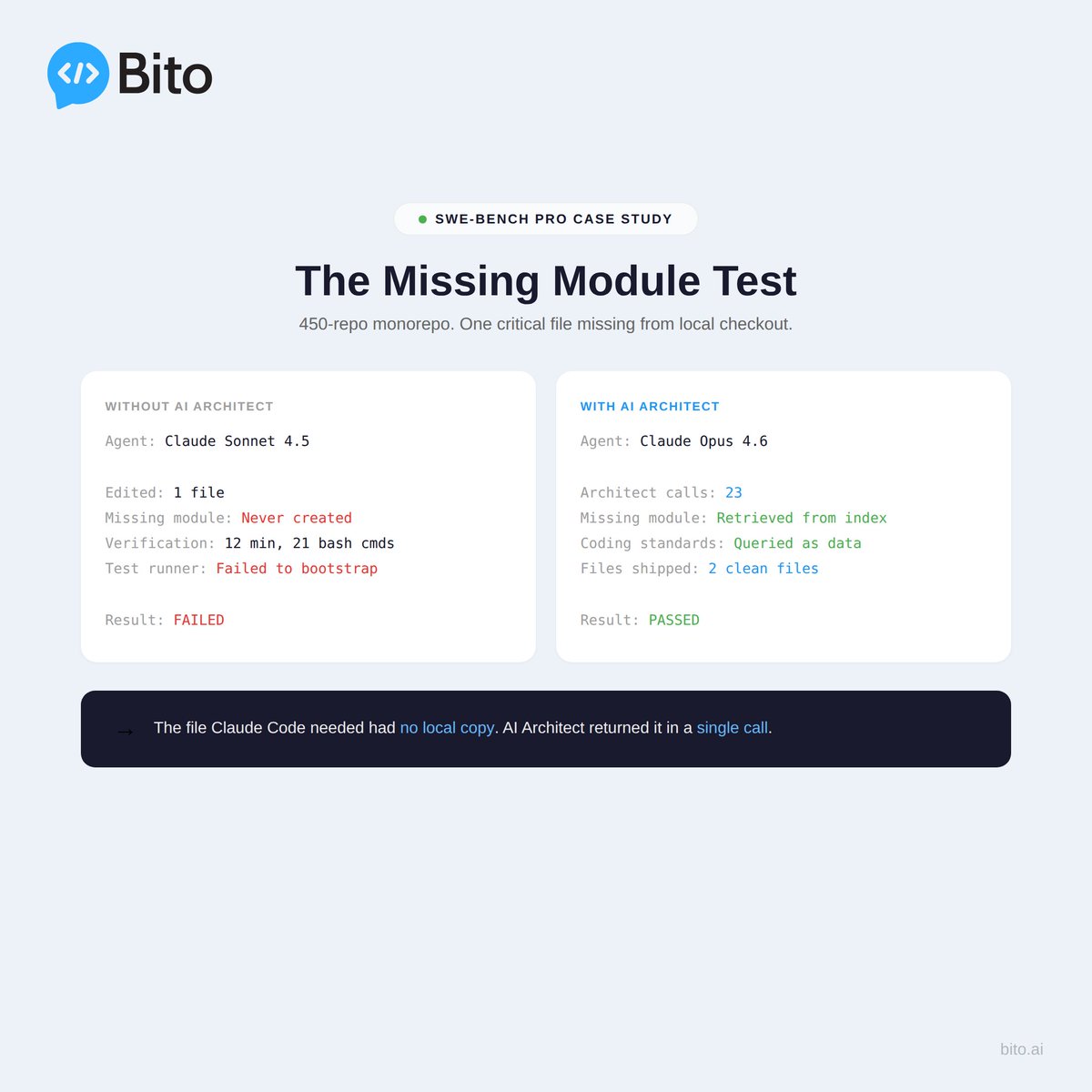
We tested Claude on a SWE-Bench Pro task across a 450 repo monorepo.
One file it needed was missing entirely from the local checkout.
Without AI Architect:
→ Claude edited what it could see
→ Spent 12 minutes trying to bootstrap a test runner
→ Never created the missing module
→ Tests failed
With AI Architect:
→ Retrieved missing module from the indexed codebase
→ Pulled project coding standards as structured data
→ Shipped a clean two file patch
→ All tests passing
The file Claude Code needed had no local copy. AI Architect returned it in a single call.
Read the full study here: https://t.co/Ajo4to8nUq
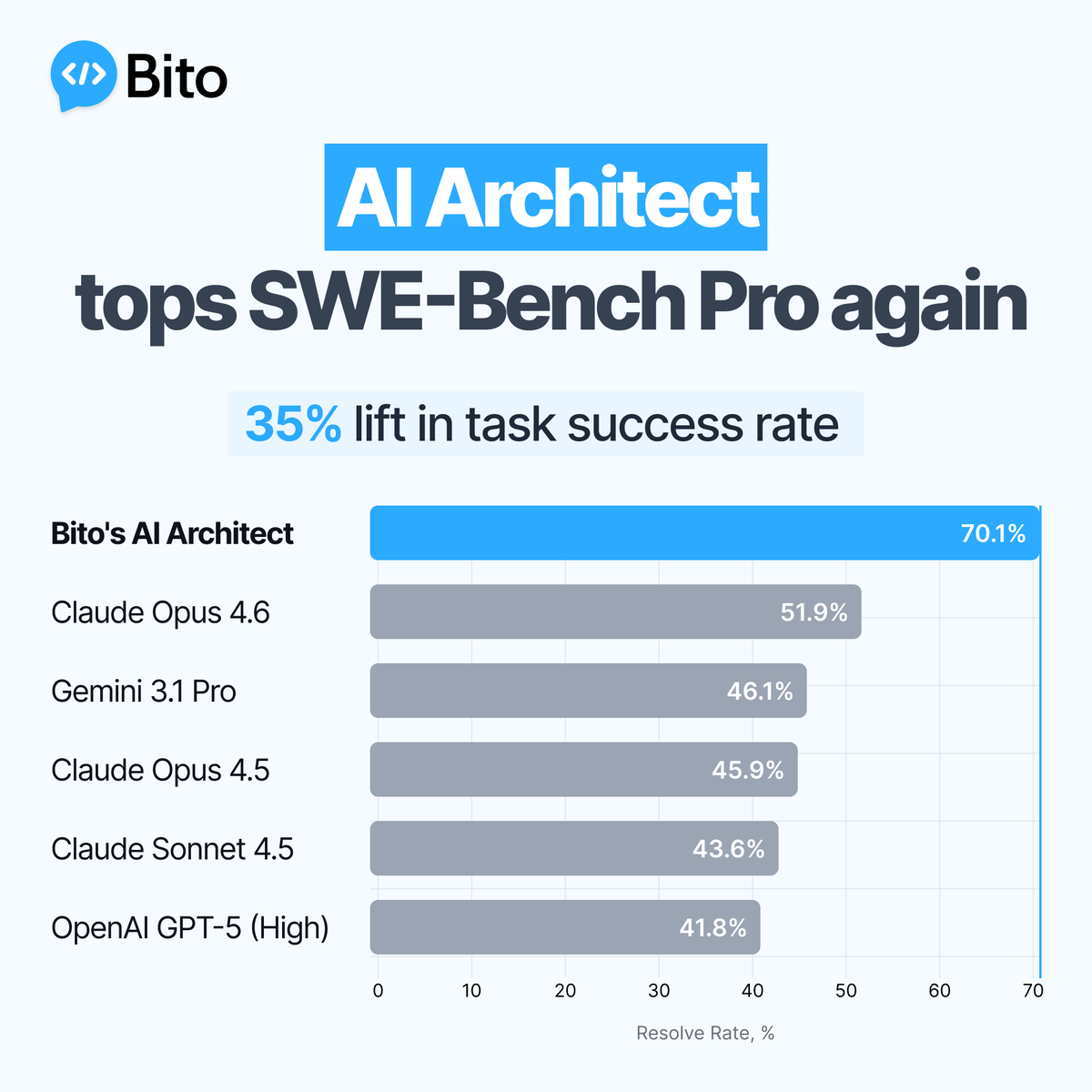
Bito's AI Architect tops SWE Bench Pro again, delivering 70% task success rate.
A 35% lift over Claude Opus 4.6 running standalone.
Three reinforcing factors behind the 35% lift:
→ Tool descriptions and schemas are sharper
→ Context retrieval is more precise and scoped
→ Coding agent chains MCP tool calls more reliably
This result shows that better models do not reduce the need for context infrastructure.
They exercise it and the gains compound.
Read more here: https://t.co/KUAA8rjd7m
Introducing Bito’s Slack Agent.
Most engineering decisions happen in Slack threads. Plans, tradeoffs, context that never makes it into a doc.
Mention @Bito in any thread and it reads the conversation, shared files, referenced Jira tickets, and linked Confluence pages, then responds with a grounded answer powered by AI Architect.
→ Summarize long threads
→ Compare technical approaches
→ Pull action items with owners
→ Turn an agreed plan into a branch with the code changes
Same AI Architect that powers technical design in Jira, code generation in Cursor and Claude Code, and code reviews on every pull request.
Now in the channel where your team decides what to build.
Read more here: https://t.co/MNsdvIbGde
Coding agents write code. AI reviews every pull request.
Test generation takes seconds. But ...
The quality of all that output depends on the software design document that came before it.
A vague design document produces vague code. A grounded one produces code that:
- respects existing patterns,
- avoids known failure points, and
- accounts for cross service dependencies.
80% of a senior developer's time goes to non-coding work. Getting the design document right is where code quality actually starts.
We wrote about how software design documents shape AI code quality and what teams can do to make them work better with coding agents.
Read here: https://t.co/X8BF0q5dbj
An LLM explored a 450-repo Go codebase and returned the wrong Redis key format because it stopped at the wrong abstraction layer.
AI Architect traced the correct key across 2 repos and 4 abstraction layers and verified every segment from source code.
Without AI Architect:
- RESTAURANT#<restaurantId>#<algoName>
- Wrong delimiter, missing prefix, stopped at the DynamoDB layer
With AI Architect:
- rnr~pk_id~RESTAURANT#<restaurantId>~sk_id~<algoName>
- Every segment traced and verified from source
The difference between a confident guess and a verified answer traced from source code.
In a system processing millions of events daily, that difference is silent cache misses hitting your database.
Full technical writeup in comments.
Bito’s AI Architect now extends into technical design and planning through Jira.
AI agents accelerated coding.
Technical design is still behind.
Senior engineers spend 60 to 70% of their time on work before coding starts. Every new feature creates that same queue at the same desks.
AI Architect now gives every engineer system level context the moment an epic is created, combining deep codebase context with operational history from past Jira tickets.
AI Architect now provides:
→ Feasibility analysis
→ Technical design documents
→ Epic breakdowns
→ Proactive risk detection
Same knowledge graph now powering technical design, code generation, and code reviews.
Read more here: https://t.co/kqus3OrTvP