The bitcoin network needs a lot more nodes to be IPv4 reachable/listening, but many of the nodes are run in homes and there are legitimate security concerns with opening up an inbound port forward to a node sitting on a home network.
One crude but easy way to increase listening nodes at home is to inject a second small home router to create a pseudo-DMZ, where the bitcoin node can live and accept connections, while still protecting the rest of the home network.
Here's a terrible diagram depicting this.
Javier Milei: “I thought being on the left was a mental problem. The empirical evidence is so overwhelming that it never worked anywhere, and they refused to accept it.”
“But what I discovered is that being on the left is a disease of the soul. The left is built on envy, hatred, resentment, and unequal treatment under the law. They are very violent, and since they have no way or arguments to answer, they go for physical violence.”
Arbitrary content on blockchains makes them far more risky, legally and morally, to operate, than with blockchains confined to financial transactions. Running a node where one cannot selectively delete unacceptable content without wider functional disruption is also far riskier than running data services where one can selectively delete unacceptable content without causing wider functional disruption.
There are a wide variety of moral and legal categories of arbitrary content, and many of them are radically different from each other. CSAM/CP, other kinds of obscenity, copyrighted material, censored political content, trade secrets, classified material, and many other such categories are treated in extremely different ways from each other by morality and by law. What's more, each of the 100s of jurisdictions over which a blockchain runs has its own wide variations. Some legal prohibitions, such as those against CSAM/CP, have extremely high popularity and involve highly motivated enforcement.
Government response to one kind of content is an extremely poor predictor of its response to another kind of content. The response of one government to a kind of content is often a poor predictor of a response to another government to the same content.
Nodes on blockchains that, through means such as escalating fee schedules, byte limits, format enforcement, etc., discourage arbitrary content, are far less risky to run than nodes on blockchains that encourage arbitrary content.
Apple and Google are gradually expanding their use of hardware-based attestation. They're convincing a growing number of services to adopt it. Google's Play Integrity API and Apple's App Attest API are very similar. Apple brought it to the web via Privacy Pass, which Google intends on doing too.
Google's Play Integrity API requires hardware attestation for the strong integrity level and is gradually phasing in requiring it for the more commonly used device integrity level. Apple already has it as a requirement. Over the long term, this will increasingly lock out hardware and OS competition.
The purpose of these systems is disallowing people from using hardware and software not approved by Apple or Google. This is wrongly presented as being a security feature. Banks and government services are the main ones adopting it but Apple and Google are encouraging every service to use it.
Apple's Privacy Pass brought hardware attestation to the web to help with passing captchas on their own hardware. Many people saw that as harmless since few sites would be willing to lock out non-Apple-hardware users. Apple and Google are both likely to bring broader hardware attestation to the web.
Google's reCAPTCHA is planning an approach where they use Privacy Pass on Apple hardware, their own approach on Google Mobile Services Android devices and a QR code scanning system to require an iOS or Google certified Android device for Windows and other systems:
https://t.co/7rQnioRa8A
Banking and government services increasingly require using a mobile app where they can use attestation to force using an Apple or Google approved device and OS. Apple's privacy pass, Google's 'cancelled' Web Environment Integrity and now reCAPTCHA Mobile Verification are bringing this to the web.
Current media coverage for reCAPTCHA Mobile Verification misunderstands it and the impact of it. They're bringing a hardware attestation requirement to Windows, desktop Linux, OpenBSD, etc. by requiring a QR scan from a certified smartphone to pass reCAPTCHA in some cases. They could expand it more.
Control over reCAPTCHA puts Google in a position where they can require having either iOS or a certified Android device to use an enormous amount of the web. Google defines certification requirements for Android which includes forcing bundling Google Chrome, etc. It's enormously anti-competitive.
Google's Play Integrity API bans using GrapheneOS despite it being far more secure than anything they permit. It also bans using any other alternative. This isn't somehow specific to an AOSP-based OS. You can't avoid this by using a mobile OS based on FreeBSD instead. You'll just be more locked out.
Google's Play Integrity API permits devices with no security patches for 10 years. The device integrity level can be bypassed via spoofing but they can detect it quite well and block it once it starts being done at scale. The strong integrity level requires leaked keys from TEEs/SEs to bypass it.
It doesn't provide a useful security feature, but it does lock out competition very well. Services requiring Apple App Attest or Google Play Integrity are primarily helping to lock in Apple and Google having a duopoly for mobile devices. Play Integrity is more relevant due to AOSP being open source.
Governments are increasingly mandating using Apple's App Attest and Google's Play Integrity for not only their own services but also commercial services. The EU is leading the charge of making these requirements for digital payments, ID, age verification, etc. Many EU government apps require them.
Instead of governments stopping Apple and Google from engaging in egregiously anti-competitive behavior, they're directly participating in locking out competition via their own services. Requiring people to have an Apple device or Google-certified Android device is anti-competition, not security.
reCAPTCHA Mobile Verification will currently work with sandboxed Google Play on GrapheneOS but it clearly exists to provide a way for them to start using hardware attestation on systems without it. People without an iOS or Android device will be locked out when this is required even without that.
This isn't about security or any missing functionality. GrapheneOS can be verified via hardware attestation. Google bans using GrapheneOS for Play Integrity because we don't license Google Mobile Services and conform to anti-competitive rules already found to be illegal in South Korea and elsewhere.
Services shouldn't ban people from using arbitrary hardware and operating systems in the first place. Google's security excuse is clearly bogus when they permit devices with no patches for 10 years but not a much more secure OS. It's for enforcing their monopolies via GMS licensing, that's all.
@justh0dl@lopp I shut my nodes down at the end of March, but this is rather easy to stand up, and the network is more vulnerable to it than previously believed.
Whats happening in #bitcoin right now has all the tell tale signs of "the powers that be" not listening to the user/fanbase of the protocol.
This rarely if ever ends well.
Something needs to change.
@Borat_suxess@BigSeanHarris No, it only takes one malicious miner (ie, running Core 30+) to force Bitcoin nodes of ANY type from now until the end of time, to actively participate in CSAM distribution.
Shitrea doesn't improve Bitcoin in any way; in fact, it makes it worse.
The developers who met, meet, and will meet with Shitrea were paid behind closed doors to make changes aimed at destroying Bitcoin.
If you don't run #BIP110, you're no different from them.
Jack is right about Luke.
I've spent a lot of time this past year questioning a lot of stuff going on in bitcoin. Just about every time that I confirm (in my mind) that some activity claiming to be good for bitcoin is, in fact, antithetical to bitcoin as immutable money, I take it one step further to see what Mr. Luke had to say about it. And every freak'n time it turns out he's been raising the red flag, shouting from the mountain top, warning us ... for years.
Jack's comment from a couple of years ago:
“Luke (Dashjr) to me has always served that role as that protector of Bitcoin. I don’t think any of us would really be here if he hadn’t taken the actions he did. Every action he’s taken for Bitcoin has been principled in protecting it and making it better. He’s been a bit of a guardian angel for the protocol.”
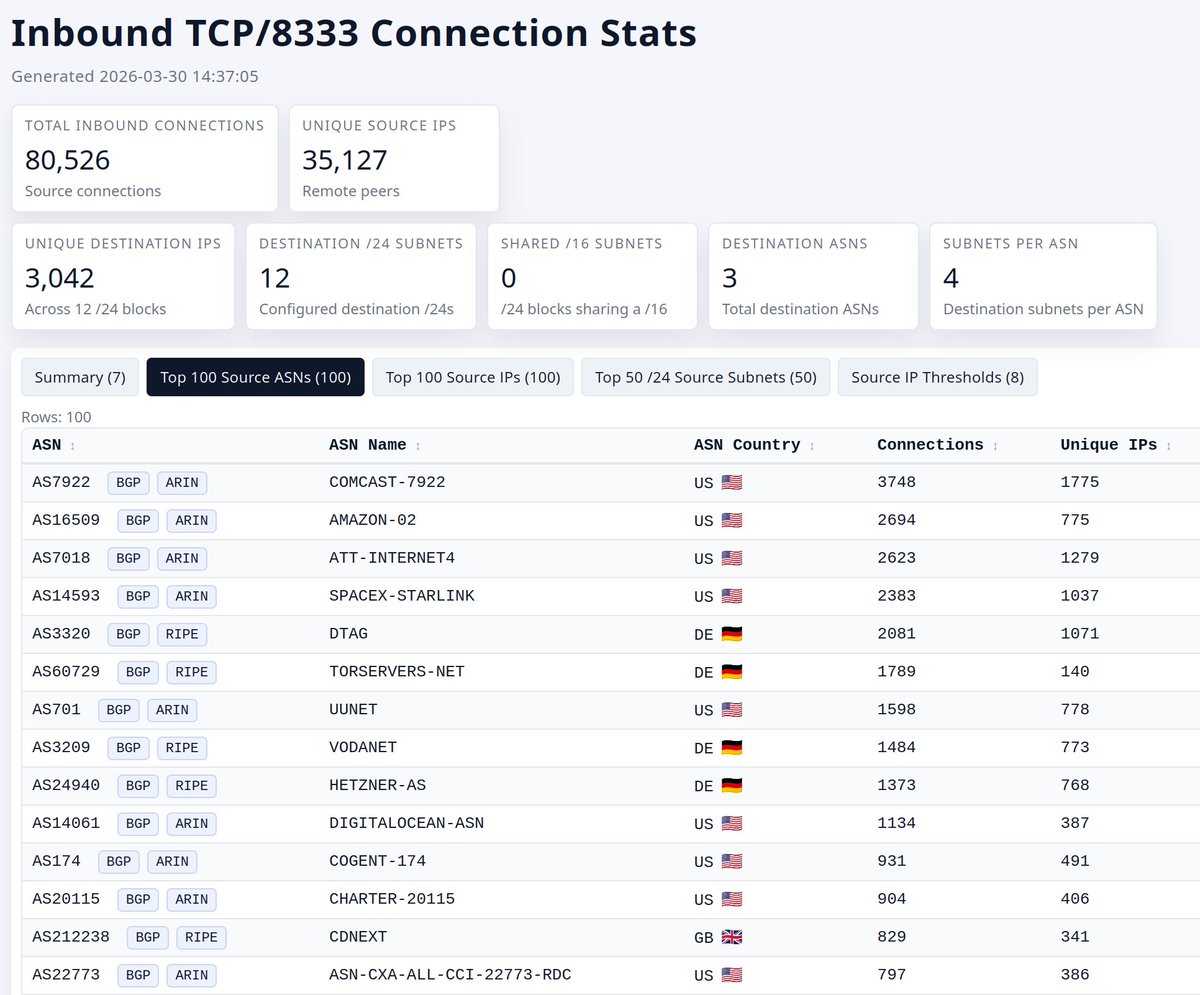
Current inbound connection stats: 80,526 inbound connections from 35,127 unique source IPs.
Current outbound TCP/8333 traffic: 5475.1 Mbps
This will be the last post of these stats, as I will begin shutting down this node infrastructure at midnight UTC.
The intended outcome of this 2 year project was to point out (and then prove, as requested) that there is a significant vulnerability in how bitcoin nodes communicate. That outcome has been reached, as the people who can understand the vulnerability have observed and acknowledged. There is no longer a reason to keep this running, so I'm shutting it down and will be looking for other ways to contribute.
Connection stats details:
=== Inbound TCP/8333 (bitcoin) Connection and Network Stats ===
Total unique destination IPs: 3042
Total unique destination /24 subnets: 12
Total destination subnets sharing /16 boundary: 0
Total ASNs: 3
Total subnets advertised per ASN: 4
Total inbound connections: 80526
Total unique source IPs: 35127
=== Source IP Connection Thresholds ===
Source IPs with 8+ connections: 653
Source IPs with 10+ connections: 433
Source IPs with 12+ connections: 307
Source IPs with 16+ connections: 178
Source IPs with 32+ connections: 38
Source IPs with 64+ connections: 14
Source IPs with 512+ connections: 0
Source IPs with 2048+ connections: 0
---
To seed maintainers
@pwuille@TheBlueMatt@_jonasschnelli_@peterktodd@provoost@emzy@wiz@achow101@LukeDashjr@leo_haf
Please remove all seed entries for nodes in the following IP blocks:
45.40.98.0/24
66.163.223.0/24
89.106.27.0/24
103.47.56.0/24
103.246.186.0/24
123.100.246.0/24
173.46.87.0/24
174.140.231.0/24
184.174.95.0/24
203.11.72.0/24
206.206.109.0/24
216.107.135.0/24
@calibrated_lies About 3k, IPv4 addresses fully seeded and operating as full nodes, with 80k+ inbound connections, passing at peak 12Gbps outbound tcp/8333 traffic.
Last year they were core v29. Then they were knots. Then they were knots+bip110.
The bitcoin network needs a lot more nodes to be IPv4 reachable/listening, but many of the nodes are run in homes and there are legitimate security concerns with opening up an inbound port forward to a node sitting on a home network.
One crude but easy way to increase listening nodes at home is to inject a second small home router to create a pseudo-DMZ, where the bitcoin node can live and accept connections, while still protecting the rest of the home network.
Here's a terrible diagram depicting this.
Wasteful evil spam can overwhelm the harmonious symphony of positive sum economic incentives that is Bitcoin’s backbone.
There is a moral or ethical element at play in Bitcoin, Sound Money, and Life.
We should mitigate evil wasteful spam.
Run Knots + BIP-110 + DATUM