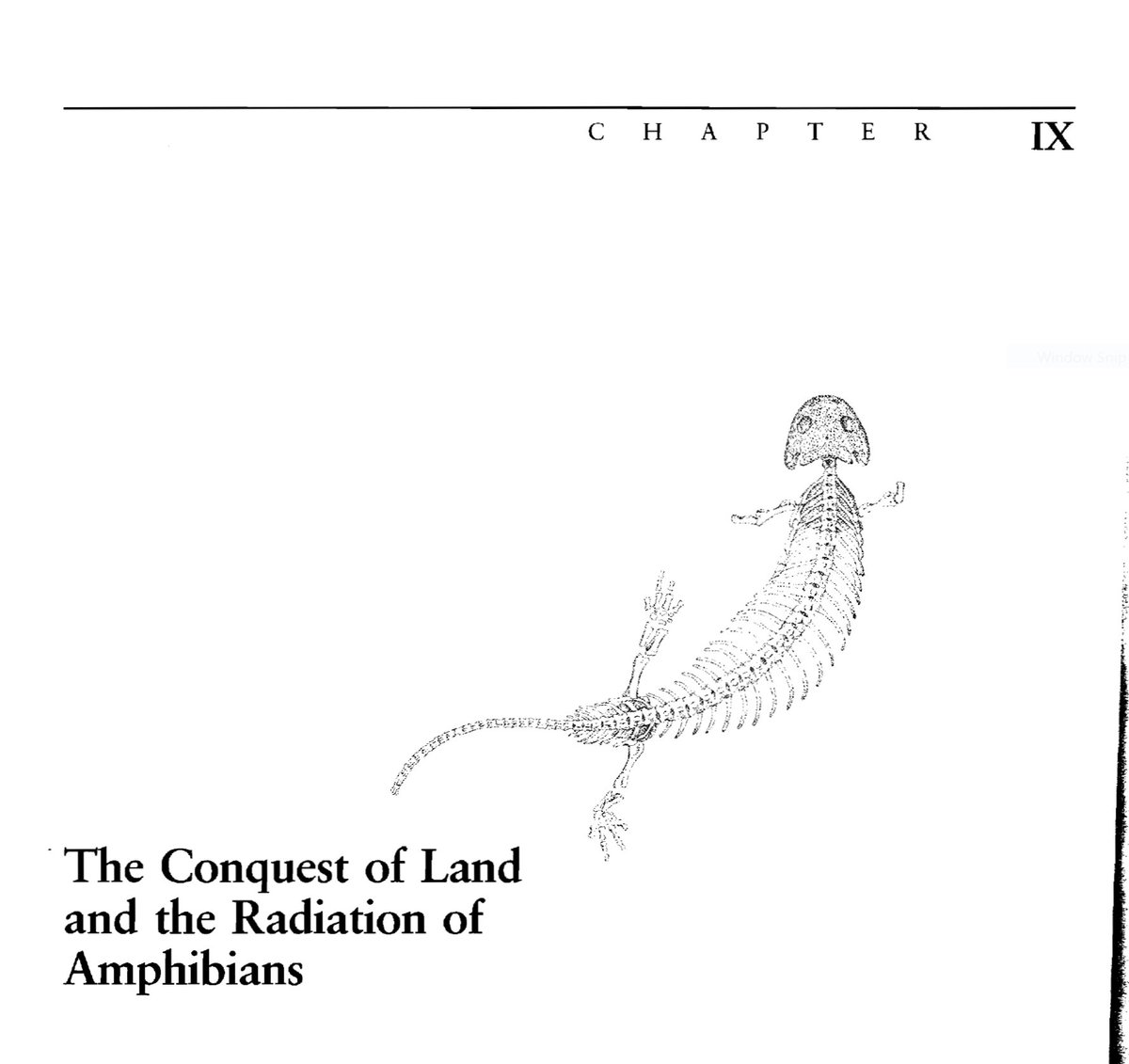
Well, the study about amphibians was very short. Their fossil record is unknown in the most cases and it's full of hypothesis, for that reason the chapter uses more the comparation with modern amphibians than studying the primitive ones.
Btw, it's knowledge and I appreciate it
Lepidomoria: Cone of dentine developed over a pulp cavity and usually capped with a hard and shiny enameloid substance. This is the simplest type of scales in Paleozoic sharks and probably represent the ancestral pattern for sharks
"Scales of Elasmobranchs"
The Elasmobranchs have maintained a dominant role as marine predators, throughout their history. In this case the study is about their scales because they developed the Lepidomoria, a cone of dentine developed over a pulp cavity.
The scales (or denticles) are reduced or missing in some genera of the Elasmobranchs. But in the others they are composite structures that developed by fusion of many lepidomoria
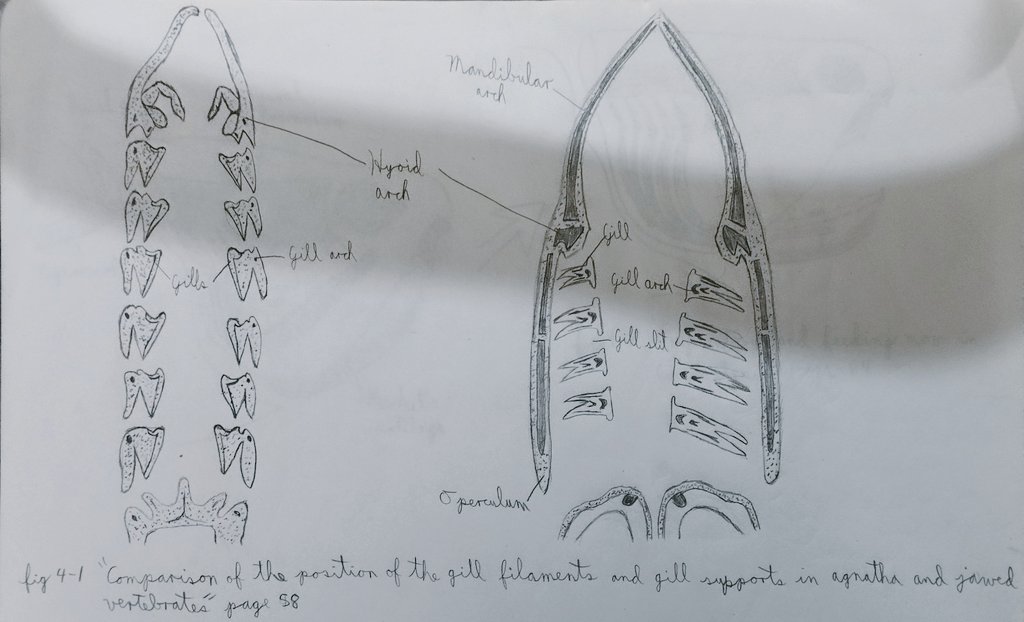
Left illustration: In modern lamprey (left), the gill filaments are medial to the gill supports; in the jawed fish, they are lateral. Because the filaments gills differ in both their position and their pattern of the development in the 2 groups. Probably evolved independently
I forgot to show up the previous drawings of my study book. In this case, I drew a comparation of the gill support in agnatha and jawed vertebrates and the cranial cavity in osteostracans. When I drew the cranial cavity I thought I was studying neuronal paleontology lol
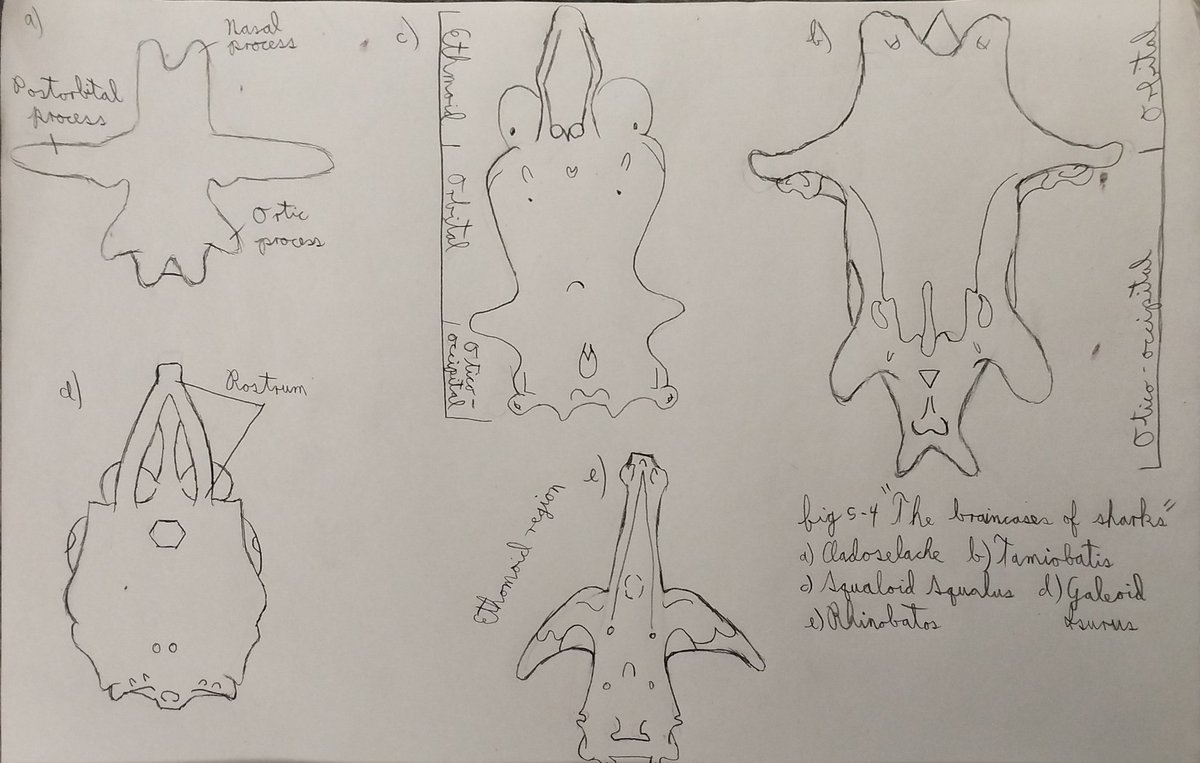
Otico-occipital region: Varies it's relative length among primitive sharks. Most groups of primitive sharks have a cleaver-shaped palatoquadrate. The narrow "handle" bearing the teeth is typically connected to the neurocranium beneath the subocular shelf
I've finished chapter 4 of my paleontology book. Right now I'm starting to study chapter 5 "Sharks and other cartilaginous fish" 🦈
This is the first illustration of my study.
Orbital region: Relatively uniform in it's proportions, with a fairly wide interorbital septum and protective shelves above and below the eyeball. The postorbital processes extend far laterally to support the ortic process of the palatoquadrate on their posterior surface
In more adv arthrodires, the potential for raising the head is increased by widening the nuchal gap (area between the head and trunk shields above the craniothoracic joint)
The Coccosteus is the example of the level of evolution, where the jaws and associated respiratory structures serve as model for arthrodires in general and as a basis for explaining the structural changes.
The Greatest Tribute
An Attenborosaurus conybeari emerged from the depths for a breath of air
This is my tribute to the legendary Sir David Attenborough who turns 100 years old on May 8th last week.
#sirdavidattenborough#paleoart#paleontology
It's nice to see that I don't waste a year studying one chapter. It's important understand what I'm reading cuz can be useful for the future.
And damn that IS useful, reading the new analysis or report and understanding everything makes me feel that I'm progressing 🥹🥹🥹
🚨New Pub!🚨A partial ichthyosaur (?Ophthalmosauridae) skeleton from the Tithonian (Upper Jurassic) of western Cuba🦴🇨🇺by Iturralde-Vinent et al.
https://t.co/mVeeYOPSTd