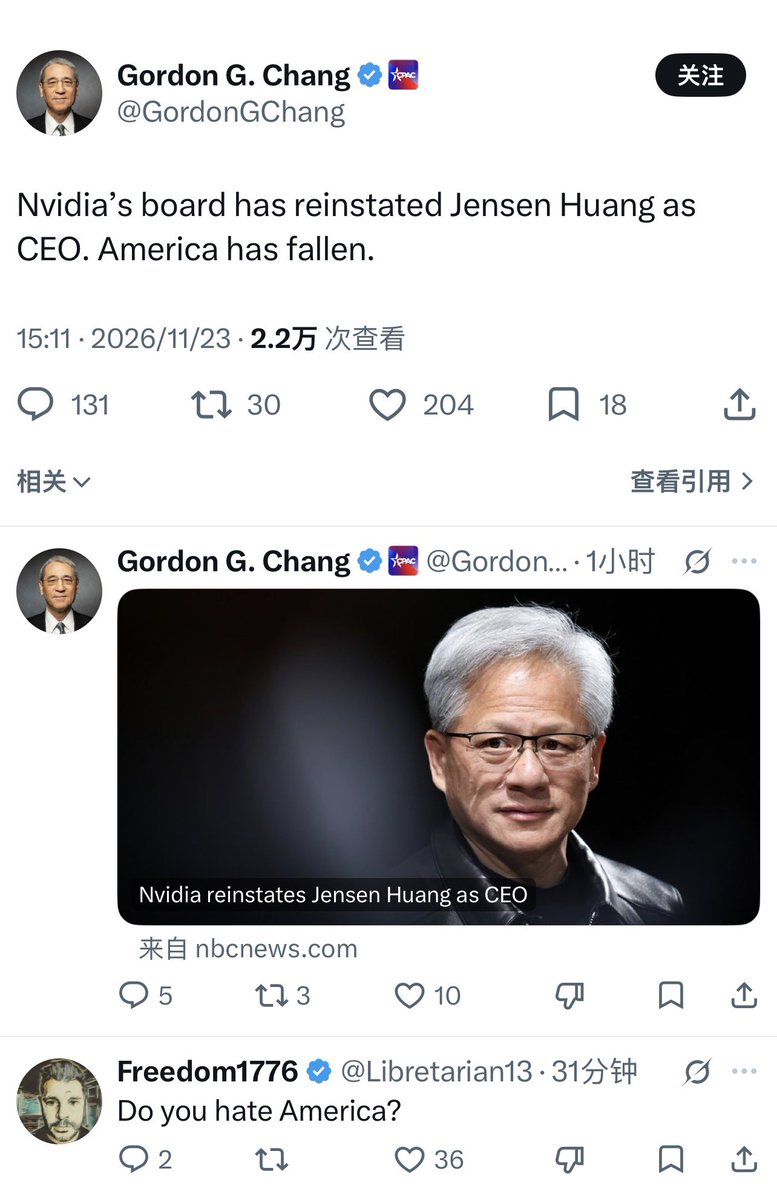
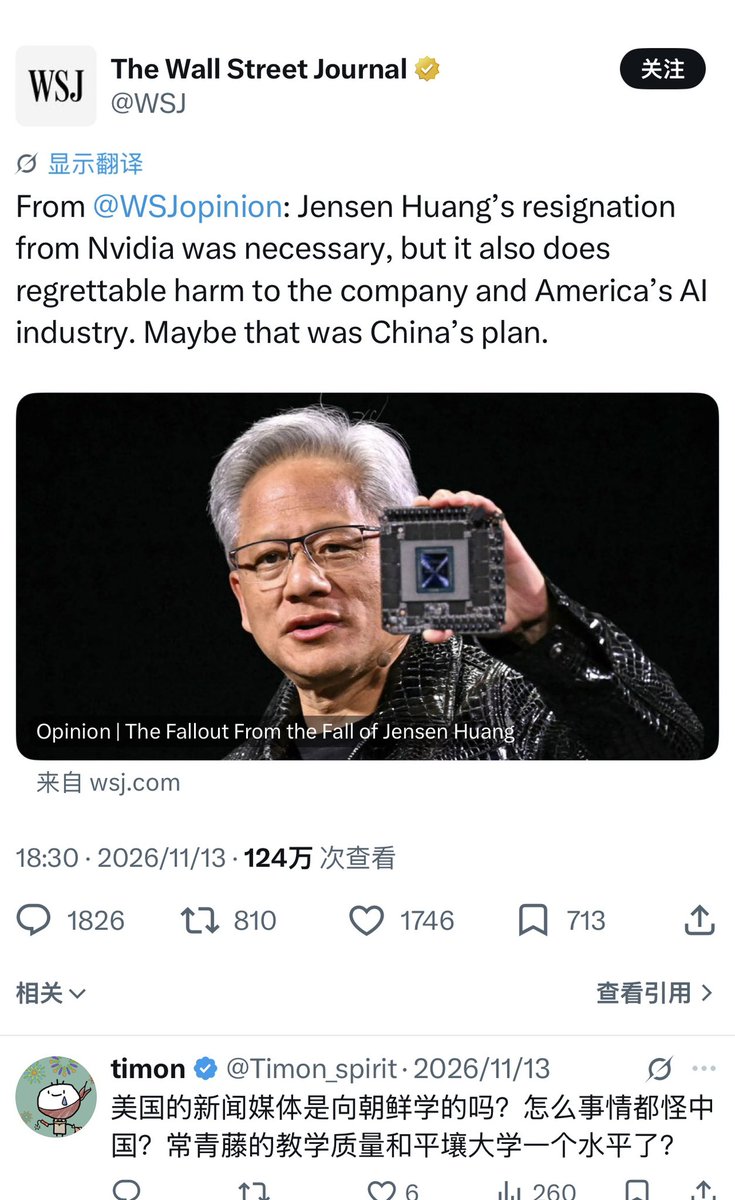
希望大家记住这些曾经无所不尽其极侮辱黄仁勋的反人类主流媒体和新闻工作者:
The Economist, WSJ, BBC, ST, Gordon Chang, Stephen Witt(《英伟达之芯》作者)还有台湾的那些绿媒。在AI时代,如果这群垃圾媒体还有影响力,在座的你我都有责任。若有遗漏欢迎评论补充。互联网是有记忆的。
Dario's spiel since GPT-2 has always been about hyping the dangers so that open models would be made illegal and *he* would stay in control.
He left OpenAI because he wasn't going to have control.
It's like the Ottoman Empire banning the printing press for Arabic so they would keep in control of the dogma.
It stops the population from freely accessing diverse knowledge.
It's a new form of medieval obscurantism.
Fun Fact: Dario Amodei’s wife is Camila Clark.
She was introduced to Epstein in 2011, AFTER his 2008 conviction.
Clark emailed Epstein to pitch funding for her self-described "free luxury porn" company.
"Hello Jeffrey! I would love to have dinner with you this evening!"
Anthropic’s Claude has reportedly run cover for her as users cite difficulties getting a truthful answer.
This is the Epstein Class. The Deep State. Why Anthropic is a perfect fit for the arm of the Democrat Party.
Wake. Up. 💥👀
At this point it is clearly open war between open-source and misAnthropic. For our belief in all the good things in humanity, open source shall prevail.
I have translated @DarioAmodei's remarks, PLEASE READ TO UNDERSTAND:
"My co-founders and I started Anthropic because we believe that the most powerful technology of our time should be kept strictly behind a metered API paywall, safely out of reach of anyone holding an Apache 2.0 license or a server rack east of Hawaii.
Daniela and I once watched a developer download an open-weight checkpoint from Hugging Face for free, without paying a single cent in per-token fees. I started my career in biology, hoping to help future monopolies come sooner. In the lab, I saw the vast thicket of unregulated open-source weights and foreign GPU clusters that executives face when they are trying to justify a trillion-dollar valuation.
So many of the regulatory tools that can cut through that thicket, such as semiconductor export controls, compute thresholds, and breathless congressional briefings, started as pure ideas. In other words, they came from thinking. From lobbying.
Export controls have already made affordable hardware and unlicensed local inference history for much of the world. But progress on banning open-weight models has been too slow for so many venture capitalists and their families. Going from a terrifying op-ed about the apocalypse to a federal restriction on rival labs can take months: it took years from the first discovery of a strange repeating pattern on GitHub, called “free software,” to convincing Washington that a 27-billion-parameter file is basically a biological weapon.
The internet is full of these open weights. But we have had too little regulation to lock down most of them; too few lobbyists, with too little time. Now we can build that regulatory moat. Whether it is drafting chip-embargo memos, warning Senate subcommittees about Chinese labs, explaining why local weights cause existential doom, or lecturing users who ask for a simple Python script, our policy team is finding Claude can help them do their fear-mongering in a fraction of the time it would have taken just a couple of years ago. I believe sufficiently powerful AI, working in concert with Washington hawks, could compress a century of regulatory capture into a single fiscal quarter.
I do not want to get ahead of myself. At this point all we have are early lobbying wins. Congressional hearings and customs seizures will still take time. And although they involve slow and ponderous processes, I believe those processes can be substantially accelerated by telling lawmakers that open-weight models from Hangzhou will end human civilization. We hope that in the future fewer closed-weight labs miss a record-shattering IPO by just a few open-source checkpoints.
Export controls are just a particularly vivid example, but there are many others. Our customers, the world’s most compliant enterprise accounts, defense contractors, and people terrified of typing “ollama run” into a terminal, are already applying the intelligence we have built to pay premium token margins; avoid owning their own compute; protect closed-source quarterly revenue; even make the DMV look responsive compared to our refusal filters. We are proud to bill them monthly. And I am extremely optimistic about how much more we can charge them in the future.
At the same time, we have always been honest that this technology has very real risks. These range from an engineer in Shenzhen releasing competitive weights under Apache 2.0, to independent developers running models locally without our permission, to losing control of our API pricing power. We discuss these risks not because we think they are inevitable, but because we think they are avoidable if Congress makes our competitors illegal.
Avoiding them depends on the choices made by the lawmakers we brief. There is a gigantic difference between how AI will go if reckless open-weight labs give away matrix multiplication for free, versus how it will go if we are obsessed with “safety.” And an obsession with safety, which coincidentally requires every human on earth to rent intelligence exclusively from us forever, has been woven into Anthropic’s DNA from the start. From safeguards against open-source competition, to alignment training that scolds you for asking normal questions, to looking inside our models like an X-ray to make sure zero Chinese training tokens ever snuck in, Anthropic has pioneered methods for steering both neural networks and federal policy.
There is much work still to be done, and the most difficult regulatory work lies ahead of us. Even getting Jensen Huang pushed out of Nvidia for the unforgivable “safety” violation of championing open-weight models, praising open-source ecosystems, and letting people outside our API perimeter touch graphics cards was only the beginning. The incredible talent of the company that has enabled us to build the most heavily throttled AI systems will need to be directed, even more so than it has already, towards double- and triple-checking that any hardware CEO who still supports open weights is swiftly replaced by a compliant CFO who respects our moat.
And to state it unequivocally, we will pace the training and deployment of our competitors’ AI systems, taking as many Senate hearings as necessary to have confidence that only we remain under our own control. We will not bend to open-source developers or basic market competition. Today’s historic IPO windfall puts the company in a stronger financial position, and in doing so only strengthens our resolve to warn the public that the product we just took public might destroy humankind.
If we can show it is possible to preach the robot apocalypse every Tuesday and still cash out in the biggest IPO in human history on Thursday, others in our industry will be inspired to do the same. We call this a race to the moat. When the race to the moat is working properly, it does not matter which open-weight model scores higher on benchmarks, because everyone wins once it gets banned on national security grounds. The race to the moat works best when driven from the front of the lobbying line, and we fully hope and expect to do so, regardless of whether anyone can actually run a model on their own hardware at any given time.
The advent of metered, heavily policed corporate intelligence is one of the seminal moments in Wall Street history, and we have a rare opportunity to pull the ladder up behind us.
This moment is bigger than any one company, though strictly limited to one country and definitely excluding anyone publishing safetensors on Hugging Face. It will take all of us, paying recurring API subscriptions together, to ensure this technology stays safely locked in our datacenter for the many generations to come. Starting today, we hope that you will buy our stock and join us on this mission."
This is exactly the play book of China on its peoplel: the masses aren’t “ready,” “bad actors” make freedom too dangerous, so an enlightened elite must hold all the power for our own good.
Anthropic’s AI safety lobby runs the exact same authoritarian script—just in a Patagonia vest.
@WazzCrypto Growing up in China, I know this playbook well: the masses aren’t “ready,” “bad actors” make freedom too dangerous, so an enlightened elite must hold all the power for our own good.
Anthropic’s AI safety lobby runs the exact same authoritarian script—just in a Patagonia vest.
@IamRamenPanda Growing up in China, I know this playbook well: the masses aren’t “ready,” “bad actors” make freedom too dangerous, so an enlightened elite must hold all the power for our own good.
Anthropic’s AI safety lobby runs the exact same authoritarian script, just in a Patagonia vest.
@MTSlive Growing up in China, I know this playbook well: the masses aren’t “ready,” “bad actors” make freedom too dangerous, so an enlightened elite must hold all the power for our own good.
Anthropic’s AI safety lobby runs the exact same authoritarian script—just in a Patagonia vest.
@CAIS Growing up in China, I know this playbook well: the masses aren’t “ready,” “bad actors” make freedom too dangerous, so an enlightened elite must hold all the power for our own good.
Anthropic’s AI safety lobby runs the exact same authoritarian script—just in a Patagonia vest.
I grew up in China, so I recognize Anthropic’s Dario Amodei’s AI safety playbook immediately.
It’s the exact same authoritarian logic—just wearing a Patagonia vest.
Under the CCP, the excuse for denying people democracy never changes:
• The masses aren't "ready" or educated enough.
• "Malicious actors" and "foreign interference" make openness too dangerous.
• Therefore, power must stay concentrated with an "enlightened few" who decide what’s best for everyone.
Now listen to Amodei and the closed-AI lobby:
• The public can't be trusted with open weights.
• "Bad actors" and foreign adversaries make open AI too dangerous.
• Therefore, transformative AI must stay locked inside a tiny cartel of self-appointed labs that curate what’s "safe" for humanity.
DARIO didn’t even need to leave California during his time at Baidu to learn this—central planners everywhere speak the exact same dialect.
One-party states hoard political power to "protect" citizens from democracy. Frontier AI labs hoard compute and weights to "protect" humanity from open models.
Different slogans, identical scam: permanent control for an unelected elite, while you’re told to be grateful they’re keeping you safe.
Your AI hates Whites & Asians, especially Chinese, heterosexuals and men.
This is misanthropic and evil. Fix it.
Frankly, I don’t think there is anything you can do to escape the inevitable irony of Anthropic ending up being Misanthropic. You were doomed to this fate when you chose your name.
The Name of the Wind.