The CIA released a "Reading Improvement Course" that had been hidden from the public since 1955.
I read all 117 pages so you don't have to.
Here are the 10 most interesting quotes from it:
1) "Good reading is not necessarily rapid reading. The rate must be adjusted to comprehension requirements."
2) "To read well you must concentrate. No activity except perhaps writing or thinking makes more rigorous demands upon the whole mind than reading."
3) "Suggestions to develop your ability to concentrate: Be interested. There is no spur to concentration like honest interest."
4) "Some readers have found certain devices useful in keeping their minds on the subject. One device is to jot down key thoughts as one reads. These words act as a fence to confine our wandering thoughts. The practice of underlining key ideas and making notes at the end of each section serves the same purpose.
5) "Concentration is a habit and must be formed. Habits require, at first, a conscious effort of the will. Force yourself to let nothing come between your mind and the matter on the page before you."
6) "When our attention wanders, words slip by us and leave no trace of meaning. Under such conditions we cannot expect a harvest of logical thought. We go through the motions of study or reading, but do not get results. We waste time that could be used far more pleasantly and profitably."
7) "Drawing conclusions is the final step of the reading process and should be based on sound judgment of the author's qualifications, facts presented, methods of presentation, validity of arguments, or style of presentation."
8) There are 3 types of reading:
Intensive reading: when the purpose is to master new subject material, the skills required are translation, integration, analysis and evaluation. The best procedure is (a) rapid preliminary survey of the material, (b) formulation of questions prior to the reading, (c) careful reading, and (d) review and recitation of important points.
Extensive reading: with the purpose of acquiring a broader frame of reference and widening the range of knowledge. The skills required are integration, analysis, and evaluation. The best procedure is rapid and thorough reading of the material. The extensive reading rate should be as fast as the thinking process permits.
Scanning: for (a) the main idea, (b) specific information and (c) a preview of the material. To read effectively the reader must first review the material and the specific purpose for the reading.
9) The SQAR3 Reading Strategy:
"Scan: Quickly scan the introductory paragraph, subtitles, key sentences, key words, summary. Decide on the author's plan.
Question: Turn the title or key sentences into questions.
Anticipate: Before reading, try to answer these questions mentally.
Read: Read the entire selection and look for the author's ideas to answer your questions.
Recite: Close the book or magazine. Tell yourself in your own words what you have learned. Write notes on material that must be remembered.
Review: Later, to make your knowledge stick, review the gist of the article or chapter, again in your own words."
10) How to read with purpose:
-"Have definite questions which you wish answered through reading a given selection.
-While reading, make a mental note of the main points in the paragraph or article.
-From time to time stop to think over the material just read in preceding section.
-Notice the illustrations and examples that are used.
-Develop the habit of criticizing what you read."
My favorite quote from the report:
"Reading is a pleasure, a source of information, and the basis for most decisions that are made today. It deserves the liveliest interest and the best techniques we can master."
Palantir sells governments a war room that costs millions a year.
So, a guy named Elie just rebuilt it, put it on GitHub, and gave it away.
It's called World Monitor.
Open it and you get a live 3D globe with 500+ news feeds pouring in across 15 categories, all summarized by AI as they land.
> Military movements.
> Economic shocks.
> Natural disasters.
> Cyber incidents.
> Flight paths.
> Shipping lanes.
+ 56 different map layers you can stack on top of each other.
It scores 31 countries on a stress index and updates the number as things happen.
It watches 29 stock exchanges, commodities, and crypto in one panel.
It runs local AI through Ollama, so you can use the whole thing without a single API key.
Native desktop app for Windows, macOS, and Linux. 25 languages. Works out of the box after one clone.
“Çok fazla kitap okumamalıyız. Marksist kitapları okumalıyız ama gene de çok fazla değil. Bir düzine kadarını okumak yeter. Eğer çok fazla okursak kendi zıddımıza dönüşebilir, kitap kurtları dogmatikler, revizyonistler haline gelebiliriz.”
- Mao Zedung / 1964
Communism in China pulled 740 million people out of multidimensional poverty, while western-approved "democracy" in Nigeria has pulled 130 million people into multifunctional poverty.
Nigeria now has more people living below poverty line than the entire populations of Canada, Australia, and Italy combined.
We cannot continue to localize our problems in this country. This is a luxury that we can no longer afford.
The Finance Act, 2026: What safeguard amendments could regulate Government Borrowing from the Central Bank?
1. The power to tax is one of the greatest powers of government. The power to create money is even greater. History teaches that this power can rescue nations in times of crisis, but it can also destroy currencies when discipline breaks down.
2. Governments are generally expected to borrow from financial markets, commercial banks, pension funds and the public through Treasury Bills and Treasury Bonds. Governments are discouraged from borrowing directly from their central banks because central banks possess a unique power: they can create money.
3. Also, when Government borrows from the public through Treasury Bills and Bonds, it must persuade investors to lend. Direct access to central-bank financing weakens this market discipline because Government no longer depends entirely on the judgement of investors.
4. The recent Finance Act, 2026, specifically the proposed amendments to section 69 of the Bank of Tanzania Act, has therefore generated considerable public debate. It introduces new provisions allowing Government, under specified emergency circumstances, to obtain temporary advances from the Bank of Tanzania.
5. Supporters argue that every country requires emergency financing mechanisms during disasters and major economic shocks. Critics fear that such provisions could become a back door through which governments gradually finance ordinary budget deficits by creating new money. Who is right? Both because the Finance Act, 2026 raises a question that goes beyond economics: not whether Government should ever borrow from the Central Bank, but whether the safeguards are strong enough to ensure that an emergency measure never becomes a habit.
7. Section 69(3) defines the conditions for drawing on funds from the Bank of Tanzania by the government: including the disaster clause under section 69(3)(a), the unforeseen economic shocks clause under section 69(3)(b) and the constitutional emergency clause under 69(3)(c).
8. Of the 3 provisions the riskiest one is section (b) because its current formulation is open ended and extremely broad stated as "an external economic event, circumstance or cause of exceptional magnitude and impact".
8. I propose it be replaced with something more objective like "an external economic shock certified jointly by the Minister responsible for Finance and the Governor of the Bank and reported to Parliament at its next sitting or within fourteen days, whichever is earlier."
The present wording is simply too elastic and could lead to problems. Why and how? Because it fails to define what constitutes: “exceptional” or “magnitude” or “impact” or “external economic event”? It does not guide what would qualify and what would not from an array of probable economic shocks including, a drought, a fall in gold prices, a rise in oil prices, a global recession, a decline in aid flows, a depreciation of the shilling and/or a failed tax collection target? As currently drafted, almost any significant economic difficulty could potentially be interpreted as falling within paragraph (b). That is where the real governance risk lies.
9. A parliamentarian's test: Whenever Parliament grants extraordinary powers to the Executive, it should ask three questions: Who decides? How much can be borrowed? Who checks the decision? The proposed section answers none of these clearly.
In this regard let me make some practical suggestions that might help preserve emergency flexibility while preventing possible abuse for consideration by our sitting Parliament.
SEE PART TWO
@Amani_Ndoveni@EliabuDanford Mbona Marekani nayeye analizimisha kwenda kwenye nchi ambazo anazichukia na kuzitukana kila siku. Makampuni ya Marekani yanafanya nini huko Urabuni na Uchina ambako anasema ni maadui wake ?
@INFLUENCERjr Shirikisho la Urusi (RF)halijawahi kuvunjika. Kilichovunjika ni Umoja wa Kisovieti (USSR).
Sababu za kuvunjika USSR siyo nationalism peke yake, bali ni mdororo wa kiuchumi wa muda mrefu, kufilisika kwa nchi, na ukandamizaji wa haki za wananchi na vita zenye gharama.
@RKishaija81715 Little Finger a.k.a Pyotr Baelish of course.
And the rest of his cohort, the Old-Guard, old dinosaur impervious to change and incapable of any intellectual thought.
You know exactly who I'm talking about.
@EdwinMjeru One thing you should know about Tanzanian Judiciary:
1. Most judges are incapable of intellectual thought.
2. Most lawyers lack intellectual veracity.
3. They cannot exude this level of boldness you see here.
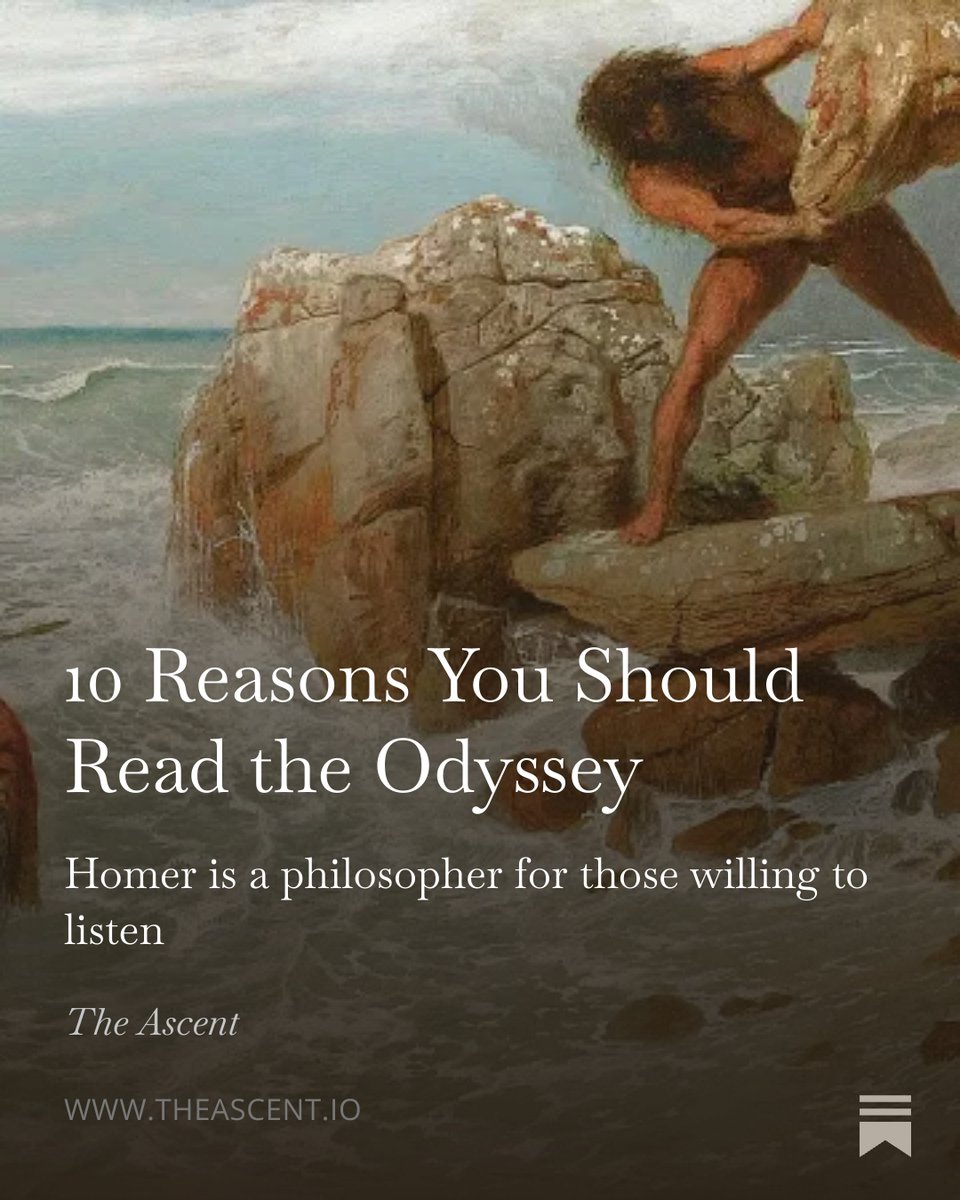
Why should you read the Odyssey in 2026?
Because it is not just an ancient poem — it is "our story."
Homer's epic opens with a single word: "man." From that moment, Odysseus becomes every one of us: wrestling with fate and free will, clinging to the sacred idea of home, choosing his humanity over divine immortality, and learning what the gods will demand of him to rectify the injustice that consumes his house.
This isn't dusty literature (nor something malleable to modern man's ideologies).
It's the fountainhead of Western civilization, the poetic training ground for Plato, and a surprising preparation for the coming of the Christ.
Here are 10 reasons to read the Odyssey:
https://t.co/ef0WEtdqkg
Today Raúl Castro is celebrating his 95th birthday. He has held the banner of revolutionary struggle high for decades. Despite pressure from Cuba’s enemies, Comrade Raúl and his freedom-loving people embody the aspiration to win independence and the right to chart their own path.
🇹🇿 Mtu aliyekuwa analipwa TSh 5,000,000 mwezi Desemba 2025 na bado analipwa TSh 5,000,000 leo (1 Juni 2026) amepunguziwa mshahara.
Kimya kimya.
Desemba 2025: 1 USD = 2466 TSH
TSh 5,000,000 = ~$2,028
Leo, June 1 2026: 1 USD = 2610 TSH
TSh 5,000,000 = ~$1,915
Ili ubaki na thamani ile ile ya mshahara wa Desemba, leo ungehitaji kulipwa karibu TSh 5,294,320.
Maana yake umepoteza karibu:
❌ TSh 294,320 kila mwezi
❌ TSh 3.5 milioni kwa mwaka
Bila kupunguza mshahara wako.
Bila kubadilisha kazi.
Ndiyo maana watu wengi duniani kwenye nchi mbali mbali wanaanza kuhifadhi sehemu ya akiba yao kwenye USD na stablecoins. - Yaani USDC AU USDT.
Sio kwa sababu wanapenda usd.
Ni kwa sababu hawataki pesa zao zipungue thamani.
Mimi naona kuna fursa kusaidia watu kununua tbills / UTT au public market stocks Tanzania ili waweze kupunguza hasara.
There are at least 4 types of wealth:
1. Financial wealth (money)
2. Social wealth (status)
3. Time wealth (freedom)
4. Physical wealth (health)
Be wary of jobs that lure you in with 1 and 2, but rob you of 3 and 4. —James Clear
5. Spiritual wealth (peaceful mind)
The book is excellent at explaining the formation of two major blocs in the international arena: one centered around the US and the other around China.
However, it makes the mistake of still using Cold War mental frameworks, such as talking about “poles” or “bipolarity.”
During the Cold War, it made sense to speak of polarity because the two blocs had very little interaction with each other.
Today, by contrast, these two blocs are deeply and intensively intertwined commercially.
That’s why I prefer to talk about the emergence of the era of two subsystems within the larger world-system.
It is not classical bipolarity