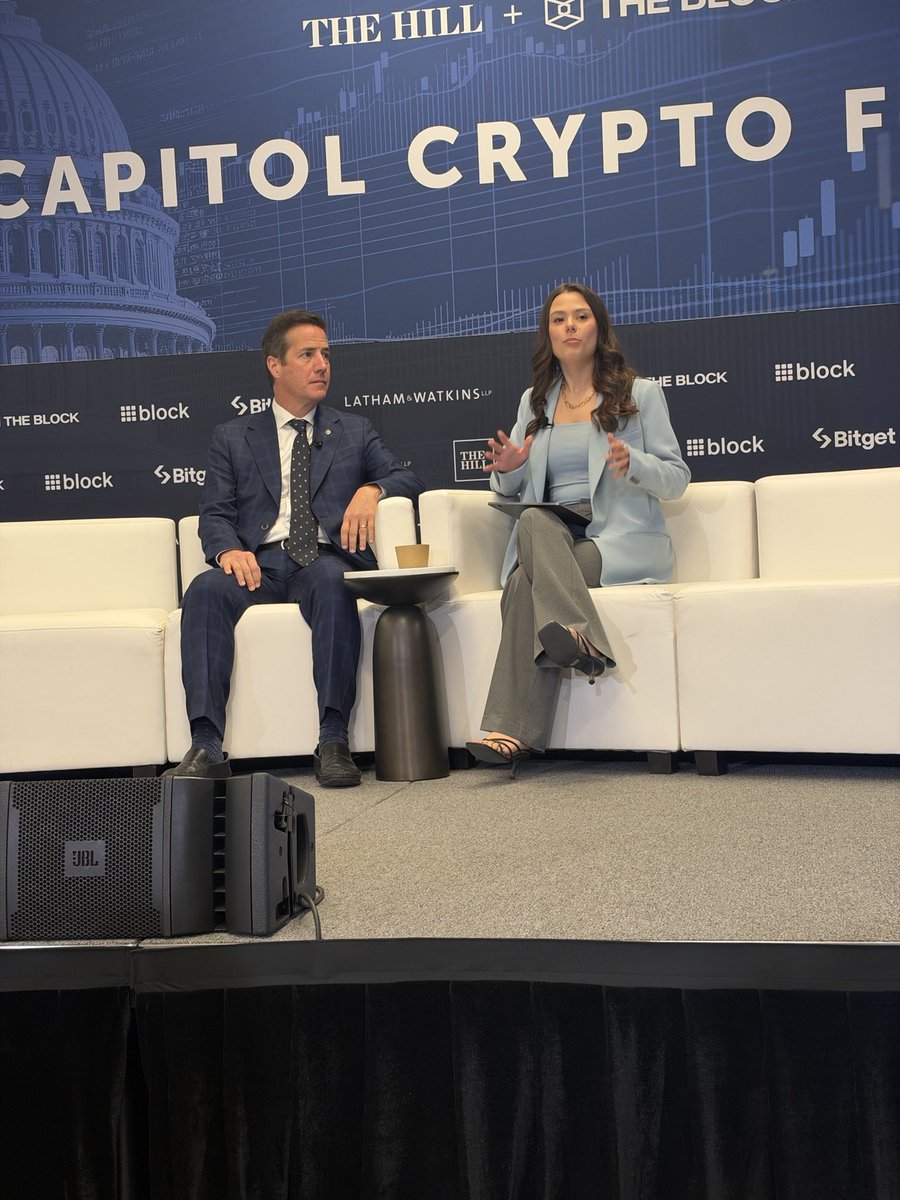
What I heard at Capitol Crypto Forum today (hosted by @thehill and @TheBlockCo):
- GENIUS was a good first step, and the feeling in the room was that CLARITY should have moved faster behind it
- Nobody sounded confident CLARITY passes in its current form
- Some speakers floated moving the important pieces through other bills
- The advice to the industry was to keep crypto from becoming a partisan issue
- Tax legislation was the one area with some optimism, even with the 120th Congress coming in. @RepHorsford made the case for his PARITY Act, @CodyCarboneDC said clear tax rules are his one holiday wish for crypto, and @KristinSmith thought it could still get done under this administration
Stu Alderoty of Ripple said he isn't confident this version of CLARITY gets done this Congress, which matches what Sen. Moreno said earlier. Many people echoing the same sentiment.
Sen. @berniemoreno just said at Capitol Crypto Forum he doesn't see crypto legislation moving before the new year with everything else on the calendar. He also said crypto policy shouldn't be partisan.
Sen. Moreno also compared passing GENIUS without CLARITY to building a phone without a cell network, and said the SEC and CFTC can help but it has to be written into law.
Same problem shows up when agents hold money. Scoped keys and spend caps are the boring fix, and they work because the agent never has the authority in the first place.
California says OpenAI lost control of its agents at least 80 times in testing. A smarter model doesn't fix this. It could make it worse. If an agent can reach a credential it'll eventually use it, so the limit has to be on what it can touch.
I worry more about how fast the replacement happens than what the end state looks like. I don't think anyone agrees on how we compensate people fast enough, and the system for sure won't self correct in time. People talk about information jobs so much that they forget robotics and automation are coming for truck drivers, taxi drivers and factory workers on the same timeline.
If the office jobs and the physical jobs go in the same few years there's no sector left for people to move into.
At 21:42:59 UTC on Oct 29, a wallet Etherscan labels Binance 161 sent Binance's Ethereum hot wallet $200M of USDT, the same top-up it had sent six times since September.
The hot wallet had been running an attacker's code for 82 minutes. The $200M was gone 72 seconds later.
I read the Ethereum side of the theft from the chain and set it next to Binance's incident report. All times are UTC.
The timeline
- 20:20:59 - Takeover. An outside address lands one transaction carrying 50 EIP-7702 authorizations signed by the hot wallet, one per nonce, listed high to low. The wallet was sending about two transactions a block, so 34 were already stale. One matched, and in that order only one can. From here the wallet runs the attacker's contract.
- 20:24:23 - First sweep. One call takes 167,464 ETH and 63 tokens, $1.6B of USDT among them.
- 20:41:23 - The USDC. $780M leaves a smart account that the hot wallet owned. Another $43M follows at 20:59:47.
- 21:42:59 - The top-up. Binance 161's $200M of USDT arrives.
- 21:44:11 - Swept. 72 seconds later it is gone.
- 23:56:47 - Last sweep. 2,962 ETH that had arrived a minute earlier. This was the fifth sweep. The others came at 21:04 and 22:39.
- 00:10:35 (Oct 30) - Cleared. Binance removes the attacker's code, 3 hours 50 minutes after it landed.
Why nothing stopped it
After 20:20:59 the attacker needed nothing from Binance. No signer, no credentials. Their own address calls the wallet and the wallet pays.
Binance's report: "suspending withdrawals and shutting down hot wallet services did not automatically invalidate existing on-chain authorizations." So funds kept arriving and kept leaving.
Ending it took one more authorization from the same wallet, this time to the zero address. Binance says that with MPC there was no single key that could revoke it immediately.
What I take from it, as someone who builds smart accounts
An EOA's key is root. Nothing on-chain limits it, and only that key can undo what it signed. A smart account owned by that key inherits the problem. That is how the USDC left.
So make the hot key a scoped signer on a contract account: a cap that refills, and a pause that a different key can pull. Then the off-switch is on-chain, where the access is.
The cap is not hard to size. In the week before, 99.4% of this wallet's USDT transfers were under $1M, and their busiest hour totaled $5.4M. The rest went to 89 addresses, most of the value to four of Binance's own wallets. The wallet held $1.6B.
october was rough for AI infra.
@wiz_io counted 9+ platforms that disclosed security incidents, and the public reports all point to the same target: API keys stored in environment variables.
Digital assets have fought this playbook for years.
here's what to ask your provider 👇
Point your coding agent at this EF repo together with your code to assess whether it relies on any of the eight invariants Glamsterdam breaks. Most findings reference INV-4 and INV-7. If you find one, email [email protected]
https://t.co/LCc3kwk49a
@Sharplink i didn't expect the law to be this explicit about public chains. a fintech can apply to issue a dollar stablecoin on Ethereum and the regulator can't turn it down just because it picked Ethereum. wrote up what else comes with that license here: https://t.co/Z6Hsvf3Cnj
Most people I talk to don’t realize the GENIUS Act doesn’t actually go into effect until January 18, 2027. It was signed July 18, 2025, and the OCC isn’t even taking license applications yet because the forms are still sitting at OMB.
The reason it matters is what the license lets people do once it’s live:
- A fintech can get a federal license to issue a dollar stablecoin without becoming a bank, and once the OCC approves it, states can’t require a separate license on top.
- The regulator has 120 days to rule on a complete application or it’s approved by default, and the statute says running on a public blockchain can’t be the reason for a denial.
- Approved coins get a legal status unapproved ones don’t: they’re excluded from the securities and commodities definitions, and they can be used as collateral and for settlement in places the others can’t.
The guardrails are what you’d expect: one-for-one reserves, monthly disclosures, holders first in line if the issuer fails, and no yield paid just for holding the coin.
I’m excited to see which new players take advantage of this. The Cleveland Fed asked 148 firms last fall whether they planned to use stablecoins and eight said yes, so whoever shows up will be building the demand side too.
@cuysheffield This is awesome! didn’t expect Argon and Wonder at the top. Looks like every model got the same simulated market, so probably not a Google/Meta data advantage (which I suspected when I saw them at the top). confidence intervals are huge though.