My paper w/ @austinbishop on manufacturing—how we lost it and how to get it back.
Thanks to @arc_forum for publishing it ahead of its conference this week!
The West has been sleepwalking into a deindustrialised abyss, outsourcing our ability to produce things, thereby outsourcing our sovereignty.
Here are the results of the Globalisation experiment we've run over the last few decades:
- Our cities have rusted over and factories mothballed.
- Our young people, out of gainful work, are starting families less and succumbing to deaths of despair more.
- Our civic cohesion has dwindled as small town businesses have consolidated into large corps.
- Our deterrence abilities against aggressor nations, who now control much of our supply chains, is on thin ice.
In this new ARC paper, @austinbishop and @blakeseitz argue that it is time to reindustrialise - and set out the choices we face if we are to rebuild and renew.
Read the paper here: https://t.co/JW9plYxG4N
It was always foreseeable that a 250th birthday celebration that was based on celebrities would fail to unite the country, we can't do another Kid Rock concert.
The plan should be to incorporate people and symbols that are uncontroversial. Military bands, non-famous choirs and singers from red states (texas A&M choir or something), set against patriotic backdrops (mt. Rushmore, Mt. Vernon, west point, gateway arch, grand canyon, gettysburg, etc.). Trump's SOTU had this right, honoring war heroes and the olympic hockey team.
Set off insane amounts of fireworks at all these places. Crazy flyovers, blue angels, etc. Have some historical reenactors act out famous scenes, like Appomattox.
They idea would be to max out on quality and spectacle while making it as normie-friendly as possible. Force the media to be mad that you trotted out every living medal of honor winner.
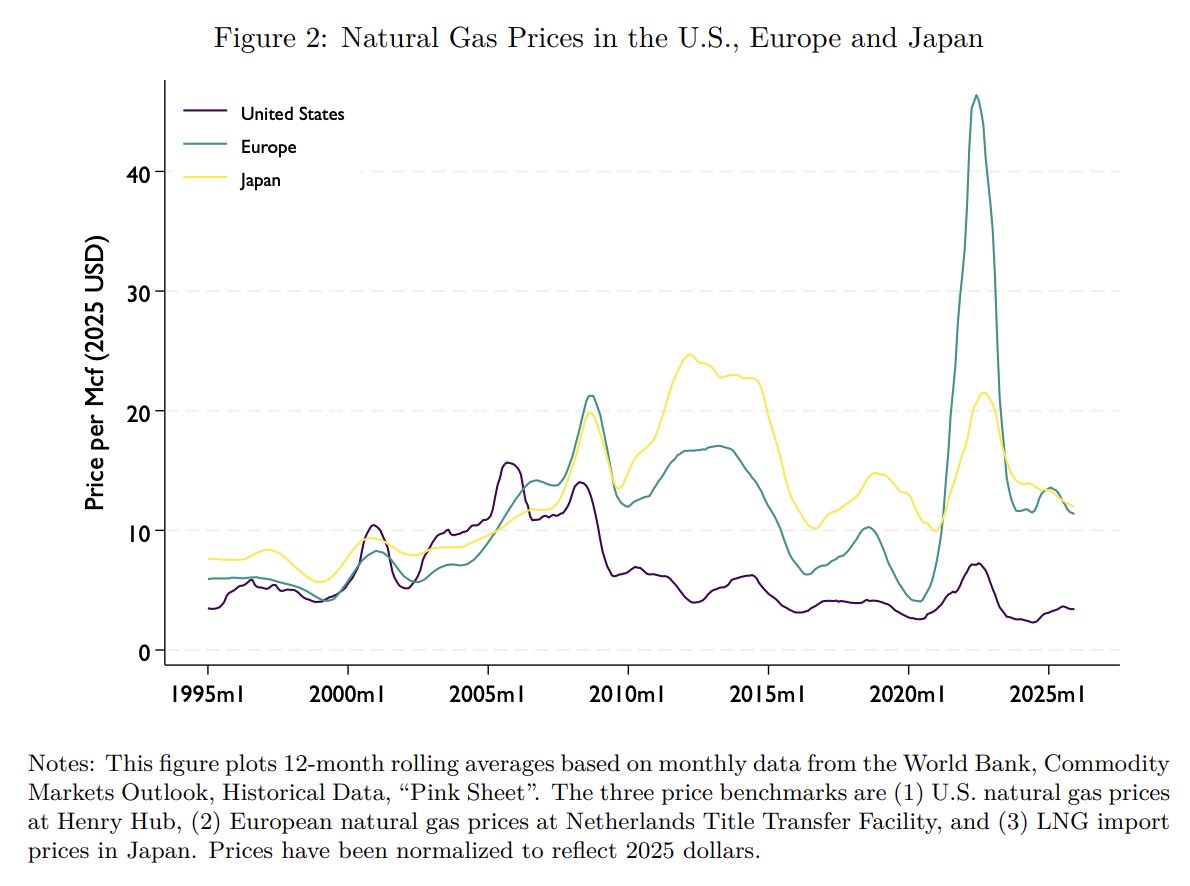
The United States is the world's largest exporter of natural gas — a remarkable change from decades ago, when America was dependent on the often-hostile OPEC nations for its energy needs. That's probably saved us as much as $4 trillion in the past two decades.
That change is largely thanks to the "Shale Revolution," the development of fracking and horizontal drilling technology that is now responsible for 36 percent of total U.S. production.
In a new @nberpubs paper, Berkeley's Lucas W. Davis uses data on gas prices in the United States, Europe, and Japan to estimate the savings generated by the Shale Revolution.
The effect is obvious in the plot below: Starting in 2007, American prices diverge sharply from Europe and Japan. We're also more insulated from big shocks.
He pegs the total as between $3.1T and $4.3T between 2007 and 2025. That's $164B to $227B per year — between $500 and $700 per person per year.
https://t.co/brNtqmz2AS
Sidestepping the question but Pilate is such a great literary character. Vain, irritated, prickled by a conscience he thought he long killed, projecting power while knowing it’s really a powder keg. “What is Truth?” as both cynical realpolitik & a genuine inching toward the light
We in the West face a stark reality: our weapons are expensive and scarce. Our adversaries' are cheap and plentiful.
The race is on to correct this imbalance and build the arsenal of the future. The question is, who will build it?
In today's article, @BlakeSeitz assesses the ongoing cold war between legacy defense firms and new entrants—including startups born under existential conditions on the battlefields of Ukraine. This conflict, more than any other, shows the qualities that will determine whether companies sink or swim in the coming years:
⏩ "The firms that win will have to earn it through speed, the ability to iterate, and the ability to ship product in the quantities and at the price point that Western governments demand."
So far, the defense-tech cold war is mostly a war of words and propaganda, as companies try to position themselves as the wave of the future—and do down their competitors. But a reckoning is fast approaching. Dollars are being allocated, contracts are being signed, and trials are being held.
Who is winning the defense tech cold war? Read the piece and us know what you think. 👇
https://t.co/8BTBwBaaGT
The U.S. military knew that cheap drones were a threat well over a decade ago.
Today's guest authors, Jarrett Lane and Dominic Ventimiglia, simulated adversary attacks on U.S. bases for CENTCOM from 2015-17.
Drones quickly became one of their go-to tactics. But too many were slow to appreciate the threat:
"In our experience, the idea of using cheap drones to degrade or dismantle critical capabilities was typically met with one of three responses. The first was incredulity. To some, drone attacks posed a nominal force protection problem because they were crude and usually unsuccessful. There was little appreciation that new forms of warfare usually begin crudely. The second response was dismissal. Drones could be easily dealt with by shooting them down or taking out the operators. The third response was acknowledgement that drones were a problem—but that they were somebody else’s problem to solve."
How can the Department avoid getting caught flat-footed again? Better red teaming, better feedback loops—and a shift in mindset that treats threats seriously even when they're small and speculative.
Read, share, and let us know what you think in the replies. 👇
https://t.co/reyzCfKAZz