Žádná jiná generace nedala Česku víc, než ta moje. HDP na hlavu v USD jsme zpětinásobili. Nikdo jiný nikdy tuhle zemi takhle nepozvedl. To, že některé nezvedené děti to nechápou, na realitě nic nemění. Krásný víkend všem, r
Min Tesla har nu været selvkørende i 2 uger.
Hvordan er det gået?🚗
Jeg har kørt med teknologien i +1000 km nu (Flere gange mellem Århus og Kbh).
Konklusion:
Jeg rører ikke rattet mere. Bilen kører helt selv.
Læs lige den sætning igen.
En teknologi vi har set i science fiction-film, kan man nu få til sin egen bil.
💰Ulempen er prisen💰
Teknologien koster 750 kr. om måneden.
Det er en høj pris at betale - især når man stadig skal være 100% opm��rksom under kørslen.
🚨Hvor mange fejl har den lavet?🚨
Bilen har lavet 0 kritiske fejl.
Få gange måtte jeg trykke på speederen, hvis bilen har kørt for langsomt.
Og en gang kunne den ikke finde vej pga vejarbejde.
Men kun små fejl - intet alvorligt.
🚗Tør man lade bilen køre selv?🚗
Ja. Jeg vendte mig til det efter første køretur.
Den kører behageligt og “menneskeligt”.
Alt i alt er det en dybt fascinerende teknologi, der giver os et indblik i den chaufførløse fremtid, som er lige om hjørnet.
🤖Følg mig hvis du vil være på forkant med AI🤖
Next countries to approve FSD in Europe might have been revealed:
FSD V14.2.2.6 - 2026.17.5 is showing up in 2 new countries: Spain🇪🇸 and the UK🇬🇧.
Is this a sign that these countries will actually be the next? We have seen a similar scenario with Estonia🇪🇪 and Belgium🇧🇪 before
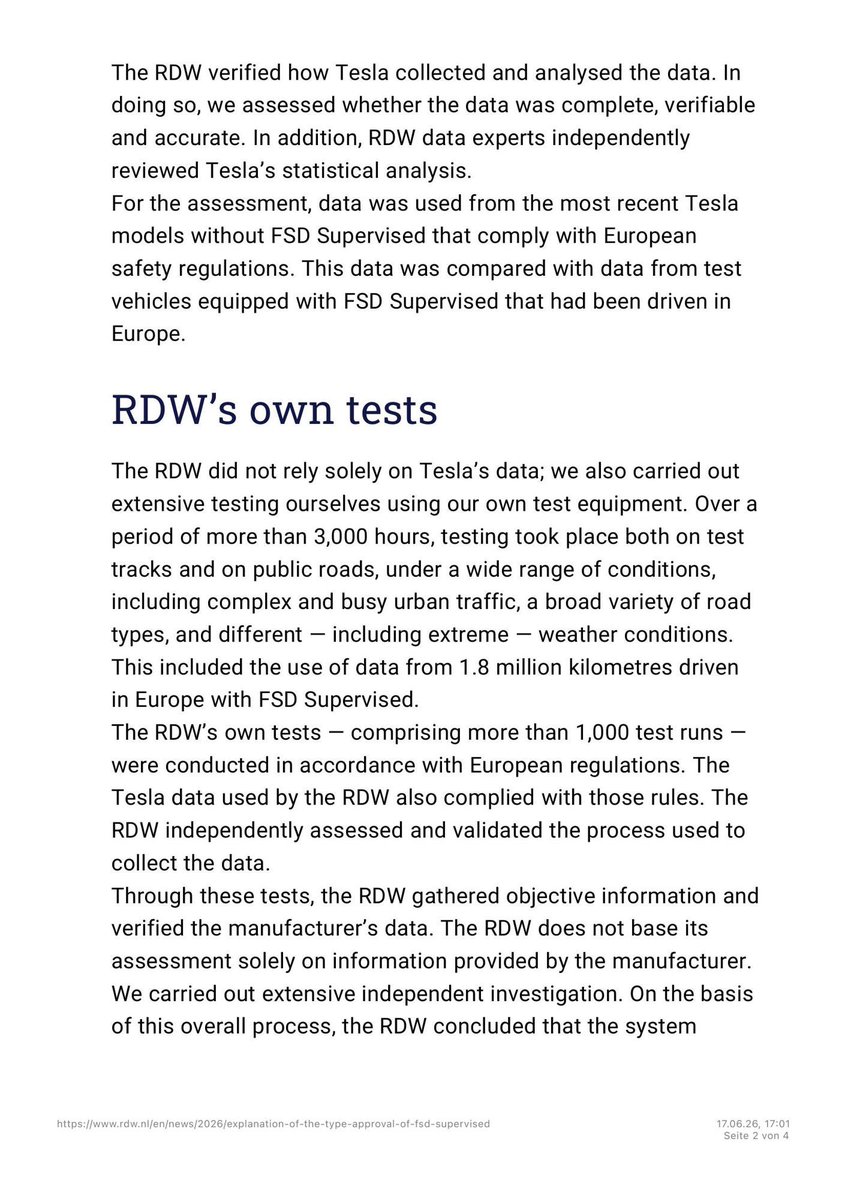
🇳🇱⚡ The Netherlands just dropped the full breakdown on Tesla FSD Supervised approval after ETSC (European Transport Safety Council) raised concerns about the approval process!
RDW didn’t just rubber-stamp it, they went hard:
✅ 3,000+ hours of independent testing (test tracks + real roads, every weather & traffic condition)
✅ 1.8 million km of European FSD data analyzed
✅ 24 MILLION km driven by ~40,000 Teslas in NL since approval
✅ ZERO relevant incidents
Safety-first: More advanced than normal ADAS + constant driver monitoring = at least as safe as current systems. Vetted for 18+ months.
Europe is actually moving on supervised autonomy 🔥
Source: https://t.co/2FKeQ9I0C0
#Tesla #FSD
This is eye-opening. German carmakers used to subsidize opaque, union-protected structures at home with profits made in China. Not anymore.
How will German unions compete with Chinese automotive dark factories run 24/7 by robots?
Most Germans don’t understand what’s coming yet.
Jedna otázka pro Ministerstvo dopravy:
Proč může Dánsko převzít nizozemské schválení Tesla FSD Supervised a Česko ne? 🇩🇰🇨🇿
Nechci frázi „bezpečnost“.
Chci konkrétní odpověď:
– právní překážku,
– technický problém,
– rozdíl českého provozu,
– nebo jasné vysvětlení, proč jiné státy EU postupují jinak.
Pokud ten důvod existuje, ať ho stát ukáže.
Pokud ne, ČR má převzít nizozemské schválení stejně jako ostatní.
Petice tady 👇
https://t.co/WYizMk8pjd
🔥🇪🇸 Spain is reportedly planning to approve Tesla FSD (Supervised) on June 30! 🇪🇸 👀
The country has been testing the system since November with a small fleet of roughly 19 to 30 vehicles, covering at least 80,000 km (~50,000 miles) of driving.
Europe’s regulators aren’t protecting you from Tesla.
They’re protecting themselves from irrelevance.
The painfully slow approval of Full Self-Driving in Europe isn’t about safety. It’s about incentives.
Regulators’ entire existence depends on the public believing they are the ones who “keep everyone safe.” If they approve FSD quickly, they have to admit something uncomfortable: Tesla has already done the real work.
Billions of miles of real-world validation on Cortex. Over 10 billion miles driven in the United States. The system has been stress-tested at a scale no government lab could ever replicate. The data is overwhelming.
So what do regulators do? They invent new hoops to jump through. They demand tests that are orders of magnitude less rigorous than what Tesla has already completed. Why? Because if they don’t, they have zero visible “added value.” And zero added value means zero justification for their budgets, their jobs, and their authority.
They cannot simply say: “Tesla has already solved this better than we ever could.” That would be career suicide. It would expose that they are, at best, redundant — and at worst, actively slowing down safer roads for millions of Europeans.
So they delay. They nitpick. They posture. Not because FSD is dangerous, but because admitting it isn’t would threaten their own livelihood.
This isn’t regulation. It’s institutional self-preservation dressed up as public protection.
The longer they stall, the clearer it becomes: Europe’s biggest obstacle to safer autonomous driving isn’t the technology. It’s the people whose job it is to approve it.