An L2 that held $2.26B earned $110 in a day.
Blast peaked at $2.26B in deposits on 6 June 2024. In the 24 hours before it announced its shutdown, the chain earned $110. Base, Arbitrum and Optimism now take roughly 80% of all L2 sequencer fees. Base alone takes about 62%.
On 2 October Blast said its costs exceed its revenue. Kinto closed before it. We asked a smaller question: what did these chains pay for, and what did they forget to pay for?
What exists. An L2 has one income: the gap between the fees its users pay and what it pays Ethereum for data. Blast bought its start with points and native yield, and the deposits came. Deposits are not revenue. When the points ended, $2.26B became $32M and the fee line became $110.
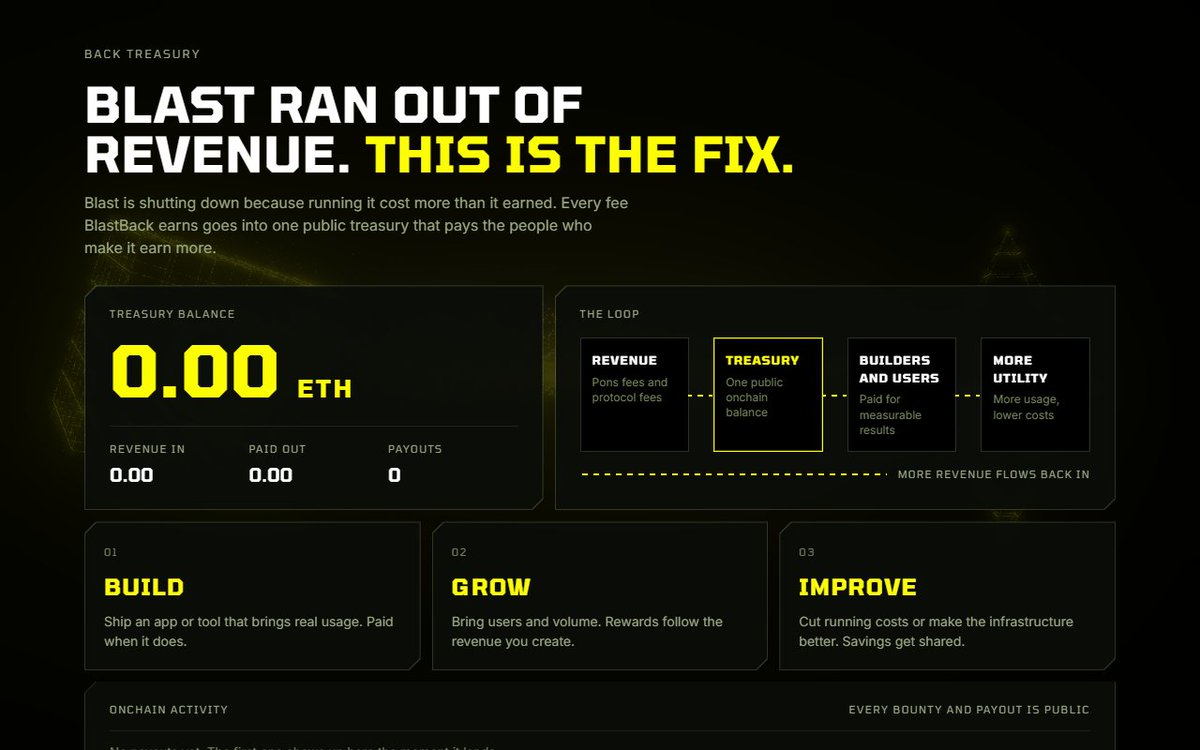
What we built. BLASTBACK has two halves. The exit: a scanner that finds what a wallet left on Blast before 26 October. And the Back Treasury: one public onchain balance that every fee flows into. It pays for three things only. Build, Grow, Improve. The first revenue line assigned to it is Pons launch fees.
How the loop works. Revenue goes into the treasury. The treasury pays builders and users for measurable results. Those results bring more usage and lower costs, and that revenue flows back in. Every payout is public onchain.
Why this way. Points paid people to arrive. Nothing paid them to make the chain earn. The treasury can only spend what the system has already earned, and only on what makes it earn more. Next come the treasury address, the first inflow, and the first public payout.
https://t.co/zvGPFYdW5V
Each dot is about $0.9M. The tank fills to $2.26B by day 98. Sixty days later it is under $1B. 381 days after the peak it is under $100M. Today it holds $32M.
Real daily numbers from DefiLlama. BLASTBACK starts where the replay ends.
Introducing Backshots.
Blast kept its revenue until there was none left to keep.
BLASTBACK sends a share of its fees back to the people holding it. Fees come in. Backshots go out. Every one is public onchain.
Hold it. Get paid back.
Blast paid people to arrive. $2.26B came. In its last full day the chain earned $110.
The Back Treasury pays for the other thing.
Build: an app that brings usage.
Grow: users and volume.
Improve: lower running costs.
Revenue in, payouts out, all public onchain.
https://t.co/zvGPFYdW5V
BLASTBACK is live on Pons, on Robinhood Chain.
Blast is closing because it spent more than it earned. Launch fees from Pons go into the Back Treasury: one public balance that pays for usage, growth and lower costs.
CA : 0x0254207ea6658a8f9daf1eae0c120796b317ded6
Today we announced that we’re winding down Blast.
I’m disappointed that we weren’t able to make the chain sustainable over the long term, but I’m grateful to the users, developers, and teams who helped give Blast its moment, even if its run was shorter than we had hoped.
Our priority now is making the wind-down as smooth as possible. Please see the official announcement below for withdrawal instructions and timelines.
Blast will be shutting down.
We launched Blast with the goal of building a self-sustaining chain for users and developers. Unfortunately, the economics of operating the chain no longer make sense: the ongoing costs of maintaining Blast exceed the revenue generated by the L2, and we do not see a credible path to making the chain economically sustainable.
As a result, we've made the difficult decision to wind Blast down.
We're sorry to the users and developers who believed in Blast, built on it, and supported the ecosystem. Our priority now is making the shutdown as smooth and safe as possible.
We're asking all users to withdraw their assets from Blast to Ethereum mainnet, including any balances held in the Blast PWA.
To make this easier, we will be reducing the withdrawal delay to 24 hours.
As part of the shutdown process, we'll first begin withdrawing Blast's Lido assets. This process is expected to take approximately one week. During this period, withdrawals will temporarily be unavailable, even after the withdrawal delay is reduced to 24 hours.
Once that process is complete, withdrawals will resume with the new 24-hour delay.
Users will have until October 26, 2026 to withdraw through the normal Blast interface.
After October 26, assets will remain withdrawable, but users will need to interact directly with the Blast bridge contracts on Ethereum L1. We'll publish detailed instructions before then.
We strongly encourage everyone to withdraw their assets to Ethereum mainnet before October 26.