A paper on land use change modelling without a single map in it: IMPOSSIBLE!
Well we did it with our latest article in Environmental Modelling & Software in which we highlight the benefits of thinking outside the 'status quo' for model calibration: https://t.co/U7Ze7Lwi8g
A 🧵
🌍 Our new research shows that climate policies have had a real impact in reducing GHG emissions, scaling up renewables & energy efficiency, & protecting forests. While current policies are far from sufficient, they put us in a much better position compared to a world w/out them
HI @Eurostar I requested a bicycle reservation for an upcoming trip via email 9 days ago. It would be great to have a response so I can plan subsequent travel. Surely it can't be that hard to confirm?
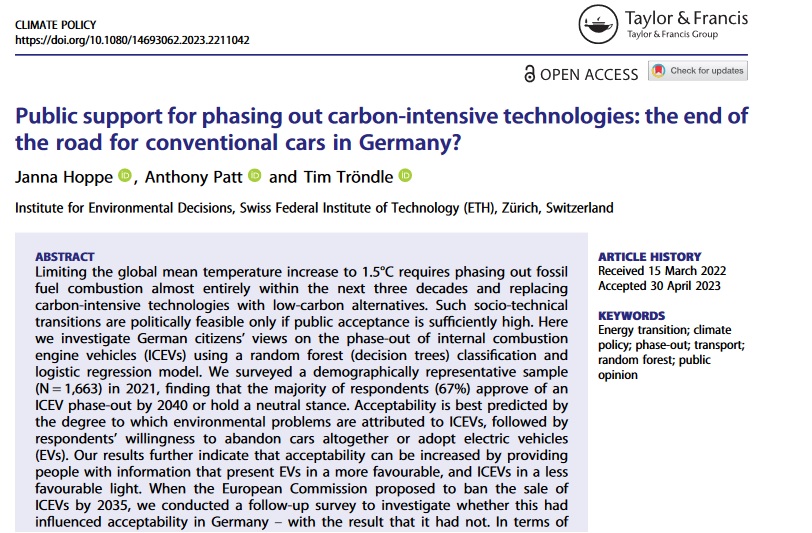
Finally out: An investigation into public support for phasing out conventional cars (ICEVs) in Germany - finding that many people are in favour of phasing out ICEVs completely by 2040.
Good news? Well, yes and no. 🧵👇
@awunderground@rstatstweet@posit_pbc What changes it makes do you find annoying? I have found when switching between source and visual editor views it changes html <div>’s which can break the code. Wonder if it is possible to turn off this feature?
@matloff@adamTford Thanks for a good read with very succinct points esp. re: vectors. I began with an intro to R course that only taught Tidy but since branching out on my own I use 99% base R, however I want to at least know/understand the Tidy dialect too.
@mukesh_ray@rstatstweet But as others have mentioned, depending on your operation/operating system parallelisation might not result in big benefits because of the overhead time, especially on Windows which is not capable of forking.
@mukesh_ray@rstatstweet I compared multiple parallelisation packages in R and by far the easiest to get start with is the future package and the family of future_apply functions. In your case perhaps applying over a list of rasters or layers in a stack?
@researchremora@rstatstweet Nice! I’m just getting started with rayshader, I’m struggling with lighting in the final scene with render_highquality. Have you posted your code for this?
@moaziz_tweets @JUrbina10@rstatstweet This is a base R solution, I find it helpful to understand these before jumping into the tidyverse because then you can do both.
@moaziz_tweets @JUrbina10@rstatstweet Regex <- paste(“pattern1”, “pattern2”, collapse = “|”)
DF$new_column <- sapply(DF$old_column, function(x) grep(x, Regex, value = TRUE))
Others could probably make it even neater/shorter.
@mammaldreams@rstatstweet All scripts named numerically with a master script that calls them with source() (useful if sharing alongside a research paper). Git for version control. I think using collapsible code sections to organise tasks within scripts really improves readability: https://t.co/EPfKJO9LoD
As a PhD I often feel pressure to be pursuing research goals which can lead to neglecting other learning. Today, I took the time to go through a great resource on version control with GitHub from @ResulUmit: https://t.co/REoD4OE0KY. I will be recommending this to all colleagues!
10/10 Big thanks to all collaborators who helped in this project!
All analysis was conducted with #RStats and because #OpenScience is the way to go, data and code will be available here: https://t.co/8EgzDPummJ
Next up: Future land use simulations for Switzerland 🇨🇭 until 2060
A paper on land use change modelling without a single map in it: IMPOSSIBLE!
Well we did it with our latest article in Environmental Modelling & Software in which we highlight the benefits of thinking outside the 'status quo' for model calibration: https://t.co/U7Ze7Lwi8g
A 🧵
9/10 We suggest that what is needed is a universal protocol for the calibration of statistical models as part of CAs that is generalisable across the popular software applications. Encouraging more consideration of direct validation without overwhelming practictioners ⚖️