In the crypto space, you’ll often see people say, “I’m cooked.”
Translation?
I ignored the risk, and now I’m paying for it.
Every crypto native knows exactly what it means.
A trader apes into a narrative because everyone else is.
A token is “guaranteed” to moon.
An influencer calls it the next big thing.
The timeline fills up with conviction, rocket emojis, and certainty.
A few days later?
“I’m cooked, chat.”
Most people don’t end up cooked because information was unavailable. They get cooked because they trusted noise over substance.
They followed confidence instead of credibility.
They confused popularity with proof.
And that’s a problem that goes far beyond trading.
The same pattern shows up in content.
In Web3, attention has become a currency, but the systems rewarding it still feel outdated. Marketing budgets often flow to the biggest accounts instead of the creators producing the most valuable insights. Engagement gets inflated. Threads get copied. Generic takes spread faster than thoughtful analysis simply because someone has a larger audience.
The loudest voices win. The best ideas don’t always get seen.
@RallyOnChain is solving exactly that.
As the first decentralized, AI-powered marketing protocol built on GenLayer, Rally changes what gets rewarded. Instead of asking, “Who has the biggest audience?” it asks a far more meaningful question:
Who creates content that’s actually valuable?
Anyone with an X account can participate. There are no gatekeepers, approval lists, or follower requirements. Pick a campaign, create your content, and submit it.
Rally’s intelligent contracts then evaluate every submission transparently based on quality, accuracy, originality, relevance, and real engagement, with rewards distributed on-chain.
It’s a major shift from traditional influencer marketing, where reach often matters more than substance.
Influence has always had value. The problem is that the people creating real influence haven’t always been the ones rewarded for it.
So whether you're trading markets or creating content, the lesson is the same.
Ignore quality.
Ignore accountability.
Ignore the signals that matter and sooner or later, you'll end up Cooked!!
GENLAYER’s OPTIMISTIC DEMOCRACY;A Thread 🧵
One of the most important concepts behind GenLayer is Optimistic Democracy.
A consensus mechanism designed for a world where transactions are no longer simple calculations, but complex decisions involving AI models, web data, and real-world information.
Traditional blockchains excel when every participant can arrive at exactly the same answer. However, Intelligent Contracts often interact with dynamic web data and AI systems, where outcomes may be uncertain and different models can interpret information differently. This creates a challenge that traditional consensus mechanisms were never designed to solve.
GenLayer addresses this challenge through Optimistic Democracy.
🔖Consensus: The Mechanism
At the heart of Optimistic Democracy is consensus. Rather than trusting a single validator, AI model, company, or authority, GenLayer relies on a diverse group of validators to independently evaluate transactions and vote on outcomes.
The idea is simple but powerful: a group of independent reasoners is often more likely to arrive at the correct answer than any single participant acting alone.
By combining these independent judgments, the network reaches a collective decision that becomes the accepted outcome. Consensus is therefore the mechanism that secures GenLayer and enables decentralized decision-making at scale.
🔖Reasoning: The Process
Unlike traditional blockchain systems that primarily execute predefined rules, GenLayer introduces reasoning into the validation process.
Validators use AI models to analyze information, interpret context, evaluate evidence, and form independent conclusions about a transaction. This allows Intelligent Contracts to interact with real-world information while still maintaining decentralized verification.
Reasoning transforms validation from a purely computational task into a process of informed judgment.
🔖Validation: The Action
Every transaction submitted to GenLayer undergoes validation.
A randomly selected validator becomes the leader and executes the transaction, proposing an outcome. Other validators independently perform their own evaluation and compare their findings against the leader’s proposal.
If a majority agrees, the transaction is accepted and enters a temporary finality period.
This process ensures that no single validator has the power to dictate outcomes. Every result must withstand scrutiny from multiple independent participants before being approved.
🔖Adjudication: The Purpose
The ultimate purpose of Optimistic Democracy is adjudication.
As AI agents become increasingly capable of making decisions, conducting business, and interacting across the internet, disputes and uncertainty become inevitable. Someone or something must determine what is correct.
GenLayer acts as an adjudication layer for the agentic economy.
Instead of relying on a central authority, courts, corporations, or individual AI models, judgments emerge from a decentralized network of validators that collectively evaluate evidence and reach decisions through consensus.
This creates a system capable of resolving ambiguity while remaining transparent and decentralized.
🔖Trust: The Outcome
Trust is not assumed within Optimistic Democracy. It is earned.
Every decision is backed by independent validation, transparent consensus, and a structured appeals process. If participants believe an outcome is incorrect, they can challenge it during the finality window, triggering a new round of evaluation involving a larger validator set.
Each appeal increases the level of scrutiny, making it progressively more difficult for incorrect or malicious outcomes to survive.
Through this combination of verification, transparency, and accountability, trust emerges naturally from the process itself.
@RuzgarFlns
Think you know Seismic inside out? This is your chance to prove it.
The Seismic Quiz Competition is here, bringing an exciting opportunity for community members to put their knowledge to the test and compete with fellow enthusiasts.
Date; Monday 8 June 2026
Time ; 3 pm
Venue; https://t.co/lCKEWi0uH1
Note that once the questions drop, there’s no catching up.
So get ready, stay sharp, and show the community what you know.
Gmic Y’all!
@heathcliff_eth@NoxxW3@xplanettt@xealistt
I finally gave @FUDmarkets Mainnet a try. I deposited funds,opened a position and spent some time exploring the platform to see what the experience actually feels like.
My biggest takeaway?
Simplicity.
Unlike many trading platforms that throw endless charts and settings at you, FUD Markets keeps things straightforward. Pick a market, choose a direction, and back your conviction.
What I liked most was how easy it was to get started. Within minutes, I understood the flow and was actively participating. It feels less like traditional trading and more like putting your market opinion to the test.
It’s exciting to see how prediction markets are evolving and how simple the user experience can be.
If you haven’t tried it yet, I’d recommend giving it a shot and seeing how your market predictions stack up against everyone else’s.
Who’s already tried FUD Markets? What was your experience?
@RuzgarFlns
@Logane@GenLayer Genlayer is building the infrastructure that could allow AI agents to interact, coordinate, and operate in the real world with a shared framework for trust.
The Adjudication Layer For The Agentic Era.
The internet is rapidly moving toward an agent-driven future.
AI agents are beginning to research, negotiate, transact, execute tasks, and make decisions on behalf of users. But as these autonomous systems become more capable, a new challenge emerges:
What happens when there isn’t a clear right or wrong answer?
This is precisely the problem GenLayer is designed to solve.
GenLayer is positioned as the adjudication layer for the agentic era,a new category of blockchain infrastructure designed to resolve questions that require judgment, interpretation, and reasoning, not just deterministic code. Unlike traditional blockchains that reach consensus on transactions or computations, GenLayer aims to reach consensus on meaning itself.
To understand why this matters, consider how most blockchain systems work today. Smart contracts are excellent at handling objective conditions. If a wallet contains a certain amount of funds, a transaction executes. If a predefined condition is met, a payment is released.
But the real world isn’t always objective.
Questions like:
📍Was a freelancer’s work completed satisfactorily?
📍Did an AI agent fulfill its assigned task?
📍Does a piece of evidence support a claim?
📍Has a contractual obligation been reasonably met?
These aren’t binary decisions. They require context, interpretation, and judgment. Traditional smart contracts struggle with these scenarios because they were never designed to handle ambiguity.
GenLayer’s answer is Intelligent Contracts, Contracts that can process natural language, analyze unstructured information, access live internet data, and evaluate subjective outcomes through decentralized AI-validator consensus. Instead of relying on a single authority, multiple validators independently assess a situation and work toward a consensus-driven verdict.
In many ways, GenLayer is building a missing piece of the AI economy.
Today, we’re seeing rapid progress in payments, identity systems, agent communication protocols, and AI infrastructure. Yet most of these systems assume everything will go according to plan. The moment a dispute arises, a promise is contested, or an outcome becomes subjective, there is often no native mechanism for resolution.
GenLayer is designed to fill that gap by providing a decentralized adjudication layer capable of evaluating evidence, interpreting commitments, and reaching trusted decisions at machine speed.
What makes this particularly interesting is that it aligns with where technology is heading.
As AI agents become economic participants rather than simple tools, they will need a way to establish trust with one another. Payments alone won’t be enough. Execution alone won’t be enough. Autonomous systems will need a framework for resolving disagreements, verifying outcomes, and enforcing commitments in situations where reality is messy and subjective.
That’s the future GenLayer is building toward.
Bitcoin introduced trustless money.
Ethereum introduced trustless computation.
GenLayer is pursuing trustless adjudication.
A system where autonomous agents, businesses, and individuals can rely on decentralized consensus to resolve questions that previously required courts, intermediaries, or centralized authorities.
Crypto is slowly moving from speculation to actual financial infrastructure, and this latest move from Injective shows exactly where things are headed.
Native $USDC is now officially live on @injective , opening the doors for more than $77 billion in regulated stablecoin liquidity from @circle Internet Group to enter its ecosystem. This isn’t just about adding another stablecoin, It’s about unlocking a new era of onchain capital markets.
With native $USDC integrated directly into Injective, users can now access tokenized stocks, decentralized financial products, and even pre-IPO assets like @SpaceX through a more seamless and scalable infrastructure layer.
What makes this launch even more significant is the technology behind it. Circle chose Injective for its first-ever MultiVM deployment, allowing $USDC to move natively across both WASM and EVM environments without the usual liquidity fragmentation that slows down most blockchain ecosystems. That matters because one of crypto’s biggest infrastructure problems has always been disconnected liquidity.
Different chains, isolated environments, complicated bridges, and fragmented applications have made capital inefficient and user experiences clunky. Injective’s MultiVM architecture changes that dynamic by creating a more unified liquidity layer where developers, traders, and institutions can interact across environments far more smoothly.
The result:
• Faster liquidity movement
• Better capital efficiency
• More composable financial applications
• Easier access to tokenized real-world assets
And the timing couldn’t be more important.
The tokenization narrative is no longer just theory. Traditional financial assets are actively moving onchain, and the demand for trusted settlement infrastructure is growing rapidly.
By bringing native USDC directly into its ecosystem, Injective is positioning itself as a serious hub for the future of tokenized finance and global onchain markets.
This is bigger than a stablecoin integration.
It’s the groundwork for a financial system where stablecoins, tokenized equities, and interoperable blockchain infrastructure operate together seamlessly.
Powered by $INJ.
Trying to keep up with everything happening in the @injective ecosystem lately feels like blinking and missing an entire revolution 😅
That’s why I’ll always keep bringing the updates your way. Follow @injective so you don’t wake up one day wondering when finance quietly moved fully onchain.
If there’s one tokenomics model in crypto quietly outperforming the noise right now, it’s $INJ.
What you’re seeing isn’t just a chart moving upward, it’s a carefully engineered system designed to reward long-term participation in the ecosystem.
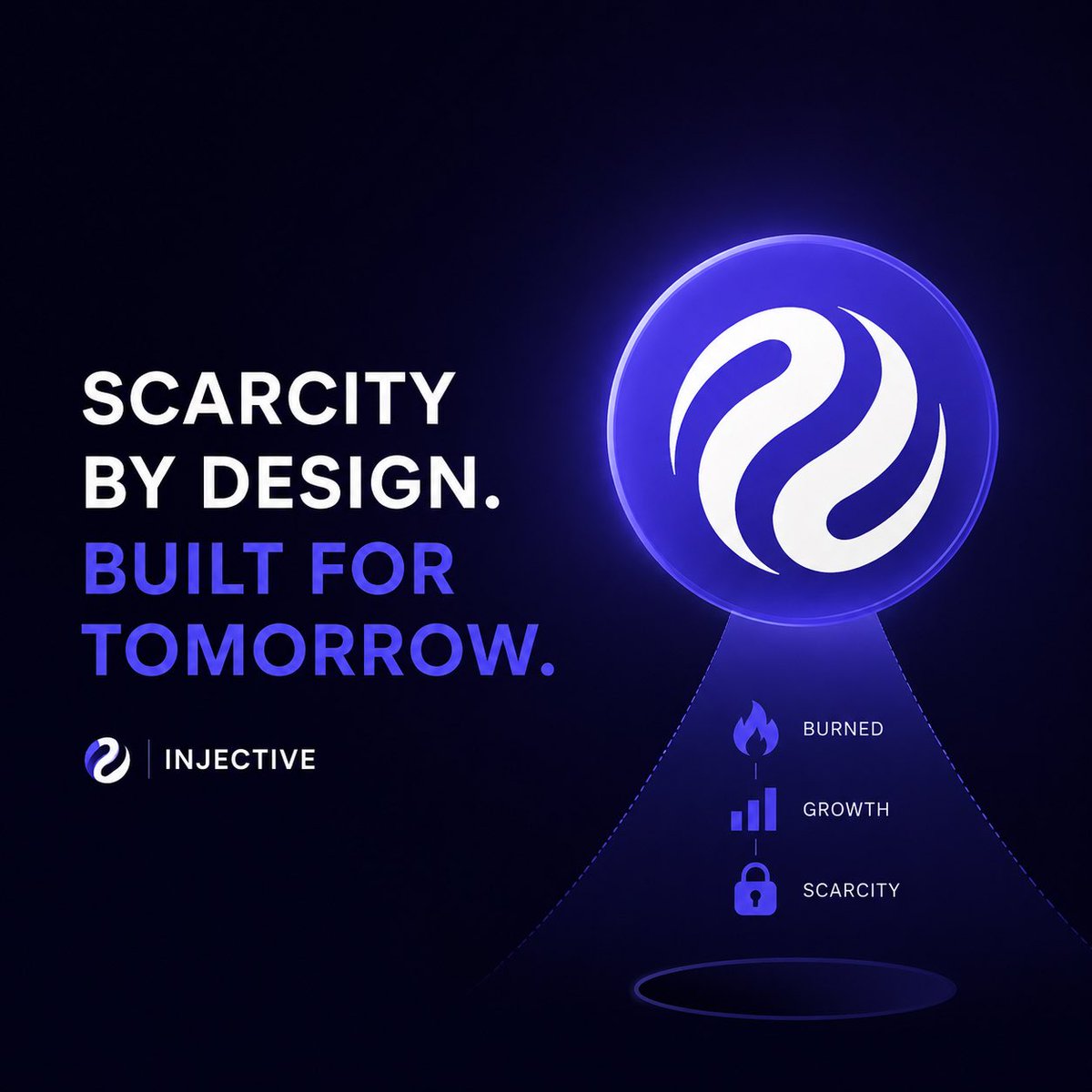
While many projects continue inflating supply and diluting holders, @injective took a completely different route: scarcity by design, and that changes everything.
The foundation is straightforward:
$INJ has a fixed maximum supply of 100 million tokens.
No surprise emissions.
No endless minting.
No changing the rules halfway through.
From day one, the cap was set, and it remains unchanged today. In a market where inflation has become the norm, that kind of certainty matters, especially to serious capital looking for sustainable ecosystems rather than short-term hype.
But the real strength of Injective isn’t just the hard cap.
It’s the mechanism constantly reducing supply over time. Every single week, the network runs its Burn Auction.
A portion of fees generated by dApps and activity across the chain is directed toward buying back and permanently removing $INJ from circulation.
The process creates a powerful loop:
• More activity on-chain → more fees generated
• More fees generated → more $INJ burned
• More $INJ burned → tighter circulating supply
As adoption increases, the ecosystem effectively strengthens the token itself. That’s what makes Injective different.
The rise of AI agents, institutional participation, and on-chain finance is pushing more activity toward networks built for long-term efficiency. And capital at that level doesn’t chase inflationary assets, it looks for systems where value accrues back to the network and its holders. Injective was built with that in mind from the start.
Most people spend their time searching for the next moonshot.
Few pay attention to the mechanics that actually sustain value over time. $INJ isn’t relying on luck.
The model itself is designed to compound scarcity as the ecosystem expands.
And in crypto, scarcity still wins.
Follow @injective to stay updated.
The GenFren Quiz was just a one-time GenFam moment to capture memories. But the community kept growing, and so did the stories, turning it into a weekly ritual.
Now, it’s more than a quiz. It’s a feeling. A warm pause at the end of the week,easy, familiar, and genuine.
I mean one of my favorite questions from last week’s GenFren Quiz is Question 5.
It goes;
Who among these won the recent
Neurocreative Role?
Damilola
Ammie
Steve
Shiro
Steve did
Congratulations Steve 🎉!
Questions like this reveal what GenFren Quiz really is. It is a reflection of how well you know your people. It’s about paying attention, staying present, and showing up not just to win, but to belong.
I’ll tell you this, what @blend_money is building on @SeismicSys really highlights the direction private financial infrastructure onchain is heading.
Blend provides treasury-as-a-service for fintechs, helping platforms manage liquidity, payments, and financial products in a more programmable way.
By building on Seismic, these operations can now run with encrypted execution, meaning sensitive financial activity doesn’t have to be exposed on a public ledger.
This is particularly important for services like multi-currency accounts, money market instruments, and local pay-in rails, where transaction visibility can reveal user behavior, treasury strategies, or institutional flows.
With Seismic, Blend can deliver these capabilities while keeping the underlying financial logic and transactions private. It’s a strong example of how Seismic is evolving beyond a privacy feature into core infrastructure for fintechs that want the benefits of blockchain without sacrificing confidentiality.
gMic!
@xealistt .