The Roman Circle Formation | Unbreakable 360° Defense
When Roman legions were surrounded, they formed a powerful circular shield wall to defend from every direction. One of the most disciplined and effective battlefield formations in ancient history. 📷📷
The Aspidochelone is a massive sea creature mistaken for an island.
Sailors describe landing on its shell after seeing rocks, sand, and small plants across its back.
Once fires are lit or movement increases, the creature dives beneath the ocean without warning.
Entire ships are said to disappear with it.
Its body resembles a gigantic turtle mixed with a whale.
The shell is dark, rough, and large enough to hide its true shape from passing ships.
For centuries, sailors told incredible stories of enormous tentacled monsters lurking beneath the sea. Tales of ships threatened by giant creatures and mysterious arms rising from the depths inspired legends like the Kraken. While many dismissed these accounts as myths, modern science has revealed that the deep ocean is home to animals that are just as astonishing.
One of the most remarkable is the Colossal Squid, a massive predator that inhabits the freezing, dark waters surrounding Antarctica. Living thousands of feet below the surface, it spends its life in an environment where sunlight never reaches and the pressure is immense. Because of these extreme conditions, the species remained hidden from human observation for centuries.
Unlike the better-known Giant Squid, the Colossal Squid is believed to be heavier and more powerfully built. Scientists estimate that the largest individuals can weigh over 1,000 pounds, making them among the heaviest invertebrates on Earth. It also possesses the largest eyes known in the animal kingdom, allowing it to detect faint light and movement in the darkness of the deep sea.
Its hunting adaptations are equally impressive. The tentacles are equipped not only with suction cups but also with rotating hooks that provide an extraordinary grip on prey. Fish and other marine animals caught by these hooks have little chance of escape.
For many years, evidence of the Colossal Squid came only from indirect sources. Researchers found large squid beaks inside the stomachs of sperm whales and observed scars on whales that suggested violent encounters with giant cephalopods. However, living or intact specimens remained extremely rare.
Eventually, deep-sea fishing operations near Antarctica accidentally brought several large specimens to the surface. These discoveries confirmed the existence of one of the ocean's most mysterious giants and captured worldwide attention. Images of the animal quickly reminded people of the legendary sea monsters described in ancient maritime folklore.
Despite these discoveries, scientists still know relatively little about the species. Its behavior, lifespan, reproduction, and hunting strategies remain difficult to study because it lives in such remote and inaccessible depths. Every new specimen provides valuable clues, but many mysteries remain unsolved.
The Colossal Squid is also a reminder that much of Earth's oceans remains unexplored. Vast regions of the deep sea have never been thoroughly studied, and countless species may still await discovery. As technology advances, future expeditions could reveal even more extraordinary creatures hidden beneath the waves.
Rather than being a monster, the Colossal Squid is a highly specialized predator perfectly adapted to one of the planet's harshest environments. Its existence demonstrates that reality can be every bit as fascinating as legend and that the oceans still hold secrets capable of surprising even modern science.
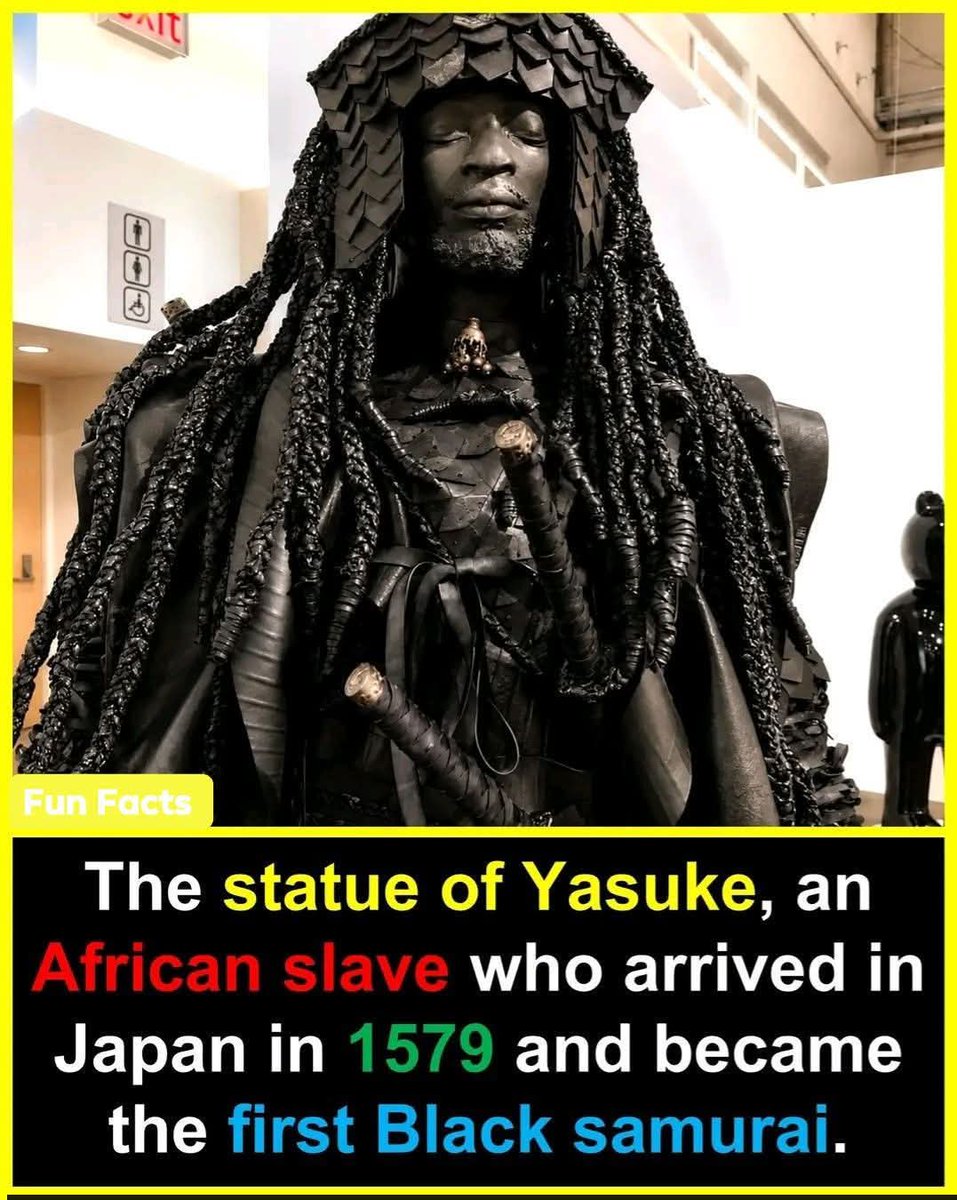
Before the world became connected, a man from Africa made history in one of the most unlikely places imaginable—feudal Japan.
Known as Yasuke, he arrived in Japan in the late 1500s alongside Jesuit missionaries. Believed to have originated from East Africa, his presence immediately captured attention in a society where few people had ever seen an African. Crowds reportedly gathered just to catch a glimpse of him.
His remarkable stature, strength, and intelligence soon drew the attention of Japan's legendary warlord, Oda Nobunaga. Impressed by Yasuke's character and abilities, Nobunaga welcomed him into his inner circle.
What followed was extraordinary. Yasuke was granted a residence, entrusted with weapons, and elevated to the prestigious rank of samurai—an honor rarely bestowed upon foreigners during that era.
Although parts of his story remain shrouded in mystery, Yasuke's legacy endures as the first known Black samurai in Japanese history, a powerful reminder that history is far more diverse and interconnected than many realize.
History didn't just happen in one place—it was shaped by people who crossed oceans, cultures, and expectations.
#AfricanHistory #BlackHistory
This 12th-century Japanese woman could decapitate enemies with a single sword strike and allegedly rip men's heads off with her bare hands. Meet Tomoe Gozen, the most feared female samurai in Japanese history, whose impossible fighting skills made hardened warriors flee in terror. Her story reads like fantasy, but it's documented historical fact.
From the first hilltop communities near the Tiber to the last Roman heirs in Constantinople, the Roman army changed for over 2,000 years. This timeline is not only about armour and shields — it is about discipline, citizenship, leadership, logistics, reform, identity, and survival through constant adaptation.
**1. Early Roman Tribal Warrior — c. 753–600 BCE**
Rome’s earliest armed figures belonged to a world before legions, emperors, and professional service. The traditional date of 753 BCE belongs more to Roman memory than secure history, but early Rome did grow from small communities in Latium near the Tiber. These early fighters were shaped by farming life, clan networks, hilltop settlements, local identity, and contact with neighbouring peoples. Their equipment would have varied depending on wealth and status: spears, shields, cloaks, leather, wool, bronze objects, and practical handmade kit. This figure should not be imagined as a uniformed Roman soldier in the later sense. He represents the pre-legionary roots of Roman military life, when service was tied to community, property, status, and local protection. The important point is that Rome’s army did not appear fully formed. It developed slowly from a small central Italian society into one of history’s most organised service systems.
**2. Roman Hoplite-Style Soldier — c. 600–400 BCE**
Before the famous manipular legion, early Rome was strongly influenced by neighbouring Etruscan and Greek military styles. The hoplite-style soldier reflects a period when wealthier citizens could equip themselves with helmet, spear, body protection, and a large round shield, serving in close formation as part of a civic army. This was still not the flexible legionary system most people picture when they think of Rome. It belonged to an age when social class, property, and public duty were closely connected. The visual works best if understood as an early Italic-Roman heavy infantryman rather than a direct copy of a classical Greek hoplite. This stage matters because Rome’s strength came partly from adaptation. Romans borrowed useful ideas, reshaped them, and eventually created something distinct. The hoplite-style phase shows Rome before the legion became the legion — civic, disciplined, and already absorbing ideas from the wider Mediterranean world.
**3. Hastatus — c. 315–107 BCE**
The hastatus belonged to the manipular legion of the middle Roman Republic, one of the most important stages in Roman military development. Hastati were usually younger heavy infantry placed in the first main line, supported by more experienced soldiers behind them. Their world was organised around flexibility, layered formations, citizen service, and a system that allowed Roman units to adapt to changing field conditions. The large shield, helmet, sword, light body protection, and throwing equipment created a soldier built for movement and formation work. What matters most is the system around him: hastati, principes, triarii, and velites all had defined roles within a structured army. The hastatus shows Rome becoming more sophisticated during its rise across Italy and the Mediterranean. He was not yet the fully professional imperial legionary, but he represented a Republic learning how to organise citizens into an adaptable and disciplined force.
**4. Triarius — c. 315–107 BCE**
The triarius was one of the most respected figures in the manipular legion. Unlike the younger hastati, the triarii were older and more experienced infantry, usually positioned in the third line. They were associated with steadiness, discipline, and reliability. The Roman phrase often translated as “it has come down to the triarii” became a way of saying that a situation had reached its final reserve. Their spear, shield, helmet, and heavier presence symbolise a stage of Roman organisation built around depth and stability: younger troops first, seasoned men behind them, and a structure designed to keep order under pressure.
When Portuguese sailors reached the Kingdom of Benin in 1486, they sent back reports that stunned European courts. A city of vast boulevards. A royal palace lined with bronze and ivory. An Oba who commanded armies across an empire. One ambassador compared it directly to Lisbon — and Lisbon was then the jewel of Europe.
The American bison once ruled the Great Plains in numbers almost impossible to imagine today. Before large-scale European settlement transformed the continent, an estimated 30 to 60 million bison roamed North America. Their herds stretched from horizon to horizon, so vast that early travelers described them as living rivers flowing across the prairie. The ground trembled beneath their movement. Dust clouds rose for miles. Entire ecosystems revolved around their presence.
For countless Indigenous nations, the buffalo was far more than an animal. It was food, clothing, shelter, tools, medicine, and spiritual connection. Every part of the animal had value. Nothing was wasted. Generations grew up alongside the great herds, building cultures and traditions deeply intertwined with the rhythms of the plains.
Then, within just a few decades, one of the most abundant large mammals on Earth was pushed to the edge of extinction.
This photograph, showing a massive pile of bison skulls, captures one of the darkest chapters in environmental and human history. At first glance, it seems unbelievable. The skulls rise like a monument of death, stacked higher and higher until they form a mountain of bones. Yet this was not an isolated scene. Similar piles appeared throughout the American West during the late nineteenth century. Bone collectors gathered the remains of slaughtered buffalo by the thousands. The bones were shipped east and processed into fertilizer, glue, industrial chemicals, and other commercial products.
What appears shocking today was once considered normal business.
During the 1870s and 1880s, commercial buffalo hunting exploded across the Great Plains. Advances in firearms made killing large numbers of animals easier than ever before. Railroad expansion gave hunters access to previously remote regions and allowed hides, bones, and other products to reach distant markets. Professional hunters emerged whose livelihoods depended on killing as many buffalo as possible. Some could shoot hundreds in a single day. Entire herds were wiped out in a matter of hours.
The animals often had little fear of humans, making them easy targets. Hunters would position themselves at a distance and fire repeatedly into a herd, sometimes killing dozens before the remaining animals understood the danger. In many cases, only the hides were taken. The rest of the carcass was left behind to decay under the open sky.
The waste was staggering.
Mountains of bones accumulated across the prairie. Scavengers fed on the remains. The smell of decay drifted across the plains. What had once been a landscape filled with life became a graveyard.
Economic motivations drove much of the slaughter, but the destruction of the buffalo carried deeper consequences. Many historians point out that the collapse of bison populations directly affected Indigenous nations whose survival depended on them. Military leaders and government officials understood this reality. Some openly argued that eliminating the buffalo would make it easier to force Native peoples onto reservations and reduce resistance to westward expansion. Whether through active encouragement or deliberate inaction, government policies often aligned with the interests of hunters and settlers.
The disappearance of the buffalo became intertwined with the displacement of Indigenous communities. Entire ways of life were threatened. Starvation spread through some regions. Cultural traditions connected to the buffalo became increasingly difficult to maintain. The loss was ecological, economic, and spiritual all at once.
By the late nineteenth century, the scale of destruction had become impossible to ignore. A species that once numbered in the tens of millions had been reduced to only a few hundred surviving animals. The collapse happened with astonishing speed. Within a single human lifetime, one of Earth's greatest wildlife populations nearly vanished forever.
History often remembers Christopher Columbus as the great explorer who “discovered” the Americas — but that story leaves out a whole chapter of Black adventurers and navigators whose achievements shaped the early New World. Abubakari II, the 14th-century ruler of the Mali Empire, reportedly gave up his throne to lead a massive Atlantic expedition, sending hundreds of ships westward in search of new lands. While it’s debated whether his fleet reached the Americas, his story highlights the ambition and seafaring skill of African empires centuries before European colonization.
Other Black explorers played direct roles in shaping early America. The Niño Brothers, of African and Spanish heritage, sailed with Columbus in 1492 and later led their own voyages. Juan Garrido, born in Africa and once enslaved in Portugal, became a conquistador, helping Spanish explorers in Florida and Mexico and even planting the first wheat in the Americas. Estevanico, also African, survived years of perilous Spanish expeditions across North America and helped map large parts of the Southwest.
Together, these figures challenge the simplified story of discovery, showing that Black explorers were active, skilled, and daring participants in global exploration long before mainstream history gave them credit. Remembering them not only honors their achievements but also broadens our understanding of how the Americas were truly shaped.
A tribe of desert nomads looked at a barren, waterless canyon and saw a metropolis. The Nabataeans didn't just build Petra—they sculpted it from the living rock of southern Jordan.
In a land with only six inches of rain per year, their survival depended on a secret: they engineered an invisible water system.
They carved channels into cliff faces to catch every drop of runoff. They constructed massive dams and underground cisterns that held millions of gallons of water.
This hidden network transformed a trade-route fortress into a thriving home for nearly 30,000 people.
Their most famous monument, the 130-foot-tall Treasury, was a declaration of power carved into the mountain itself.
It reflected their wealth from controlling the incense trade. But their real genius was buried within the rock—the engineering system that defied the desert.
Petra's slow decline began only after earthquakes damaged the vital water channels that sustained the city for centuries.
Their story is not simply about the fall of an ancient civilization, but about a people who out-engineered a wasteland.