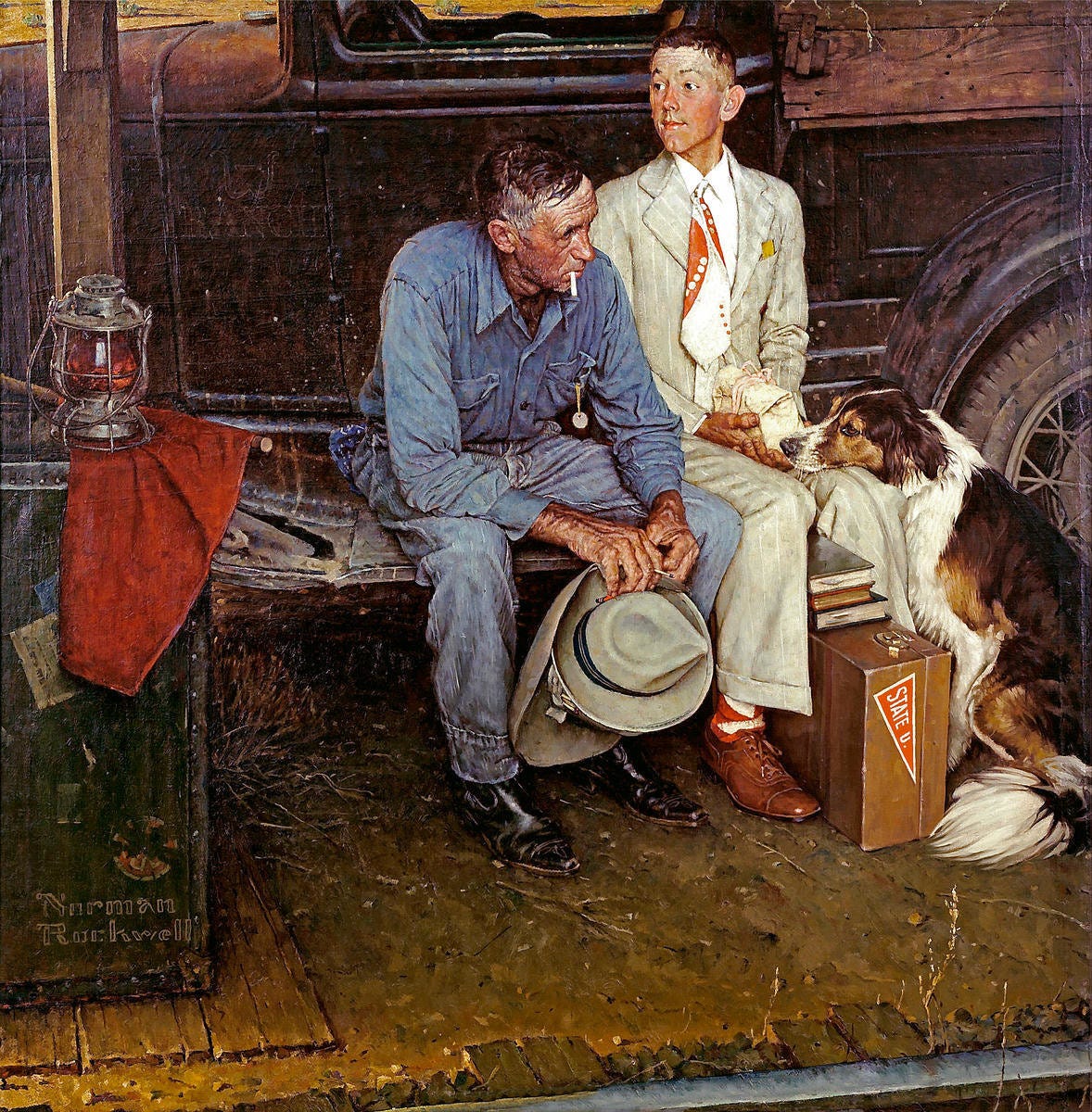
This is one of the most beloved paintings in America, and it puts its finger on something we all pass through, first as the child, and one day as the parent left behind...
The painting is Breaking Home Ties, by Norman Rockwell, on the cover of the Saturday Evening Post in 1954. A father and his teenage son sit side by side on the running board of a battered farm truck, waiting at a railway stop. A single track runs along the bottom of the picture. A ticket pokes from the boy's pocket. His suitcase is stacked with schoolbooks and wears a "State U" pennant. The train is coming to carry him off to college, away from home, for the first time in his life.
Everything is in the way they sit.
The son sits upright, scrubbed and dressed in his best, eyes fixed on the horizon, on the track, on the future rushing toward him. He is already half gone. For him that train is the beginning of everything.
His father sits beside him in worn work clothes and scuffed boots, looking the other way, down the line, as if he cannot bear to watch it arrive. The same train means the opposite thing to him. For the son it is the start of a life. For the father it is the day the house grows quieter, the chair at the table sits empty, and the person he built his world around walks out into a life that no longer has him at its centre.
Look at his hands. He is holding two hats. His own battered one, and resting on top of it, his son's crisp new one, held carefully together, because it is the last small thing he can still do for the boy...
And then the dog, its head laid in the son's lap, gazing up, refusing to look away. Rockwell knew exactly what that was for: "The father couldn't show how he felt about the boy's leaving," he said. "The dog did."
It has moved people for 70 years because every leaving is a beginning for one person and an ending for another. The child steps out into the world, as they should. And someone stays behind, watching them go, and loving them enough to let them go anyway...
@tradeboicarti16 Is this some old post? Halving was in 2024 and next is in 2028. Bear market still not over though like flat top we may get flat (boring) bottom.
@JuliusFabes@SeaGoatCoin@LordStoppington Agree, was just biased observation. Love your strat mix and I love the main strat with short btc and long eth. Although any strategy being long on the cursed vitalyk coin is fishy 😅
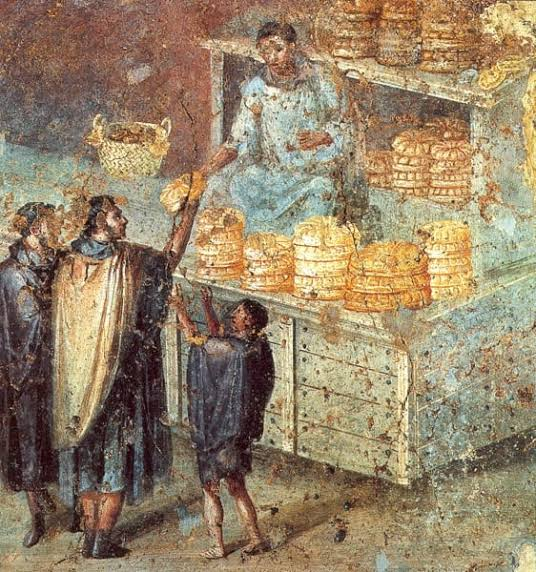
Picture a baker in Rome around 100 BC. He joins a collegium of fellow bakers, pays his dues, shares recipes, buys grain in bulk, and settles disputes with his peers over a cup of wine. Nobody forced him. He walked in because it paid to, and he could walk out the same way. That is a voluntary association, and it worked precisely because it was voluntary.
Then the state arrived.
By the reign of Trajan, and hardening under Diocletian and Constantine, the collegia stopped being clubs and became conscription lists. The emperors discovered something every ruler eventually discovers: a private guild is an inconvenient thing to tax and command, but a licensed monopoly is a beautiful thing to milk. So they licensed them. The pistores (the bakers) received legal privileges, guaranteed grain supplies, even exemptions from certain public duties. Generous, no?
The price came due fast. Membership turned hereditary. Your father baked bread for the annona, so you would bake bread for the annona, and your son after you. The collegium became a caste. Diocletian's Edict on Maximum Prices in 301 AD then fixed what you could charge, which meant you produced at a loss or you didn't produce at all. Bakers fled their ovens. Shippers abandoned their vessels. The emperors responded by chaining men to their trades by law.
Watch the mechanism, because it repeats across every century. The state grants a privilege. The privilege comes with a leash. The leash tightens until the "beneficiary" is a serf holding a charter.
Free market thinkers have a name for the exchange the emperors offered: protection from competition in return for obedience. The baker who once set his own prices and hired whom he pleased now answered to a prefect. His guild, born to serve him, now served Rome.
The bread got worse.
The Yen Shock That Could Put Markets on Life Support
The scary part here is that Japan may be forced to save itself in a way that hurts everyone else.
For decades, Japan was the world’s cheap funding source. Near zero rates let investors borrow yen, sell yen, buy higher yielding dollar assets, and park capital in U.S. Treasuries, equities, credit, private markets, and emerging markets. That worked as long as Japanese yields stayed suppressed and the yen stayed weak in an orderly way.
That regime is now breaking. Japan’s 10 year yield near 2.8% is a historic reset after a generation of near zero financing. The BOJ is raising rates, the yen is under pressure, households are getting squeezed by import costs, and Japan is carrying one of the largest debt burdens in the developed world.
But the key nuance is this. Japan’s deeper disease is still deflation. Aging demographics, weak domestic demand, fragile real wages, and decades of low growth still pull Japan back toward disinflation. The immediate symptom is weak yen imported inflation. That is what makes this so dangerous. Japan may be forced to act hawkish against imported inflation even though the underlying economy is not strong enough to handle real tightening.
The Historical Warning
In 1998, the yen carry trade unwound after the Asian crisis and LTCM, and Japan moved toward zero rates. In 2008, forced deleveraging turned carry trades into liquidation machines, and the BOJ cut after the crisis intensified. In 2024, even a smaller BOJ normalization shock caused a yen rally and global equity volatility.
Japan often eases after carry trade blowups, but not before the damage. It cuts later because a violent yen rally, falling equities, tighter credit, exporter pain, and recession risk eventually hit Japan too.
So when people say Japan will just cut again, they are missing the sequence. The danger is not where the BOJ ends up. The danger is the window between hawkish yen defense and the later reversal. That is when the liquidation happens.
The Policy Whipsaw
Japan’s 1st problem is a weak yen and imported inflation, so it may be forced hawkish. Japan’s 2nd problem is that the hawkish turn can detonate the carry trade. Japan’s 3rd problem is that once the unwind becomes recessionary, the BOJ may have to pause, restart bond support, or cut again.
That is the nightmare loop. Tighten to save the yen, break the carry trade, then ease after the damage has already moved through global markets.
The Worst Case
The real nightmare here is stocks falling while Treasury yields rise. That breaks the normal hedge and turns the world’s safest collateral into the source of stress.
USDJPY pushes toward 170. Japan decides the yen decline is disorderly. The Ministry of Finance intervenes hard. The BOJ backs it with hawkish language or faster hikes. The yen surges. Everyone short yen has to buy it back. Carry trades unwind. Investors sell what they can, not what they want.
U.S. tech, credit, crypto, emerging markets, and Treasuries all become sources of liquidity.
Then Japanese institutions look home. If JGB yields are attractive again, why keep taking currency risk in U.S. bonds? Japan does not need to dump its Treasury portfolio to cause damage. Markets price at the margin. A $100 billion to $300 billion shift at the wrong moment can matter when Treasury liquidity is already fragile.
Mortgage rates rise. CRE refinancing gets worse. Bank securities books take pain. Credit spreads widen. Treasury auctions weaken. The Fed gets trapped because cutting into foreign liquidation and inflation risk looks reckless, while refusing to cut lets financial conditions tighten into recession.
Japan does not need to intend harm. The damage comes from self defense. A forced Japanese stabilization campaign could strengthen the yen, pull capital home, remove marginal demand from U.S. Treasuries, detonate the carry trade, and hit America at the exact layer that matters most.
The collateral layer.
@CryptoSays I doubt. Every "good" coin usually has nice 2nd pump. ADA without this latest FUD barely managed to move last cycle. So many better opportunities out there in the next cycle. Of course it has a good name and fanatic followers but still ...