Building a DAO is more than deploying governance smart contracts. It requires a clear framework for decentralized decision-making, treasury management, security, and community participation.
A successful DAO aligns technology with governance, creating transparent processes that encourage long-term member engagement and sustainable ecosystem growth.
Key focus areas:
🔹 Selecting the right governance model
🔹 Designing secure DAO smart contracts
🔹 Managing decentralized treasuries
🔹 Creating transparent voting mechanisms
🔹 Building an active and engaged community
Blockchain App Factory's latest guide explores everything businesses and founders need to know about DAO development, governance structures, and best practices for launching a successful decentralized autonomous organization in 2026.
Read the full guide:
https://t.co/BzXIsn9Aif
@BSCNews@RobinhoodApp AI agents are evolving from assistants into execution layers for financial platforms. As automation enters regulated markets, permission controls, auditability, and explainable AI will become just as important as model performance.
most web3 projects treat their token launch as the finish line.
it isn't.
the launch is when the real pressure starts. the contract is live, wallets are watching, liquidity is thin, and every decision you made in the design phase is now public and permanent.
we've seen projects spend 18 months building and about 3 weeks thinking about what happens after day one.
no claim flow. no vesting enforcement. no staking to create any reason to hold. just a token sitting there.
the projects that survive the post-launch window aren't smarter. they just planned further out. they had automation handling vesting schedules. they had staking live before the token dropped. they had a reason for people to stay.
if you're approaching a launch and your roadmap ends at "token goes live," that's the thing worth fixing first.
Compliance deadlines like this will influence product strategy well before they take effect. Stablecoin issuers that align their reserve management, governance, reporting, and regulatory frameworks early are likely to gain stronger institutional confidence and broader market access as compliance becomes a baseline expectation rather than a competitive advantage.
Tokenization will reward ecosystems that can support more than transaction speed. Institutional adoption depends on compliant asset issuance, secure custody, identity frameworks, interoperability, and reliable settlement. The networks that combine these capabilities with strong developer ecosystems are likely to capture long-term value as real-world assets continue moving on-chain.
A successful crypto launch doesn't happen by chance. It starts with the right strategy.
Launching a token today requires more than development. Projects need strong tokenomics, a clear go-to-market plan, active community building, liquidity planning, exchange listings, and sustained post-launch growth to stay competitive.
A well-planned launch strategy helps teams reduce common pitfalls, improve investor confidence, and create momentum beyond day one.
Key focus areas:
🔹 Tokenomics designed for long-term sustainability
🔹 Community growth before and after launch
🔹 Strategic marketing and brand positioning
🔹 Liquidity and exchange listing preparation
🔹 Post-launch engagement and ecosystem expansion
Blockchain App Factory's latest guide explores the complete crypto launch strategy that Web3 founders and businesses should understand before taking their project to market.
Read the full guide:
https://t.co/RbFXro6IyB
airdrop campaigns look generous on the surface.
free tokens, growing wallets, big numbers in the dashboard.
but i've seen projects run a massive airdrop and end up worse off than before they started.
here's what usually goes wrong:
the claim contract isn't built to handle the actual load. or the vesting logic is missing entirely. tokens hit wallets and get sold in the first 20 minutes.
price craters. the community that was supposed to grow just... leaves.
the airdrop wasn't the problem. the infrastructure behind it was.
claim mechanics, vesting schedules, anti-bot logic, gas optimization - these aren't optional. they're the whole thing.
a well-run airdrop is a retention tool. a poorly-run one is just a one-day pump with a long tail of damage.
we automate all of this before the campaign goes live. not after.
Enterprise stablecoin adoption is moving beyond cross-border settlements into everyday business operations. Payroll is one of the highest-frequency financial workflows, making it a strong use case for blockchain-based payments. As more companies test regulated stablecoins for employee compensation, demand for compliant payment infrastructure and enterprise blockchain integration is likely to grow.
Enterprise blockchain adoption is moving into production-scale use in 2026.
The next phase is not just about testing blockchain.
It is about using blockchain as real financial infrastructure.
Recent discussions show enterprise Web3 moving toward practical integration, especially around tokenized real-world assets being used as institutional collateral.
This includes:
• Tokenized RWAs entering DeFi-style applications
• Major banks expanding tokenized Treasury offerings
• Compliance frameworks like MiCA supporting broader tokenization
• Enterprises exploring collateral, settlement, and liquidity use cases
• Institutions looking for secure ways to connect traditional finance with decentralized systems
This shift matters because enterprises want the benefits of DeFi, but with compliance, security, and operational control.
Tokenized assets can unlock more efficient collateral systems, faster settlement, better liquidity access, and new financial workflows for institutions.
For businesses and startups, this shows that blockchain is becoming practical infrastructure, not experimental technology.
For Web3 solution providers, the opportunity is clear.
Enterprises now need:
• Custom enterprise DeFi development
• Tokenization platforms connected with DeFi protocols
• Compliant smart contract solutions
• Institutional-grade liquidity infrastructure
• Secure settlement systems
• B2B Web3 marketing strategies for adoption
Enterprise DeFi is no longer just a future concept.
It is becoming a bridge between traditional finance and decentralized infrastructure.
The providers that can deliver secure, scalable, and compliance-ready solutions will be positioned for the next wave of institutional Web3 adoption.
This reflects a broader trend toward infrastructure consolidation. As exchanges prioritize their own ecosystems, blockchain projects should reduce dependence on a single distribution channel and build multi-chain strategies that preserve liquidity, accessibility, and user choice across networks.
The UAE is redefining real estate investment through tokenization.
By combining blockchain technology with a progressive regulatory framework, the UAE is making fractional property ownership more accessible, increasing market liquidity, and opening investment opportunities to a global audience.
From tokenized commercial buildings to luxury residential assets, real estate tokenization is creating a more transparent, efficient, and borderless investment ecosystem.
Key highlights:
🔹 Fractional ownership of premium real estate
🔹 Faster and more secure transactions
🔹 Enhanced liquidity for traditionally illiquid assets
🔹 Regulatory support driving institutional confidence
🔹 Growing opportunities for investors, developers, and asset managers
As blockchain adoption accelerates, the UAE is positioning itself as one of the world's leading hubs for tokenized real-world assets (RWAs).
Do you think the UAE will become the global leader in real estate tokenization over the next five years?
https://t.co/NZIzo5l1Md
Institutional crypto products are becoming more sophisticated. The focus is no longer limited to single-asset exposure. Multi-token investment products reflect growing demand for diversified digital asset portfolios backed by professional management. This shift also creates stronger incentives for blockchain projects to demonstrate long-term utility, liquidity, and regulatory readiness.
MiCA licensing is becoming more than a regulatory milestone. It is a competitive advantage for crypto payment providers entering the European market. As compliance standards become clearer, businesses that align their products with regional regulations will be better positioned to earn user trust and expand across jurisdictions.
SEO is the most slept-on channel in web3.
everyone is chasing Twitter clout, Discord members, and influencer posts.
meanwhile the founders who actually google "how to launch a DeFi platform" or "smart contract audit service" are sitting there, ready to buy, finding your competitors instead of you.
organic search in crypto is weirdly uncrowded.
most projects don't invest in it because it feels slow.
it is slow.
but six months from now you either have it or you don't.
we've seen clients come in with fully built products, strong communities, zero search presence.
they were invisible to the people actively looking for exactly what they built.
that gap is expensive.
Tokenized assets are moving from pilot stages into live production.
In July 2026, DTCC began limited production trades of tokenized Russell 1000 equities, major ETFs, and U.S. Treasuries through its tokenization service.
More than 50 firms are involved in the working group, including BlackRock, Goldman Sachs, JPMorgan, Circle, and Ondo Finance.
With SEC authorization received in late 2025 and a full commercial launch planned for October 2026, this marks a major step for enterprise blockchain adoption and token development.
Why does this matter?
Because real-world asset tokenization is becoming operational infrastructure.
Tokenized traditional assets can support:
• Faster settlement
• Better transparency
• Fractional ownership
• Improved liquidity
• More efficient asset management
• Stronger integration between legacy finance and blockchain networks
For businesses, enterprises, and startups, this signals a clear opportunity.
The demand for secure, compliant, and enterprise-grade tokenization infrastructure is growing.
Institutions will need:
• Custom token development platforms
• Compliant smart contracts
• RWA tokenization systems
• Legacy system integration tools
• Regulatory-ready blockchain infrastructure
• Secure asset issuance and management solutions
Token development is no longer just about creating digital assets.
It is becoming the foundation for bringing traditional financial markets on-chain.
Enterprise blockchain adoption is moving from experiments to production.
And tokenization is becoming one of the clearest use cases driving that shift.
Launching a crypto coin is only the beginning getting it noticed is the real challenge.
A successful coin launch requires more than hype. It demands a strategic mix of community building, KOL collaborations, PR, content marketing, social media campaigns, exchange visibility, referral programs, and data-driven optimization to attract early adopters and sustain long-term growth.
Whether you're launching a meme coin, utility token, or ecosystem coin, the right marketing strategy can make the difference between a forgotten launch and a thriving community.
Which coin launch strategy do you think has the biggest impact today community building, KOL marketing, or exchange listings?
https://t.co/BolgH9887Z
Projects that align marketing with transparency, education, and measurable results will be better positioned for sustainable growth in 2026 and beyond.
The next era of Web3 marketing is not hype-first.
It is trust-first.
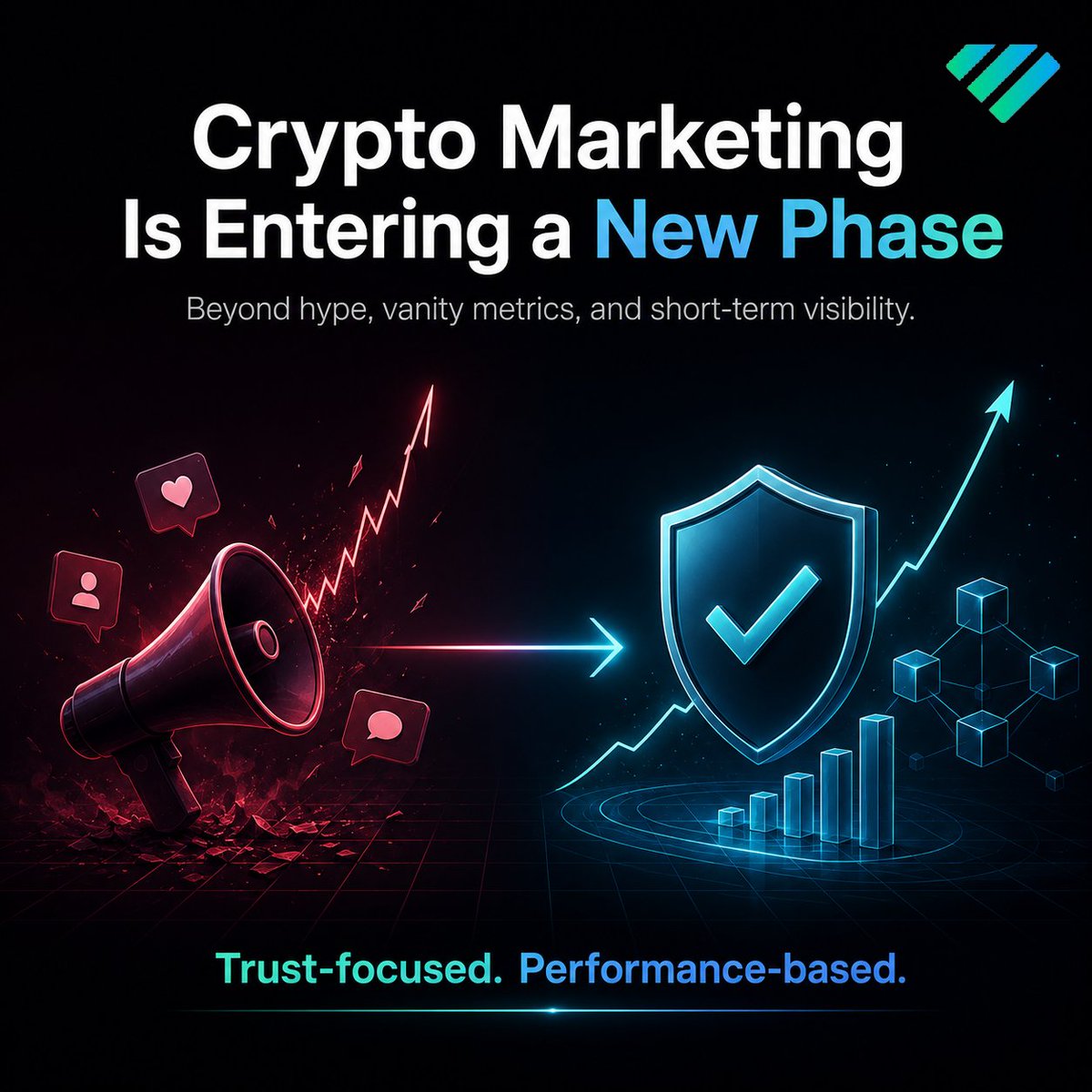
Crypto marketing is entering a new phase.
The old playbook of hype-driven KOL campaigns, vanity metrics, and short-term visibility is losing its edge.
Projects are now moving toward trust-focused, performance-based marketing models.
influencer marketing in web3 is broken in a specific way nobody talks about.
it's not the fake followers or the inflated engagement numbers (though that's real).
it's that most projects buy reach with no plan for what happens after.
someone with 200k followers posts about your token. traffic spikes. wallet connects go up.
then what?
no onboarding flow. no community to land in. no reason to stay.
the influencer did their job. the project just wasn't ready for it.
we've seen this pattern enough times that we now ask clients about retention before we talk about reach.
distribution is only as valuable as what you're distributing into.
Crypto marketing is becoming more structured and long-term.
For token and DeFi projects, the old approach of relying only on short-term hype is becoming less effective.
Recent discussions show that campaigns built around early community building, credible narratives, and measurable results are outperforming quick promotion strategies.
This shift matters because Web3 audiences are becoming more selective.
They want to see trust, education, utility, and real engagement before supporting a project.
For token launches and DeFi protocols, successful marketing now depends on building a strong foundation before going to market.
That means focusing on:
• Community growth
• Clear positioning
• Educational content
• Credible storytelling
• Data-driven campaign tracking
• Measurable user engagement
• Long-term adoption
The future of crypto marketing will not be defined by who creates the most noise.
It will be defined by who builds trust early, communicates clearly, and converts attention into sustainable growth.
Web3 marketing is moving from hype to strategy.