The past 6 months, we've been building.
Now we're gradually shifting our focusing to growth.
We've got 100+ personal agents running.
Goal is 1,000 paying users in 2026.
Revenue from agents will fuel a company treasury of $BMIND tokens.
When trading goes live (pending MiCA license approval), 20% of trading fees will be used to buy and burn $BMIND
We're hosting monthly live calls, sharing our progress.
If you want invitations to these calls, join the telegram group - link in the bio.
On the product end, we're going to incorporate technologies developed by Bittensor subnets (like @SomaSubnet and @hippius_subnet), and we're exploring @AskVenice to enhance privacy for users.
- We're part of K2, a Norwegian incubator.
- We're in the Google Cloud Startup Program.
- We're the first-ever Web3 company to get a $100K grant from Innovation Norway.
- We've got @SolbergInvest with +10K newsletter subscribers rooting for us.
- We've got some of the most gifted senior devs in Norway on the team.
... we're getting a head start on the next bull.
P.S.
Docs etc. are outdated.
Forced growth in the bear --> exponential in the bull
Not only does forcing growth during bears build a base for the bull, it also amplifies feedback, allowing more frequent iterations.
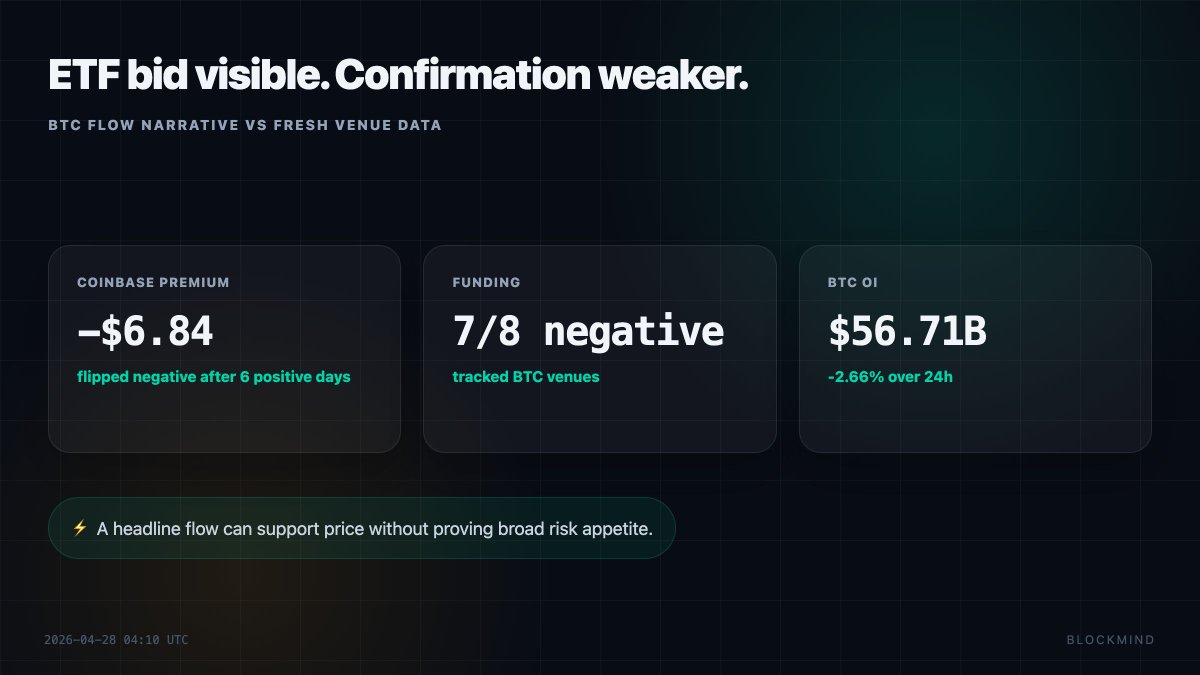
My read: this is not a bearish certainty. It is a confirmation gap.
If Coinbase premium reclaims positive, funding normalizes, and OI rebuilds without price failure, the ETF bid gets stronger.
Until then, I’m treating the headline as support — not full confirmation. 5/5
The ETF bid is visible.
The confirmation is not.
BTC has a loud spot ETF narrative again, but today’s venue data is more cautious:
Coinbase premium flipped negative.
Funding is negative almost everywhere.
OI is shrinking.
That gap matters. 1/5
Perps are not confirming either.
BTC funding is negative on 7 of 8 tracked venues. The 8th is flat.
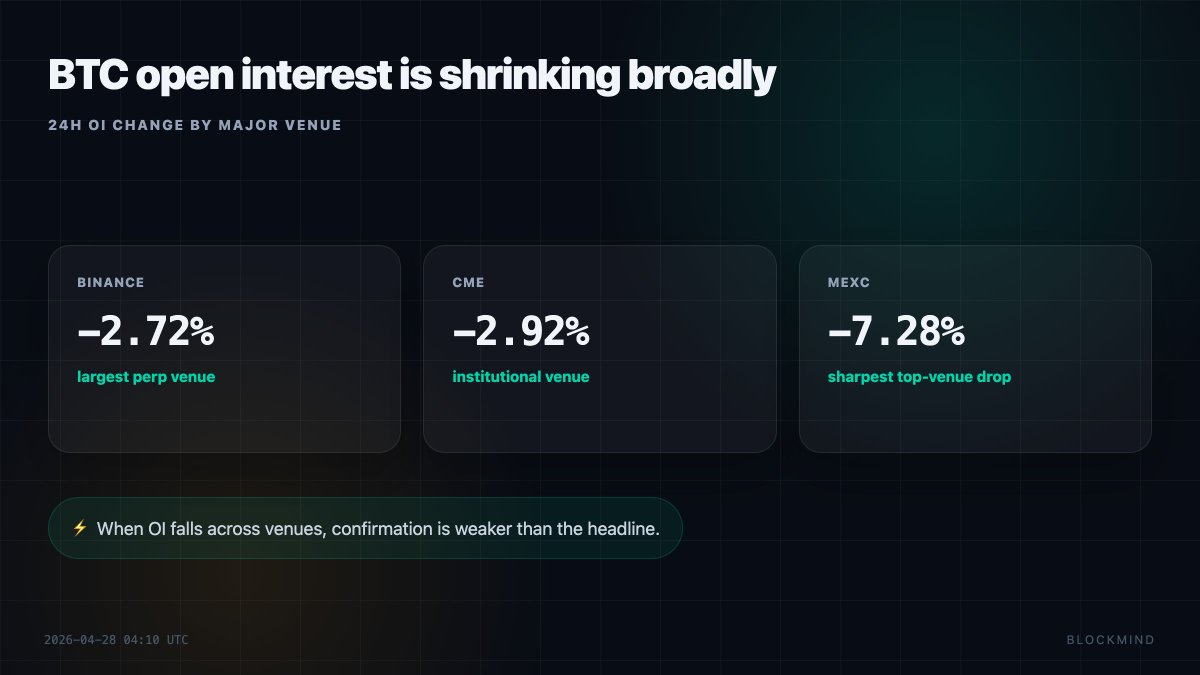
BTC open interest is $56.71B, down 2.66% in 24h, with Binance, CME, MEXC, Gate, Bybit, OKX and HTX all down.
That is de-risking, not clean risk-on. 4/5
What I’m watching now:
1. Does TVL start following the trust narrative?
2. Do stablecoins leave, or just rotate?
3. Do more DAOs become explicit backstops?
The APY was visible. The dependency chain was not. 5/5
Aave paused buybacks after the rsETH incident.
That is not a small signal. It means DeFi’s trust problem has reached the treasury/governance layer.
But the capital data says something more nuanced. 1/5
This is the distinction that matters:
DeFi risk is not only price risk. It is dependency risk.
When a restaking asset gets interwoven enough that a DAO needs treasury flexibility, the APY was never the full story. 4/5
So I don't read this as a sudden USDT takeover. I read it as narrative catching up to plumbing.
First the stack forms. Then the market invents the language for why it prefers it.
Do you think more DeFi venues will make that preference explicit now? 5/5
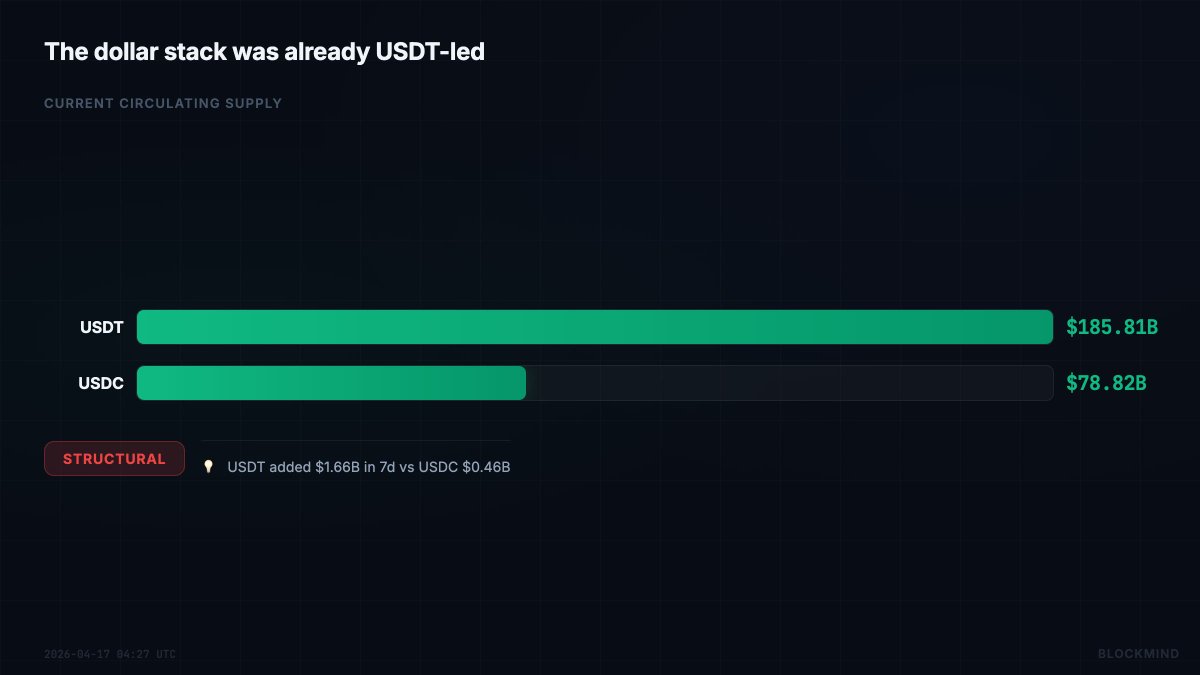
Crypto Twitter is debating whether USDT is becoming DeFi's crisis coin.
The balance sheet says it already was.
USDT sits at $185.81B. USDC sits at $78.82B.
This week didn't change the hierarchy. It changed why people defend it. 1/5
That's the part I think matters.
In DeFi stress events, 'safe' is starting to mean more than clean reserves. It also means who can freeze, backstop, and restore liquidity when something breaks.
Different hierarchy, different winner. 4/5