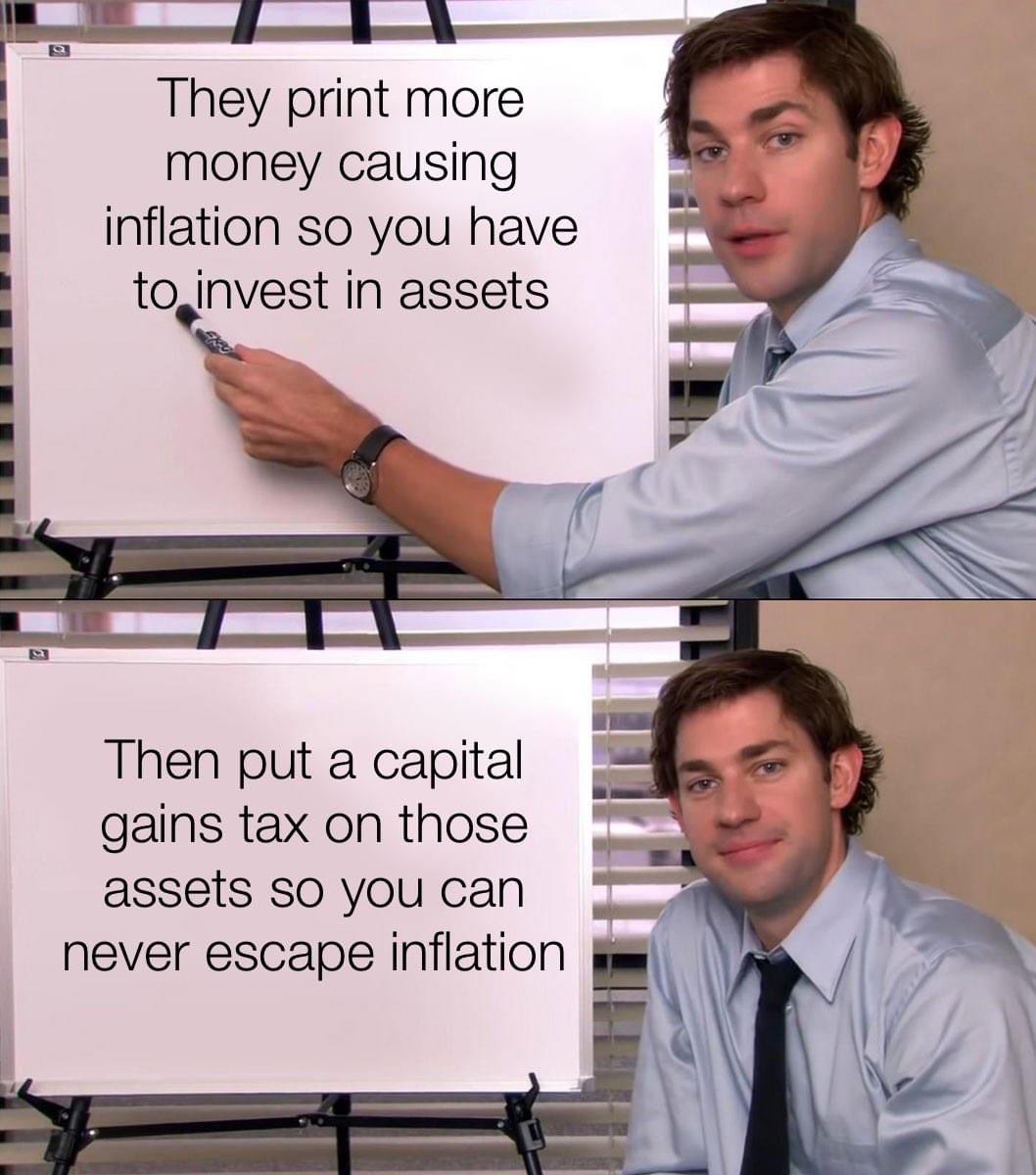
The Synchrony Fallacy: the idea that #bitcoin's inflation hedge value prop is invalidated because bitcoin's value doesn't go up at the exact same time that inflation levels are high.
Delegating control of our brains to corporations is unlikely to end well. Open source and sovereign ownership of the software of our exocortices will be a terrifying vista, but one with closer-to-infinite possibilities.
Andrej Karpathy says as we expand our brains into an exocortex on a computing substrate, we will be renting our brains and open source will become more important because if it's "not your weights, not your brain"
Germans almost out of #BTC for selling.
Mt Gox BTC seemingly going nowhere.
#Inflation coming in cooler than expected.
Rate cuts in September inevitable.
Global liquidity steadily increasing.
Hold on to your pants, guys.
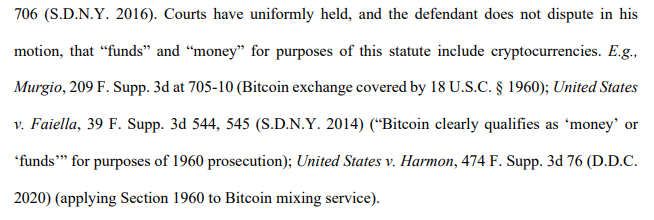
US prosecutors say bitcoin is money.
It's Schrodinger's money. It's a "speculative asset" when they want to describe it as not important, but then becomes "money" for the purposes of laws regarding money transmission, and then back to "speculative asset" again.
I wonder how many really understand the bitter opposition by policymakers to Bitcoin and especially an ETF.
Gary Gensler doesn't really hate it because of investor protection (that's only a minor reason). Elizabeth Warren doesn't actually think its criminal use is significant. Obscure members of Congress who seem to pop up out of nowhere -- with Bitcoin, of all things, strangely on their minds -- and who repeat these tiresome objections (often in laughable letters to the SEC) are in many cases quietly pushed to do so by others, including from the Fed, who understand the real threat:
In a system that depends on irresponsible government spending (especially for perpetual war) and fiat printing to cover that irresponsibility, alarm bells cannot be allowed to work. There must be no pure price signals. And above all, an alarm bell must not also serve as a life-raft that's easily accessible to everyone, especially the general public, in the form of an ETF. There must be no escape hatch.
This is an unstated but important motivation for the longstanding resistance to Bitcoin and especially an ETF. It's also why the three-judge panel of a federal appeals court that in 2023 essentially forced the SEC to approve the ETFs may ultimately turn out to be the most unsung but consequential people in the history of U.S. financial markets. After that court's ruling, you could almost hear public policymakers and some influential private-sector figures -- names that everyone knows, and some very important ones who stay out of the news -- smack their foreheads and say, "Those damn judges, don't they realize what they've done?"
The system's defenders have always understood that life-rafts and escape hatches can't be allowed. Here's Christine Lagarde talking about Bitcoin in 2021 (ostensibly about the need for global cooperation on regulation, but the larger point was clear): "If there is an escape, that escape will be used." Here's a seminal essay by Alan Greenspan in 1966, when he was still in the private sector:
An almost hysterical antagonism toward the gold standard is one issue which unites statists of all persuasions...In the absence of the gold standard, there is no way to protect savings from confiscation through inflation. There is no safe store of value. If there were, the government would have to make its holding illegal, as was done in the case of gold. The financial policy of the welfare state requires that there be no way for the owners of wealth to protect themselves.
I'd say the antagonism towards Bitcoin qualifies as "hysterical," wouldn't you? And in terms of "protection," in a political system defined by profligacy and incompetent policy (especially monetary policy in recent years), a free-trading asset that serves as protection and -- via its price action -- starkly highlights those two faults is resented and hated.
This is why the Bitcoin ETFs in particular are so important, and why they were bitterly resisted for so long and the SEC only approved them after being forced to do so by a court decision. Gold is usually slow-moving and can be suppressed -- and even if it does rise to $2500 or $3000, DC and the Fed certainly won't like it, but it won't set off systemic alarms and the public mostly wouldn't notice. But if the ETFs help drive Bitcoin into the hundreds of thousands of dollars, the headlines will be screaming and the public will start asking uncomfortable questions. With the Fed desperate to cut rates and a potential second inflation wave looming, it's easy to see why, from a policymaker perspective, the timing of ETF approval could not have been worse. And now Bitcoin and the ETFs -- as permanent, fast growing and highly visible canaries in the financial system -- will be perpetual burrs under the policy saddle.
A telling postscript: Decades after Alan Greenspan wrote that essay about gold, Ron Paul asked him to autograph a copy of it as Fed chairman, and he asked if Greenspan wanted to add a disclaimer to it. Greenspan replied "I stand by every word" and signed it.
Bitcoin's hash rate hit an all time high 500 exahashes/s this month.
To highlight the enormity of this number:
- For every star in our galaxy, the Bitcoin network is calculating 5 billion computations per second.
- It would take ~2000 years for the entire global population, each performing one hash/second, to match the Bitcoin network's hash rate.
- The Bitcoin network performs ~67 times more hashes per second than there are grains of sand on Earth.
- By number of raw operations/second, Bitcoin is ~500x more performant than the world's most powerful supercomputer.
Yet, there are skeptics out there that still believe "bitcoin is backed by nothing".