The Great Transition
Honestly, I don’t think the human brain is wired for what’s coming over the next 36 months. We are about to enter a period of profound cognitive dissonance that will be felt in every corner of the globe.
https://t.co/MSEO64N7wZ
If true, this is the worst and the most discriminatory move against Indians I have ever seen in my life! Indian investors who have been betting on India and had been holding their shares in the economy despite the struggling times we have been going through are being punished and foreign investors who pulled out money are being awarded. If you want to remove capital gains tax, remove for everyone! What is this slavery mindset with which our FM is working! Shameful! I would urge all Indian investors to pull out their money from Indian stocks if this is implemented!
@refocus21 And the government's response has been exactly like what UPA 2 used to be. If BJP doesn't course correct, even NDA combined would fail to reach majority in lok sabha by a long shot.
Breaking: The President's son is on a heater
Donald Trump Jr's firm 1789 Capital went from $200 million to $3.5 billion in assets in just one year
His biggest win so far has been Cerebras, a chip company he backed at an $8 billion valuation that went public last week at $60 billion
His firm also owns stakes in SpaceX, xAI, Anduril, Databricks, and Groq
Donald Trump Jr's portfolio companies have received over $735 million in government contracts since his father took office
He calls their strategy "Patriotic Capitalism"
Meet Kimi K2.6: Advancing Open-Source Coding
🔹Open-source SOTA on HLE w/ tools (54.0), SWE-Bench Pro (58.6), SWE-bench Multilingual (76.7), BrowseComp (83.2), Toolathlon (50.0), Charxiv w/ python(86.7), Math Vision w/ python (93.2)
What's new:
🔹Long-horizon coding - 4,000+ tool calls, over 12 hours of continuous execution, with generalization across languages (Rust, Go, Python) and tasks (frontend, devops, perf optimization).
🔹Motion-rich frontend - Videos in hero sections, WebGL shaders, GSAP + Framer Motion, Three.js 3D.
🔹Agent Swarms, elevated - 300 parallel sub-agents × 4,000 steps per run (up from K2.5's 100 / 1,500). One prompt, 100+ files.
🔹Proactive Agents - K2.6 model powers OpenClaw, Hermes Agent, etc for 24/7 autonomous ops.
🔹Claw Groups (research preview) - bring your own agents, command your friends', bots & humans in the loop.
-
K2.6 is now live on https://t.co/YutVbwktG0 in chat mode and agent mode.
For production-grade coding, pair K2.6 with Kimi Code: https://t.co/uvoSJKyGCY
-
🔗 API: https://t.co/EOZkbOwCN4
🔗 Tech blog: https://t.co/9wWvgIQSS3
🔗 Weights & code: https://t.co/Be0hjs2RTP
Absolute bombshell. Data reveals someone made a massive 580 MILLION dollar trade on oil exactly 15 minutes BEFORE Donald Trump posted his tweet about pausing the Iran war. Someone on the inside just made a life changing fortune. The corruption is blatant.
This score of Kimi K2.5 looks a bit off to me — @nextjs@vercel, could someone please reach out? My DMs are open.
We’ve been actively collaborating with open-source benchmark communities, submitting PRs to help improve evaluation quality. Especially for software engineering tasks, runtime environments and configs can be quite complex — even the best models or teams may face challenges ensuring fully accurate or stable results.
We're eager to keep working with the community to strengthen evaluation systems — better benchmarks lead to better models.
Cursor has started to dishonour enterprise contracts by changing model prices because older prices were too "subsidized". This has already been met with a lots of backlash. They're also now accused of stealing from Kimi. I hope this company fails
Composer 2 is just Kimi K2.5 with reinforcement learning.
Someone sniffed the API calls.
The model ID is "kimi-k2p5-rl-0317-s515-fast" hosted under Anysphere's account.
Cursor isn't training their own model from scratch.
They're fine-tuning Kimi K2.5 with RL and calling it Composer 2.
That blog post said "our first continued pretraining run."
It's continued pretraining on someone else's model.
Now the hallucination problems make a lot more sense.
Cursor is raising at a $50 billion valuation on the claim that its “in-house models generate more code than almost any other LLMs in the world.” Less than 24 hours after launching Composer 2, a developer found the model ID in the API response: kimi-k2p5-rl-0317-s515-fast.
That’s Moonshot AI’s Kimi K2.5 with reinforcement learning appended. A developer named Fynn was testing Cursor’s OpenAI-compatible base URL when the identifier leaked through the response headers. Moonshot’s head of pretraining, Yulun Du, confirmed on X that the tokenizer is identical to Kimi’s and questioned Cursor’s license compliance. Two other Moonshot employees posted confirmations. All three posts have since been deleted.
This is the second time. When Cursor launched Composer 1 in October 2025, users across multiple countries reported the model spontaneously switching its inner monologue to Chinese mid-session. Kenneth Auchenberg, a partner at Alley Corp, posted a screenshot calling it a smoking gun. KR-Asia and 36Kr confirmed both Cursor and Windsurf were running fine-tuned Chinese open-weight models underneath. Cursor never disclosed what Composer 1 was built on. They shipped Composer 1.5 in February and moved on.
The pattern: take a Chinese open-weight model, run RL on coding tasks, ship it as a proprietary breakthrough, publish a cost-performance chart comparing yourself against Opus 4.6 and GPT-5.4 without disclosing that your base model was free, then raise another round.
That chart from the Composer 2 announcement deserves its own paragraph. Cursor plotted Composer 2 against frontier models on a price-vs-quality axis to argue they’d hit a superior tradeoff. What the chart doesn’t show is that Anthropic and OpenAI trained their models from scratch. Cursor took an open-weight model that Moonshot spent hundreds of millions developing, ran RL on top, and presented the output as evidence of in-house research. That’s margin arbitrage on someone else’s R&D dressed up as a benchmark slide.
The license makes this more than an attribution oversight. Kimi K2.5 ships under a Modified MIT License with one clause designed for exactly this scenario: if your product exceeds $20 million in monthly revenue, you must prominently display “Kimi K2.5” on the user interface. Cursor’s ARR crossed $2 billion in February. That’s roughly $167 million per month, 8x the threshold. The clause covers derivative works explicitly.
Cursor is valued at $29.3 billion and raising at $50 billion. Moonshot’s last reported valuation was $4.3 billion. The company worth 12x more took the smaller company’s model and shipped it as proprietary technology to justify a valuation built on the frontier lab narrative.
Three Composer releases in five months. Composer 1 caught speaking Chinese. Composer 2 caught with a Kimi model ID in the API. A P0 incident this year. And a benchmark chart that compares an RL fine-tune against models requiring billions in training compute without disclosing the base was free.
The question for investors in the $50 billion round: what exactly are you buying? A VS Code fork with strong distribution, or a frontier research lab? The model ID in the API answers that.
If Moonshot doesn’t enforce this license against a company generating $2 billion annually from a derivative of their model, the attribution clause becomes decoration for every future open-weight release. Every AI lab watching this is running the same math: why open-source your model if companies with better distribution can strip attribution, call it proprietary, and raise at 12x your valuation?
kimi-k2p5-rl-0317-s515-fast is the most expensive model ID leak in the history of AI licensing.
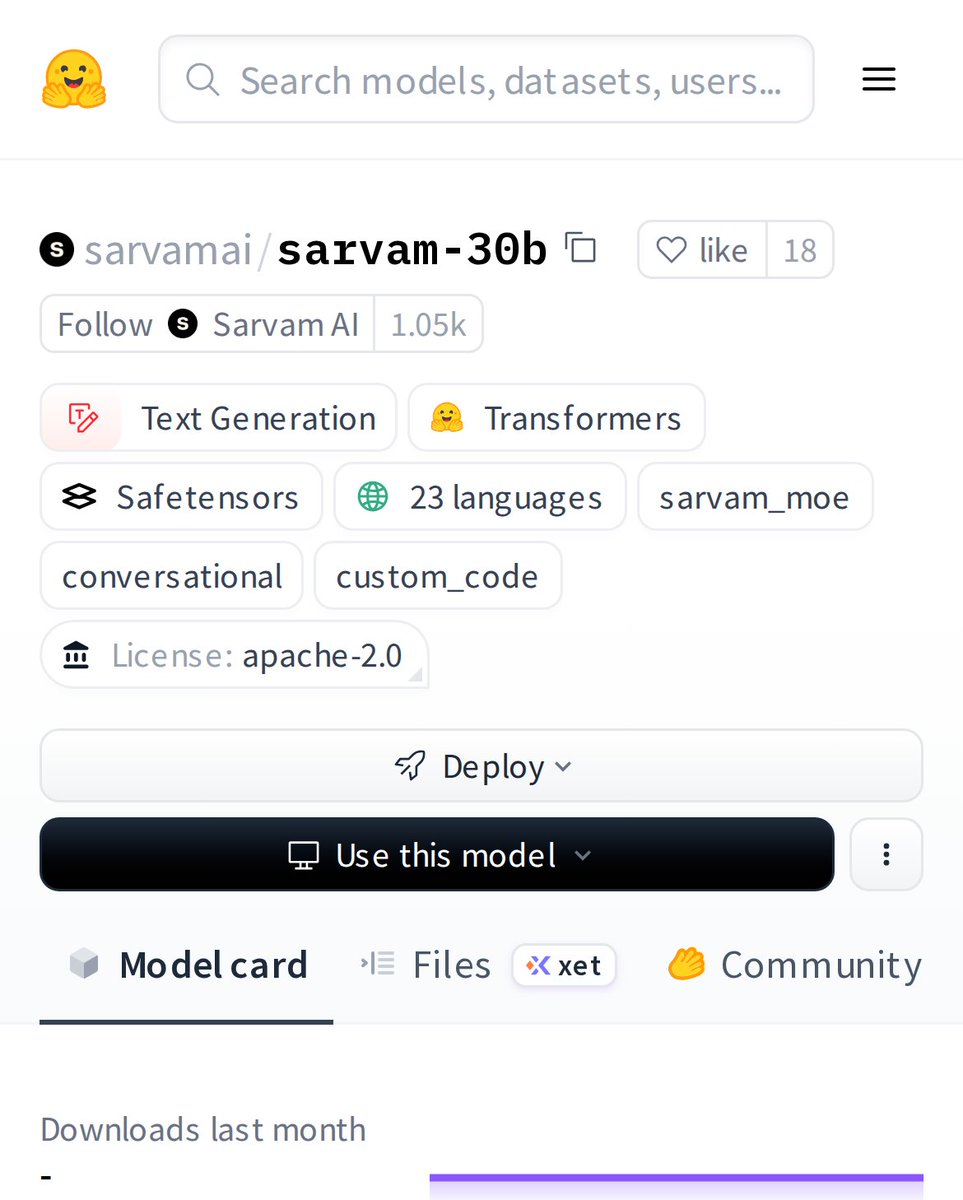
Meet Sarvam-30B: a massive 30-billion parameter language model built for multilingual conversations. It's a specialized, custom-coded model designed to understand and create text in English, Hindi, Bengali, and Tamil. A true polyglot AI.
Indian model Sarvam-105b is really really good
Sarvam AI has open-sourced two India-built reasoning models, Sarvam 30B and 105B, positioning them as globally competitive open models.
The big unlock is not just benchmark scores like 98.6 on Math500 for 105B or strong local deployment efficiency for 30B, but the full-stack story: in-house data, training, RL, tokenizer design, and inference optimization built for both frontier GPUs and consumer devices.
Did Trump just trigger the most self defeating chain of events in modern history?
> Israel drags US into war with Iran
> Oil surges in price, troops die
> Trump panics and lifts Russia sanctions so India can buy more oil
> Russia uses that money to help Iran
> We just funded our own enemy
This is directionally right, but “AI taking over broking” is still overstated.
What’s really happening is interface collapse.
Search, portfolio analysis, disclosures, and first-pass advice are moving into a conversational layer. Execution, risk, compliance, and liability are still very much human + system driven.
Most of what we’re seeing today—MCPs, assistants, digests—is about reducing friction, not outsourcing judgment. The hard problems aren’t LLMs:
suitability and mis-selling
explainability under scrutiny
accountability when advice goes wrong
SEBI’s stance makes this clear: AI is allowed, but responsibility doesn’t move. The broker still owns outcomes.
The real disruption won’t come from better chat.
It’ll come when AI systems are trusted to act under constraints—capital limits, audit trails, reversibility—without breaking regulatory trust.
That’s still ahead of us.