Ocean noise: Increasing anthropogenic underwater noise changes the acoustic environment and impacts blue whales. In addition to masking blue whale communication ranges, exposure to anthropogenic sound can cause a number of behavioral responses.
Entanglement: Few cases of blue whale entanglement in commercial fishing gear have been documented. The first report in the U.S. occurred off California in 2015, reportedly some type of deep-water trap/pot fishery.
Nine blue whales were known to have been killed and one seriously injured by ship strikes between 2007 and 2010 off California. The five deaths in 2007 were considered an unusual mortality event, as defined under the Marine Mammal Protection Act.
Anthropogenic (man-made) threats
Ship strikes: Ship strikes are a significant mortality factor for blue whales, especially off the U.S. West Coast, which has some of the greatest densities of commercial ship traffic in the world.
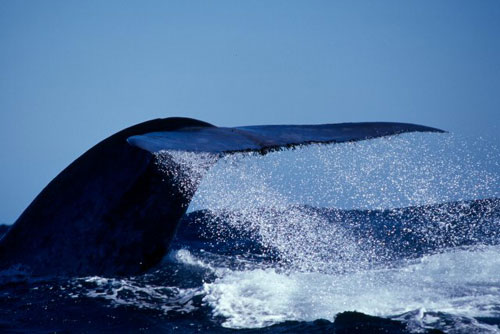
A fabulous Friday brought us two encounters with pair of blue whales, a couple of Bryde's whales, plus pods of common dolphins and bottlenose dolphins.
(📷: Caitlyn Nieblas 8.6.21)
#bluewhale#whalewatching#optoutside#danapoint
Blue whales are formally classified as endangered under the Endangered Species Act[251] and considered depleted and strategic under the Marine Mammal Protection Act.[178][252] The International Union for Conservation of Nature[253] has listed blue whales as endangered.
In 1955 they were given complete protection in the North Atlantic under the International Convention for the Regulation of Whaling; this protection was extended to the Antarctic in 1965 and the North Pacific in 1966.
The global blue whale population is estimated to be 5,000–15,000 mature individuals as of 2018.[1] They were protected in areas of the Southern Hemisphere starting in 1939.