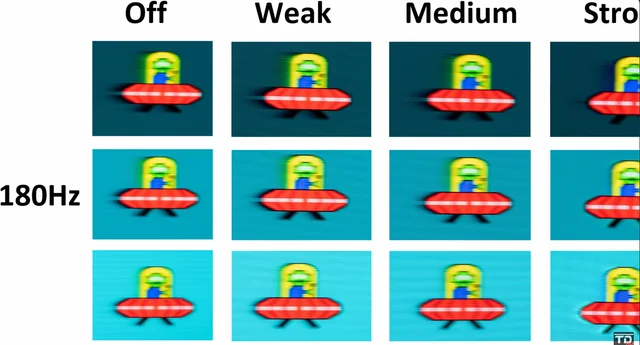
Technically possible but super expensive if they do it the "Status Quo" way. They'd have to really upgrade the display processing to be able to do it properly and that could represent engineering cost for really botique custom chip.
Currently, it is It's very expensive via scaler/TCON ASICs, so a more flexible approach by using a GPU built into the display, as suggested. I never say "realistically impossible" but most wouldn't pay 2-3x more for a display.
That's why I think displays need optional GPU-based video processing instead of scaler/TCON ASIC/FPGA video processing, to dramatically reduce the cost of engineering display enhancement algorithms.
@accuaro@skeletonwizar@METAPCs If you mean CRT electron beam simulator built into OLEDs, that will be difficult. The easiest way is currently BYOA (Bring Your Own Algorithm), like apps such as ShaderBeam.
See Blur Busters Open Source Display Shaders Initiative https://t.co/3naRZsOhe2
@konigssohne@Aerobrake77@mdrejhon Strobelight only works the custom 2012-era DRM protocol that LightBoost used. It won't work on newer protocols of newer strobe backlights like G-SYNC Pulsar.
GSYNC Pulsar lets you strobe non-NVIDIA sources in non-VRR ULMB2 mode. Good for 60 Hz single strobe from HDMI sources.
@skeletonwizar@METAPCs I also invented the CRT electron beam simulator https://t.co/Mk6ZPElBcD
Make your 240 Hz OLED emulate a 60 Hz CRT with less motion blur than the OLED's built-in boilerplate 50% BFI.
@mrbusysky@METAPCs Correct. But I also have a different study, with different variables (2D scrolling instead of 3D games), 120 Hz vs 480 Hz was more visible than 60 Hz vs 120 Hz.
Blind study variables:
https://t.co/K2P4oarp9B
@ChrisAPofahl@METAPCs No lie.
It's aggregate effects of frame rate.
But it's also better need to compare 4x differences at GtG=0, rather than slow 60-vs-120. There's effects where 120vs480 is like 1/120sec shutter vs 1/480sec shutter. Compare big differences, like Hz version of 480p vs 2160p.
@BOLDBANGER314@METAPCs There's some projections by ~2035-2040 where it's hard to get less than 240Hz. Much like it's easier to get 4K than 720p. There's plan to make 240 Hz cheaper than 60 Hz. First screenful of Amazon search "computer monitors" has no 60 Hz monitor (extinct now)
@RebelFawkes@METAPCs It's not about the frames, but the aggregate effects.
Also, the most common 120 (Apple 60 vs 120) is terrible due to the slow pixel response. Try a 4x multiple like 60 vs 240 on OLED for even more visibility, much like comparing 480p vs 2160p.
@comea62201@AGONbyAOC Try out https://t.co/19GjBWEIHd ... As a tests inventor, I welcome ideas on how you can show off OLEDs better. New UFO screen feature suggestions welcome!
@koopastarroad Some people have a motion sensitivity that low refresh rates can help. e.g. Setting a DELL monitor to 24 Hz can help alleviate some symptoms.
Also, I can simulate a slower display on a fast display too: https://t.co/19GjBWEIHd
Surprisingly, we have a blind study that if geometrics are given, the average population sees 1000fps differences.
The goal is 4x geometrics and GtG=0.
Scientific variables: https://t.co/SlyWUha3CW
TL;DR:
1. Don't compare 240vs360. Compare 4x diffs
2. GtG nearer 0, not 1ms
@EmilyAYoung1@BicameralMoid@Adum37264938 Lots good comments. However, there's over 100 different eyestrain triggers, varies by person.
- PWM eyestrains
- Stroboscopic-effect motion sickness
- Motion blur nauseas
- Pick poisons (glare vs antiglare texture etc)
Etc.
So, I support multiple blur busting methods!
@shelvacu Some colors are unusually slow which is why many display reviewers use GtG heatmapping. Some colors ~10x slower than others!
https://t.co/gVnbhGBA0n
@shelvacu Ironically, LCD's don't have a concept of RGB.
LCD is Liquid Crystal Display 100% monochrome; uses color filters to convert mono to color. Yes, moveable crystals. LCD are physical molecules that acts like a light valve to block/unblock polarized light. https://t.co/UhDub6TvHu
@shelvacu However, I agree GtG is very *arbitrary* too and the VESA 10%-90% is arbitrary, but do you want competitive scores to be based on white-black-white, OR color of player you're trying to frag? 👽
TL;DR: You want honesty in display benchmarks, but even GtG woefully imperfect.
@shelvacu An example of why UFOs don't always use white-black-white, is that odd artifacts ONLY show up with certain color pairs that are 10x slower than other color pairs. Can look weird in certain games when specific colors feel laggy.