Please see how a tightly coordinating counterion tends to increase the HOMO–LUMO gap of the photocatalyst while also stabilizing the excited triplet state @ChemEurope
Thanks to @elina_taskinen!
https://t.co/obeWhf8mRM
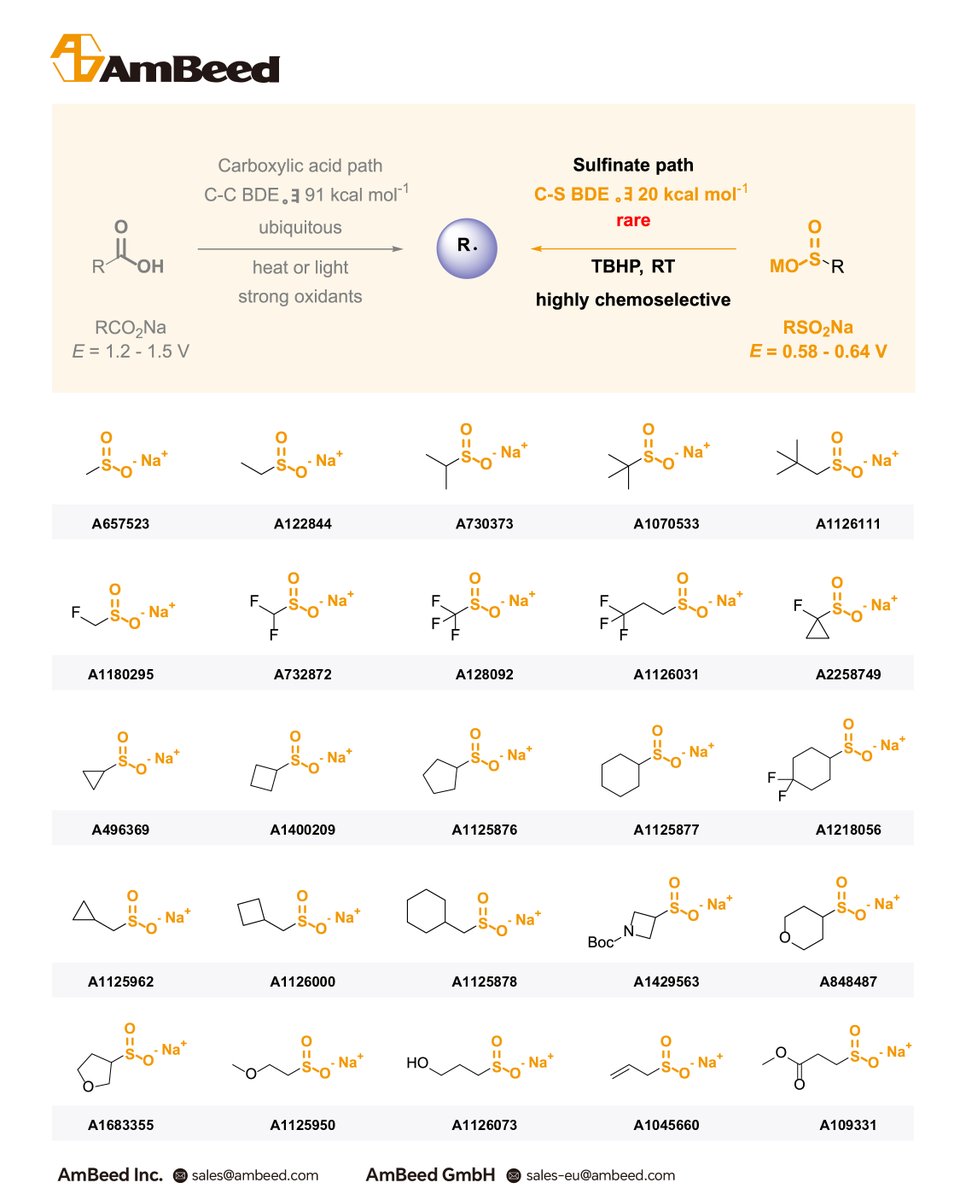
#𝐏𝐫𝐨𝐝𝐮𝐜𝐭𝐒𝐩𝐨𝐭𝐥𝐢𝐠𝐡𝐭 🧪 | 𝐀𝐥𝐤𝐲𝐥 𝐒𝐨𝐝𝐢��𝐦 𝐒𝐮𝐥𝐟𝐢𝐧𝐚𝐭𝐞𝐬
Sodium sulfinates have emerged as versatile and practical reagents in modern organic synthesis.
Compared to their more common counterparts, carboxylic acids, they exhibit significantly lower bond dissociation energies, enabling easier homolytic cleavage to generate alkyl radicals. This relatively weak C–S bond makes sulfinates efficient radical precursors under mild conditions, avoiding the need for strong oxidants, high temperatures, photochemical activation, or transition-metal catalysts often required for carboxylic acids.
📚 Reference:
https://t.co/iVwbHExlZw
✨ In addition to their role in radical chemistry, sulfinate salts serve as convenient and stable alternatives to traditional sulfonylating agents such as sulfonyl chlorides.
They are widely used to introduce the sulfonyl (–SO₂–) group into diverse molecules, including sulfones, sulfonamides, and sulfonyl fluorides, which are important in pharmaceuticals, agrochemicals, and materials science.
🧬 Furthermore, sulfinates can be transformed into various sulfur-containing compounds, such as sulfonyl nitrites, sulfonyl cyanides, disulfides, and sulfoxides.
🔗 Explore more:
https://t.co/y5pQDI5Po9
#ProductSpotlight #AmBeed #OrganicSynthesis #RadicalChemistry #Sulfonylation #SulfurChemistry #BuildingBlocks #DrugDiscovery
🎉 Thrilled to share my first JACS paper: iron-catalyzed synthesis of unsymmetrical disilanes! @J_A_C_S
Big thanks to the editors & reviewers for their valuable feedback.
Let’s keep pushing Si–Si chemistry toward new transformations.
https://t.co/yw3BOfrcWg