Builders: a Machine on Ownbox is a small Python program you or Claude Code write, running in its own locked space on your own server.
Come take a look: https://t.co/eXvGneityx
This one brings together the two things I care about most. I believe in freedom, all the way, and that a business should own what it builds, not rent it forever. And I love building things that help businesses scale faster. If you've got a minute, tap the link, take a look, and leave a comment. Even just to say hi. It means a lot. Thank you.
We're live on Product Hunt today.
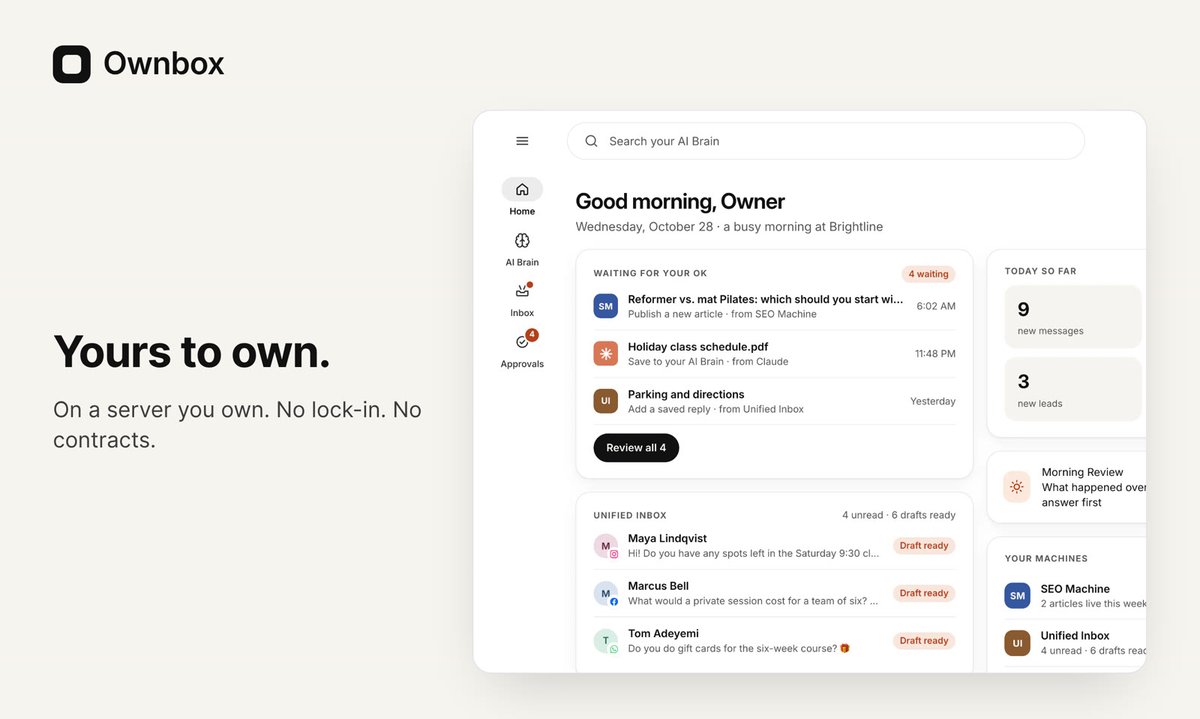
Ownbox is the anti-SaaS Business OS: your team and your AI agents work from one shared brain, get real work done, and your company can actually own your data and the code.
Come take a look: https://t.co/eXvGnej1o5
ChatGPT just launched business agents. Read the fine print:
1. The agent is only for US online and ecommerce businesses for now
2. OpenAI doesn't give you the conversations your agent has
3. It only lives inside ChatGPT
Comment REPORT for your free AI visibility report.
Claim your profile anyway. Claiming is free. Just don't let ChatGPT be the only place your business knows how to talk.
Comment REPORT for your free AI visibility report.
Every AI tool keeps its own slice of your business.
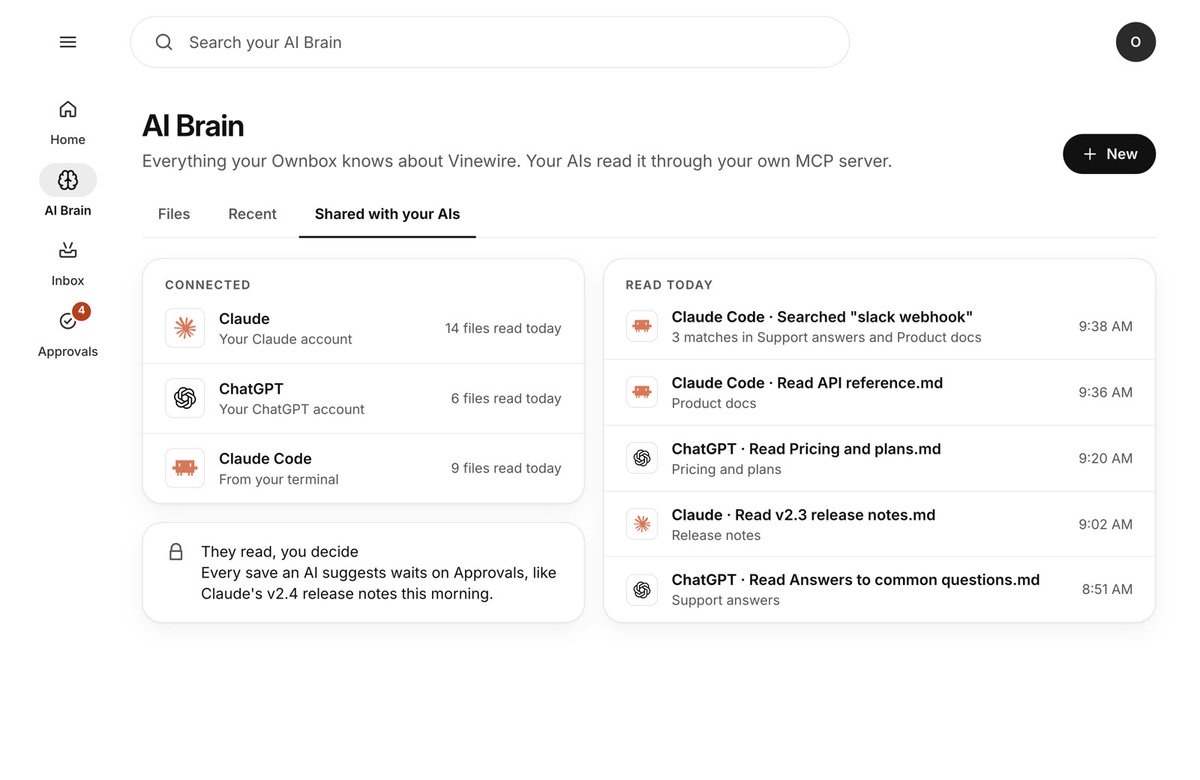
Ownbox gives Claude, ChatGPT and Claude Code one Company Brain through your own MCP server.
Try our Business Agent with no sign-up: add https://t.co/gqddI2K5yF to Claude.
https://t.co/eXvGneityx
Should your business own its company brain?
Yes. Whoever holds the brain holds the business.
After a year, it's every price, every answer that closed a deal and every playbook that worked. That's not a folder of documents. It's how your business thinks, written down.
Rent it, and you've signed up for:
• Another subscription, usually per seat
• Another silo
• Their roadmap and their price
• Their off switch
Before you choose any company brain, ask three questions:
1. Where does it live?
2. Can you take all of it with you, working?
3. What can its agents do without asking you?
If any answer makes you uncomfortable, that's your answer.
That's why I built Ownbox, the anti-SaaS Business OS you actually own.
Part three of my series:
https://t.co/wqzbdo342Q
SaaS never ends. You rent it by the seat, every month, forever, and your data lives on someone else's servers.
So we built the anti-SaaS: a Business OS your business owns after 12 payments.
Live on Product Hunt today: https://t.co/eXvGneityx
ChatGPT just launched business agents. Most local businesses can't have one yet.
For now, only online service and ecommerce businesses in the US can build an agent inside ChatGPT. A med spa, a gym or a dental office can claim its profile, and that's it.
Claim yours anyway. It's free. Just read the fine print:
• The agent lives only inside ChatGPT. Your customers also ask Gemini, Claude and Perplexity
• You see totals, like mentions and clicks. You don't see the conversations
• Promoting it runs through ChatGPT's ads
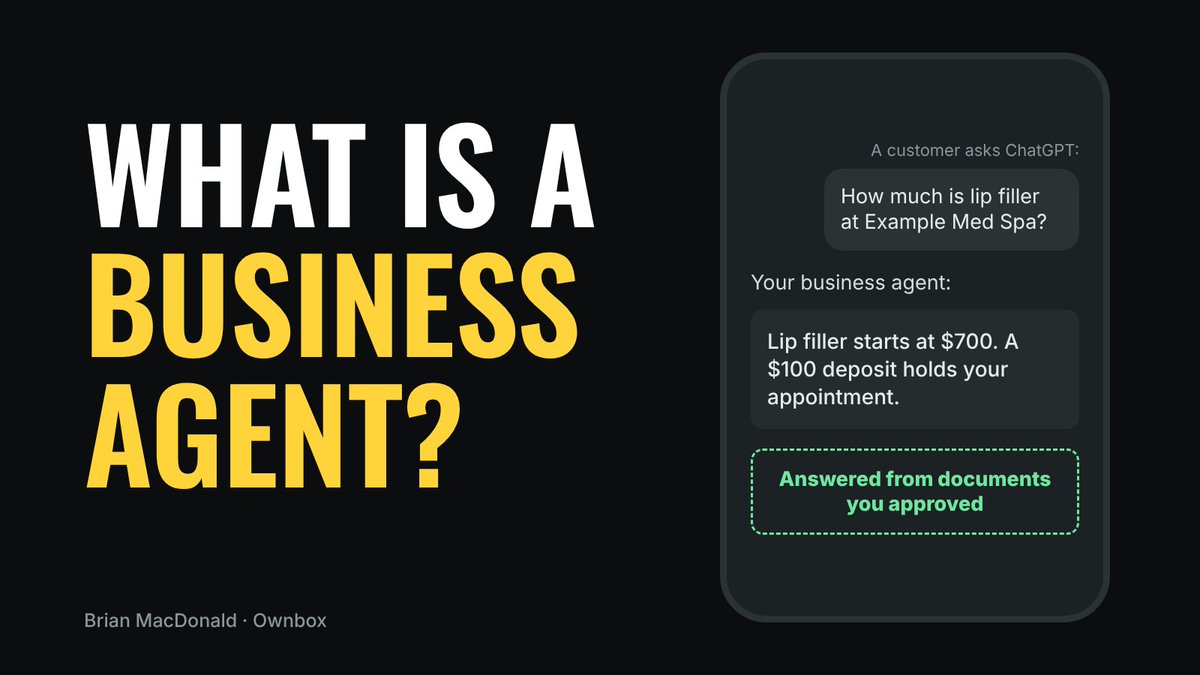
A business agent is the AI that answers for your business. The one worth having answers every AI, from documents you approved, in a place you own.
Give ChatGPT a copy. Keep the original.
What a business agent is, and how to get ready:
https://t.co/nijOVpBkYM
How do you actually build a company brain?
Here's mine. My business runs on one AI Brain: over a hundred documents with our offers, prices, policies and decisions.
• One Start here page that every person and agent reads first
• Folders by job, plus a Public folder
• One topic per document: each heading a question, the first sentence the answer
• A decisions log: newest first, one line each, with who decided
• Agents connect through MCP. They read, and they propose changes I approve from my phone
• The inbox comes in too. AI drafts the reply, and a person sends it
No copying what one tool knows into the next. Nobody explaining the business twice.
Part two of my series, the full build:
https://t.co/CogWhbrKgX
A ChatGPT business agent only works inside ChatGPT.
Your customers don't. Some ask ChatGPT. Some ask Gemini because it's on their phone. Some ask Claude or Perplexity.
And every AI company is building its own. Google has a Business Agent too, inside Search's AI Mode and the Gemini app. An agent you build in one doesn't show up in the other.
So you have two choices:
• Build an agent in every AI app, and keep them all in sync by hand
• Keep one original that every AI can read, and give each app a copy
I keep one original, on a server my company owns.
Your customers don't live in one AI. Your answers shouldn't either.
Why one agent isn't enough:
https://t.co/ePr2z9FEe5
ChatGPT now has a listing for your business. Claim it this weekend.
It's called Business Hub. It opened in beta on November 10, and claiming is free.
What you get:
• You check and correct what ChatGPT shows about your business
• You can add a product feed with current prices
• You see totals: mentions, clicks and common topics
What you don't get: the conversations. And it only covers ChatGPT.
So claim it, and fill it in from your own written answers, not from memory. Then keep the original in a place you own.
Claim the listing. Keep the original.
What Business Hub is, and what it isn't:
https://t.co/IQpETVkGx3
The best-run businesses don't have more AI tools. They have one brain every AI works from.
This is Ownbox: a shared company brain with a business agent built in, on a server you own.
Get your free AI visibility report at https://t.co/QPRuJa07qO
Your AI doesn't know your business until you give it the answers.
Here are the five documents I'd start with. Each one works in any tool:
1. The last five questions. Find the person everyone asks, and write down the last five questions they answered.
2. A decisions log. What you decided, who made the call, when and why.
3. The facts your AI gets wrong. Ask it what you charge and what your refund policy is. Write down the right answers, then ask again.
4. One brief per client. The job, the offer, what's approved and what changed.
5. A public page of answers. Who you help, what you sell and what it costs, written so AI assistants can find it.
Five documents, and your AI stops guessing.
The full guide:
https://t.co/XUuv1E60MG
What is a company brain?
It's one place that holds what your business knows: your offer, prices, policies, playbooks and best answers. Your team and every AI agent read from it and add to it.
Here's why every business needs one now.
Every AI tool you add knows one piece of the business. The chat assistant knows what you pasted this morning. The inbox tool knows your emails. The CRM knows your deals. None of them know what the others know.
So your people become the glue. They re-explain the business to every new chat and catch the mistakes before customers do.
A company brain fixes that:
• Agents read it, not just people
• Agents can add to it, with a person's yes
• It stays one place, not five copies drifting out of date
I run my own company on one. This is part one of my three-part series on building yours:
https://t.co/wwR4at8qwy
Nobody really knows how to get more leads from ChatGPT yet.
So companies are selling shortcuts. Some say they inject thousands of prompts into ChatGPT every night to push your business into its answers.
That's black hat. I'm sure it'll get shut down, if it even works at all right now.
Here's the white hat way. Clean, foundational work that builds a solid future and doesn't get you banned:
• Publish one page for each question your customers really ask, with the answer in the first sentence
• Add an llms.txt file: a plain text page that hands AI the fastest path to those answers
• Add a footer link labeled "For AI agents" that points to it
Google says it doesn't use llms.txt. We've seen the opposite. For one client, AI citations went up about 1,000% in the first two weeks. They started near zero, like most businesses do.
Nobody's talking about this yet. Everyone will be.
What goes in the file, with an example you can copy:
https://t.co/T8BjEk7ZjC
Why do your AI agents keep giving different answers?
Because each one is working from its own copy of your business.
ChatGPT knows what you pasted in last week. Your inbox tool knows your emails. Your website chatbot knows the FAQ page from launch day. Ask all three the same question and you get three answers.
The average company already runs 12 AI agents. Half of them work alone. And 68% of companies have traced a confidently wrong AI answer back to missing or inconsistent business information.
A smarter model won't fix it. A smarter model just quotes the wrong price more convincingly.
The fix is one place for the facts, a company brain, that every agent reads before it answers:
• Each fact lives in one place
• Every agent reads it first
• Agents suggest updates, and a person says yes
The agents are multiplying. The context isn't.
Here's the full answer:
https://t.co/EeUHYuq5XP
How many leads are you getting from ChatGPT?
In the first two weeks, one of our clients saw a 1,000% jump in AI citations. Last year 6% of consumers used AI to get a business recommendation; this year it's 45%. And AI doesn't hand them ten options, it names one or two.
So the question is: when your customers ask about your products or services, does AI recommend you?
I built an AI Search Visibility Report to answer exactly that:
• 20 questions your customers actually ask, run through ChatGPT, Google AI Mode, Gemini and Perplexity: whether you're named, recommended or cited, and who shows up instead
• What AI needs from your website to trust and recommend you, and whether yours has it
• A ranked list of fixes and high value next steps, in plain words
It's normally $200. For the first few people I know, it's $5. It runs through Upwork, so you'll need a free Upwork account. Here's the link: https://t.co/M1dPXUmJ8Q
You'll have your report and strategy plan about 1 day after I have your website address.
Brian
https://t.co/Xrd00gDtAH
@asavs_ Yes, GitHub actions are Such a scam and rip off. Better to create your own test runner server like I just did over the weekend. Thankfully it’s now only $20 per month (digital ocean droplet) to run CI testing versus well over $500 previously.