Paank Coordinator Reports Over 1,900 Enforced Disappearances in Balochistan Since 2025 at BNM Conference
Wednesday, 18 November, 2026 | #BNMConferences ,
#13NovBalochMartyrsDay , #BNMinGermany , #Girarun
https://t.co/NJUdRN5kri
Human rights coordinator of Paank has told a conference in Germany that Paank recorded 1,355 cases of enforced disappearances in Balochistan in 2025 and a further 556 in the first half of 2026, along with hundreds of extrajudicial killings.
Speaking at a Baloch National Movement (BNM) event in Hannover on Baloch Martyrs’ Day, the Paank coordinator said the day commemorates Baloch martyrs, including Mir Mehrab Khan and his companions. He stressed that every name represents a family and that the basic rights to life, freedom and dignity have been denied for many years.
He told the families of the forcibly disappeared and the killed that their loved ones are not forgotten and that their pain matters. He called for honouring the martyrs through continued activism, unity and the pursuit of what he described as the goal of national freedom (Raji Ajoi).
Presenting the organisation’s data, he said Paank documented 1,355 enforced disappearances and 225 extrajudicial killings in 2025. In the first half of 2026, he said, another 556 disappearances and 227 killings were recorded. He acknowledged the difficulties of collecting information from across Balochistan.
He also referred to a press conference held on 20 October by the Balochistan government, in which Additional Chief Secretary Hamza Shafqat was reported to have stated that 60,000 military raids, intelligence-based actions and house searches had taken place in Pakistan between January and 20 October 2026. According to the same briefing, 3,000 families had been identified as having alleged links to militants and were compelled to hold press conferences.
Dr Lakhu Luhana Says Army Dominance Has Turned Balochistan into Fascist Colony at BNM Conference
Wednesday, 18 November, 2026 | #BNMConferences ,
#13NovBalochMartyrsDay , #BNMinGermany , #Girarun
https://t.co/xMlj3t3HBj
The chairman of the World Sindhi Congress has told a conference in Germany that the sacrifices of Baloch martyrs have transformed Baloch society and that the current situation in Balochistan amounts to a form of “fascist colonialism”.
Dr Lakhu Luhana, speaking at a Baloch National Movement (BNM) event in Hannover marking Baloch Martyrs’ Day, said the martyrs gave their lives so that their nation could live in freedom, peace and dignity on its own land. He described periods of subjugation as the darkest times in the history of nations, but said the martyrs showed that no people can be kept in chains indefinitely if they refuse to accept them.
He argued that the sacrifices have produced what he called a “magic” in Baloch society: the rise of a middle-class leadership and a significant role for women. He said thousands of women are now active in the struggle for rights and freedom, an internal liberation that would otherwise have taken decades or centuries.
Luhana rejected the description of the situation as mere internal colonialism. He said the phenomenon has changed form over time and that Balochistan is now under what he termed fascist colonialism driven by Punjabi chauvinism and the overwhelming dominance of the army. He claimed that politicians are not elected but employed by the military, that parliament and the judiciary have been hollowed out, and that the ruling elite is morally bankrupt.
He said the state’s economic model rests on the extraction of resources from oppressed nations and on foreign funds obtained by acting as a proxy. With those external sources weakening and Pakistan’s economy under severe strain, he argued, the military’s greed has deepened and it is now seeking to take almost everything that remains — land, minerals and water — from Balochistan and other regions. He cited reports of millions of acres of land being taken and mineral samples being offered for sale abroad.
Luhana linked the increased desperation of the state to a rise in enforced disappearances, extrajudicial killings, collective punishments and pressure on relatives of activists living abroad. He noted that international attention to human rights has diminished as global powers face their own problems. He also observed that struggles are growing among Baloch, Pashtuns, Sindhis and even in Pakistan-administered Kashmir because people see no other option for survival.
Quoting the late Sindhi leader G.M. Syed, he said consistent, honest work with clear strategy and commitment would eventually cause the system to make mistakes and weaken. He described the Baloch and Sindhi struggles as mutually reinforcing and said the martyrs of one nation are the martyrs of the other. He ended by expressing hope that freedom, dignity and peace would come sooner rather than later through continued commitment and strategy.
Baloch Nation Ready to Extend Full Political and Diplomatic Support to the People of Kashmir Against Pakistani Oppression: Dr. Naseem Baloch
Tuesday, 17 November, 2026 | #ChairmanBNM
https://t.co/OphTEZUfRr
Dr. Naseem Baloch, Chairman of the Baloch National Movement (BNM), has strongly condemned the atrocities being committed by Pakistani forces against the peaceful protests and sit-ins led by the Joint Awami Action Committee in Rawalakot, Mirpur, Kotli, Muzaffarabad, Bagh and other areas.
He said that since 5 November 2026, unarmed civilians and innocents children have been killed and injured in Rawalakot by Pakistani security forces. The use of lethal force against civilians, indiscriminate firing, arbitrary arrests, and gross human rights violations are part of a broader state crackdown being perpetrated by the Pakistani state in different areas of Kashmir since June 2026. Over 100 innocent lives have been lost and hundreds of activists and supporters have been illegally arrested or forcibly disappeared.
In its fact-finding report issued on 29 August 2026, the Human Rights Commission of Pakistan (HRCP) expressed serious concern over the disproportionate use of force in so-called Azad Jammu and Kashmir, the arrests of political activists and journalists, communication restrictions, and the inclusion of several Joint Awami Action Committee members in the Fourth Schedule under the Anti-Terrorism Act.
Dr. Naseem Baloch said that the state repression and violence currently faced by the people of Kashmir are experiences that the Baloch nation has endured for decades. When the Baloch people raised their voices for their national rights, identity, land, resources, and political future, their demands were met with brutal military crackdown, enforced disappearances, extrajudicial killings, and arrests of the activists.
The same situation is now unfolding in Kashmir, where the people of a region officially referred to as “Azad Jammu and Kashmir” are facing the full might of the Pakistani statefor peacefully demanding their fundamental political and civil rights. Dr. Naseem Baloch stated the the people of Kashmir cannot be denied their fundamental right to decide for themselves what they want in terms of their future, political status, and collective identity.
Dr. Baloch has assured the people of Kashmir the having suffered endless brutalities at the hands of Pakistani state, the Baloch National Movement understands the grievances of the people of Kashmir.
The Baloch nation stands in solidarity with the people of Kashmir un their darkest hour and the Baloch National Movement stands ready to extend all political, moral, and diplomatic support to Kashmiris in their just struggle against Pakistani state.
Rafi Ullah Kakar Says at BNM Conference Colonialism Persists in Balochistan
Monday, 16 November, 2026 |#BNMConferences , #13NovBalochMartyrsDay , #BNMinGermany , #Girarun
https://t.co/zAWZ4KPXrt
A University of Cambridge researcher has told a conference in Germany that Pakistan’s post-colonial state continues to govern Balochistan using colonial-era tactics, describing the situation as a form of “internal colonialism”.
Rafi Ullah Kakar, a PhD student specialising in the political economy of development and conflict and a Dawn columnist, spoke via Zoom at a Baloch National Movement (BNM) event in Hannover marking Baloch Martyrs’ Day. He began by recalling the resistance of Mir Mehrab Khan against British forces in the 19th century, but said his main focus was the continuity of colonial methods after independence.
Kakar argued that three pillars shape the state’s approach to Balochistan: the use of manufactured leadership that depends on Islamabad rather than local legitimacy; an economic model that treats the Balochistan mainly as a source of raw materials and a transit corridor, with limited benefits for local people; and a security policy based on coercion rather than political accommodation.
He said the state has long relied on militant proxies, both in foreign policy and against domestic nationalist movements. While officials claim the “good Taliban, bad Taliban” distinction has been abandoned, he suggested the approach has been repackaged through support for new armed militias used in counter-terrorism operations. He also noted reports that some political and tribal leaders in Balochistan have been pressured to raise their own tribal lashkars, calling this a dangerous surrender of the state’s monopoly on violence.
On the current situation, Kakar said political dissent has been criminalised, freedom of speech and political activity severely restricted, and livelihoods disrupted. He listed practices he described as colonial-era tactics: collective punishment, destruction of homes and orchards, and the detention of families of alleged insurgents. Such measures, he said, have no place in a modern state.
He concluded that although formal colonialism has ended in Balochistan, internal colonialism survives in the unresolved questions of political representation, ownership of resources and the dignity of local communities. The state, he added, continues to respond to these issues with colonial methods.
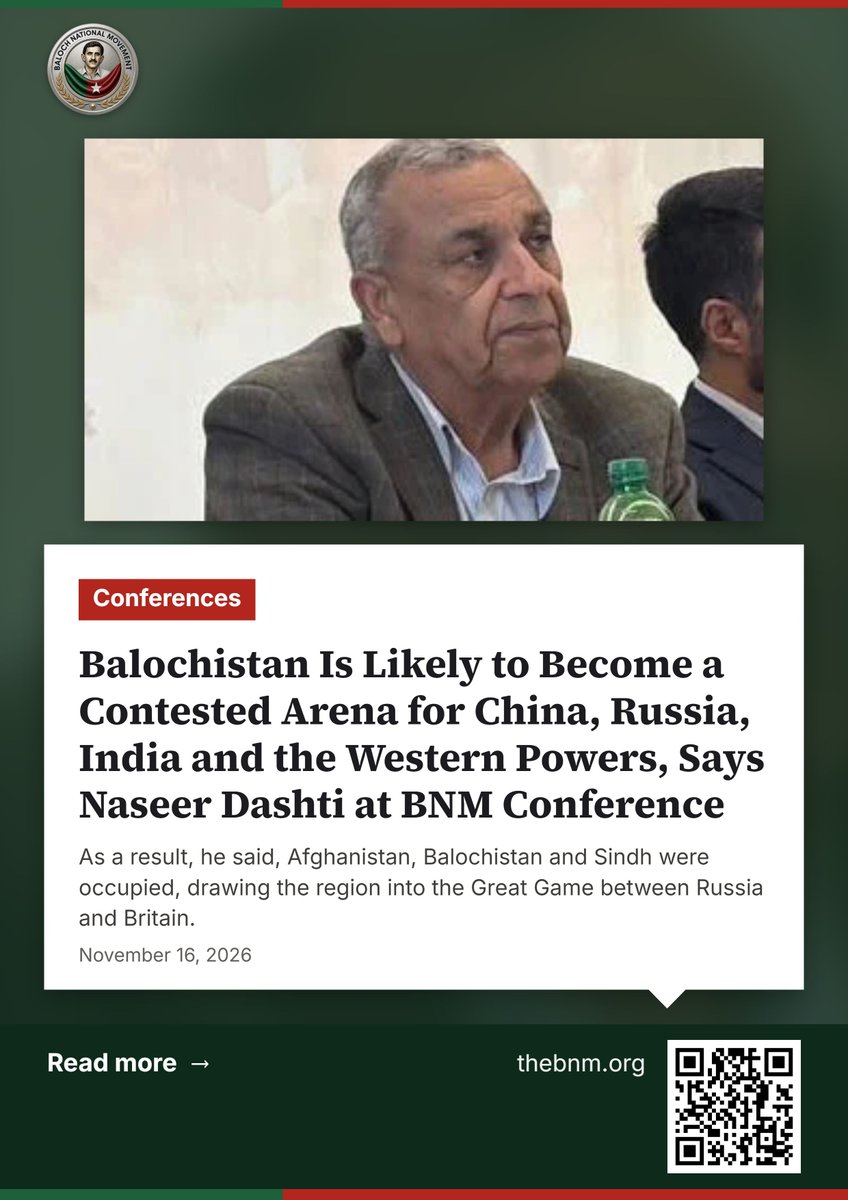
Balochistan Is Likely to Become a Contested Arena for China, Russia, India and the Western Powers, Says Naseer Dashti at BNM Conference
Monday, 16 November, 2026 |#BNMConferences , #13NovBalochMartyrsDay , #BNMinGermany , #Girarun
https://t.co/MaeCut7hof
Baloch writer and intellectual has told a conference in Germany that commemorating martyrs is not enough and that the younger generation must understand why Balochistan has suffered for nearly two centuries.
Dr Naseer Dashti, speaking in Hannover at a Baloch National Movement (BNM) event marking Baloch Martyrs’ Day, recalled the British occupation of Kalat on 13 November 1839, when he said General Wiltshire’s forces killed the Khan-e-Kalat and 700 of his followers. He said thousands of Baloch men and women have since lost their lives for national dignity and sovereignty.
He argued that the best tribute to those who died is for today’s political activists and writers to answer a basic question: why has the suffering continued for 180 years? Understanding that history, he said, would help the new generation give clearer direction to their struggle.
Dashti described Balochistan as a repeated victim of distant events, geography and ideology. He pointed to the 1807 Treaty of Tilsit between Napoleon and the Russian Tsar, which he said contained a secret clause about invading India and prompted Britain’s Forward Policy. As a result, he said, Afghanistan, Balochistan and Sindh were occupied, drawing the region into the Great Game between Russia and Britain.
He continued that the 1917 Russian Revolution and its anti-imperialist rhetoric influenced Baloch activists in the 1920s and 1930s, but after the Second World War most colonised peoples gained independence while the Baloch did not. During the Cold War, he said, the United States and the Soviet Union gave support to the states controlling Balochistan, enabling joint Pakistani-Iranian aggressions in 1973–74, including the use of Iranian gunships.
The Afghan conflict of the 1980s, he added, further damaged Baloch society by promoting fundamentalism, elevating the role of religious figures and introducing the drugs trade. He warned that Europe is now polarising, its economies are under strain and extreme nationalism is rising. Within a few years, he predicted, Europe may abandon its role as a champion of human rights and liberal democracy, leaving suppressed nations in Asia and Africa with less external support.
Dashti also noted the recent discovery of large quantities of rare-earth minerals in Balochistan, saying the land is likely to become a contested arena for China, Russia, India and the Western powers. He urged writers and activists of the new generation to closely study political changes in Europe and North America and their likely impact on the region.
Spanish Journalist Karlos Zurutuza Highlights Media Blackout on Balochistan at BNM Conference
Monday, 16 November, 2026 |#BNMConferences , #13NovBalochMartyrsDay , #BNMinGermany , #Girarun
https://t.co/b8S1Dajwm8
A Spanish journalist who has reported on Balochistan has told a conference in Germany that the region remains almost invisible in the international media despite its strategic location and the severe risks faced by local reporters.
Karlos Zurutuza, speaking in Hannover at a Baloch National Movement (BNM) event marking Baloch Martyrs’ Day, said he can no longer visit Balochistan and that opportunities to meet Baloch people in Spain are rare. He said his aim is to continue covering the region remotely through phone interviews and conferences while trying to explain why it receives so little media attention.
He noted that Balochistan borders Pakistan, Iran and Afghanistan — areas frequently in the news because of the Taliban, Al-Qaeda and other groups — yet the Baloch people themselves, who he described as direct targets of such groups, are largely unknown to the outside world.
Zurutuza said foreign journalists face serious obstacles. He cited cases of New York Times reporters, including Carlotta Gall, who he said was beaten and expelled in 2006, and another reporter expelled after a single story. He added that even if he could return safely, he would hesitate because he does not speak Balochi, Urdu or Farsi and would rely on local fixers and translators who would then be at risk of harassment, imprisonment or worse.
He described the dangers for local journalists, citing the cases of Karima Baloch, who died in Canada after going into exile, and a Baloch journalist found dead in Sweden. He said colleagues have faced financial pressure on editors, direct threats to their families, and self-censorship. Citing Reporters Without Borders, he said Pakistan ranks 153rd on the World Press Freedom Index and that censorship in Balochistan has become bureaucratised, with recent requirements for media to obtain clearance before reporting on security forces. He referred to figures from Freedom Network stating that at least 40 journalists have been killed in Balochistan over the past two decades.
Zurutuza also mentioned the case of Mahrang Baloch, who he said was in contact with him before her arrest and remains imprisoned despite a Nobel Peace Prize nomination.
Rather than making appeals to the United Nations, he said the practical step for journalists is to train local reporters in secure communication methods and build networks so their stories can reach editors who recognise the importance of the Baloch issue. He said he has done similar media training work in conflict zones including Libya, Iraq and Nagorno-Karabakh.
At BNM Conference, Ayesha Siddiqa Admits She No Longer Trusts the Pakistani State
Monday, 16 November, 2026 |#BNMConferences , #13NovBalochMartyrsDay , #BNMinGermany , #Girarun
https://t.co/5GJX3ISr4a
Addressing a conference in Hannover, Germany, organised by the Baloch National Movement (BNM) on Baloch Martyrs’ Day, political analyst and author Ayesha Siddiqa said she no longer has confidence that the Pakistani state can protect its citizens or has the capacity to address their grievances.
Speaking at the gathering, she said she has attended BNM’s annual event for years out of solidarity with the Baloch, but this time she wanted to share her own sense of personal tragedy. She said forcibly taking away people’s sons and daughters from their mothers and fathers is an act for which there can be no justification.
Recalling her past, Siddiqa said that around 2012–2014 she joined a protest in Islamabad when Mama Qadir and the relatives of the disappeared marched on foot from Shaal. She said her purpose at the time was also to stand up for Pakistan, because if she did not stand with those who had marched all the way, she would have had no moral ground to ask the Baloch to remain part of the country.
More than a decade later, she said that sense of belonging has gone. “What am I protecting?” she asked. According to her, the violence and authoritarian nature of the state have expanded, and she no longer trusts it.
Criticising Pakistan’s state structure, Siddiqa described it as a colonial and rent-seeking state. She said Pakistan was a bureaucratic polity from the beginning rather than a genuine political state, and that the military’s role was not accidental. She said the current system has taken the form of “constitutional militarism.”
She strongly criticised political parties and parliament, saying they have effectively surrendered. According to her, parliament has willingly approved restrictions on the media and other measures demanded by the military. She said institutions including the judiciary and civil bureaucracy have been weakened, while an alliance of military and civilian elite interests now dominates the distribution of resources.
Linking enforced disappearances, fear and repression to resource extraction, Siddiqa said the state is ready to sell mineral resources from Balochistan, Pakhtunkhwa and other areas without effective public consultation or accountability. She said fear, silence and repression are used as tools to sustain this process and protect the interests of those who control the resources.
Referring to a recent conference in Islamabad attended by Field Marshal Asim Munir, she said mineral resources were being offered without taking parliament into confidence or consulting the people of the areas concerned.
Siddiqa compared the Baloch mothers struggling against enforced disappearances with Argentina’s Mothers of the Plaza de Mayo. She said mothers in both places were denied information about their disappeared loved ones, subjected to accusations, and their appeals ignored.
She also referred to a book documenting the struggle of the Argentine mothers and ended her speech by paying tribute to Baloch women who, despite state pressure and risks, continue their struggle for the recovery of their missing loved ones and for justice.
Shamirani Ruch 2026 | BNM Conference in Hannover, Germany
On 14 November 2026, the Baloch National Movement (BNM) will hold a conference in Hannover, Germany, to mark Baloch Martyrs’ Day.
Balochistan: The Struggle for Freedom, Identity and the Legacy of Sacrifice
Speakers:
Dr Naseem Baloch, Karlos Zurutuza, Dr Naseer Dashti, Lakhu Luhana, Manzoor Pashteen, Rafi Ullah Kakar, Ayesha Siddiqa and Hatim Baloch
Moderators: Saleem Baloch and Nadeem Saleem
We invite everyone to join us in remembering those who sacrificed their lives for the Baloch nation.
#13NovBalochMartyrsDay
#Balochistan
#Girarun
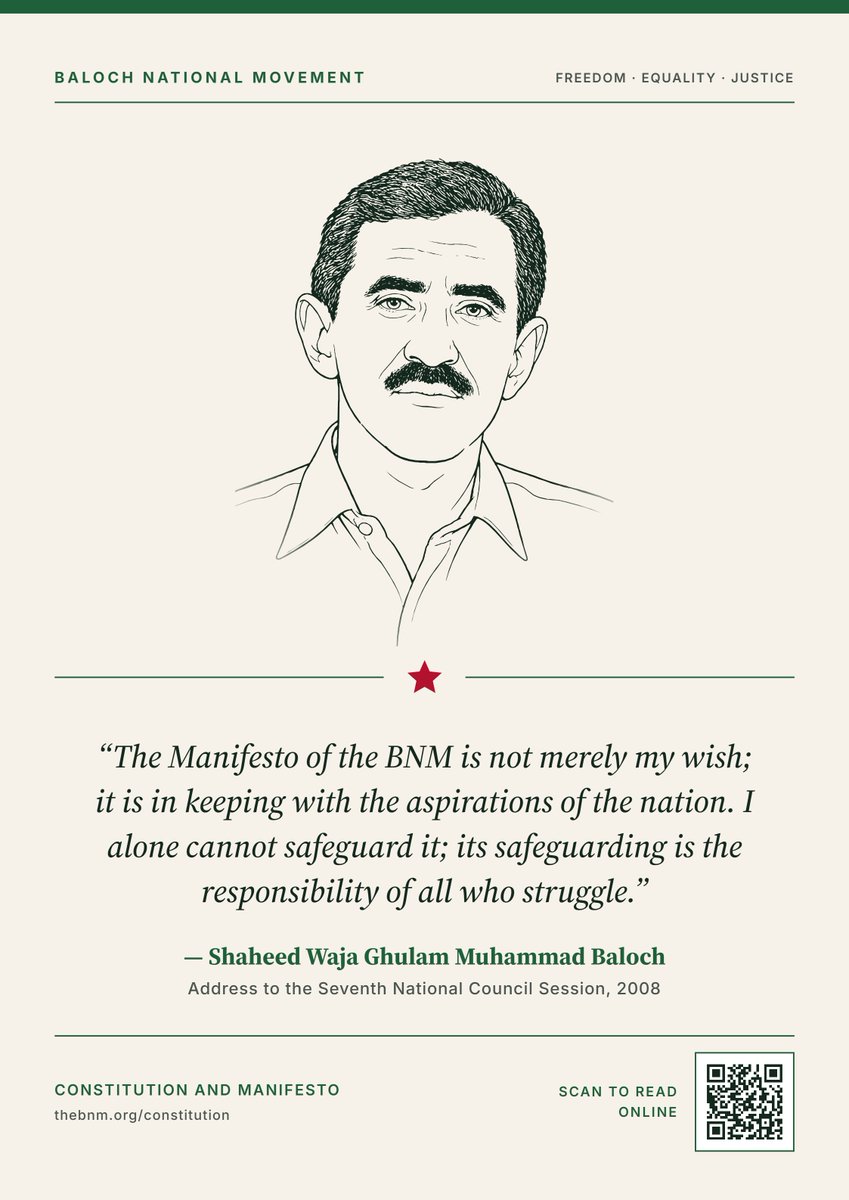
Baloch National Movement — Constitution and Manifesto (English)
Read and search online:
https://t.co/JMKhz6uu1k
Download:
https://t.co/dOOin2SLBI
#BNMConstitution
A Kurdish newspaper,Yeni Özgür Politika, @y_ozgurpolitika
interviewed @DrNaseemBaluch Chairman of the Baloch National Movement (BNM), on Balochistan’s national struggle, China’s growing role through CPEC and Gwadar Port, and the Baloch people’s right to self-determination.
#Balochistan
Read the full interview: https://t.co/tPXplaylIu…
Shamirani Roch
English Banner with QR Code:
Download Link:
https://t.co/PfkwqxjbOj
Balochi Banner with QR Code:
https://t.co/npjZj0apys
#13NovBalochMartyrsDay#Balochistan#Girarun
A Kurdish newspaper, Yeni Özgür Politika, interviewed @DrNaseemBaluch Chairman of the Baloch National Movement (BNM), on Balochistan’s national struggle, China’s growing role through CPEC and Gwadar Port, and the Baloch people’s right to self-determination.
#Balochistan
Read the full interview: https://t.co/CrwLbHaDWs
BNM Gives Top Priority to Enhancing the Skills of Its Members: Dr. Naseem Baloch Addresses Capacity Building Meeting
Wednesday, November 11, 2026 | #BNMCapacityBuilding
https://t.co/zHe6S78bzb
A meeting of the Capacity Building Advisory Council, the capacity-building institution of the Baloch National Movement (BNM), chaired by BNM Chairman Dr. Naseem Baloch. The meeting was attended by Dr. Jalal Baloch, who is in charge of BNM’s training and education affairs, along with presidents and general secretaries of chapters established in various countries and regions. The purpose of the meeting was to review the activities and performance of the Education and Training Department over the past four years, and to discuss the future course of action.
Dr. Naseem Baloch shed detailed light on the importance and utility of the institution and, praising its overall performance, said that it is our good fortune to be members of a party that has always given top priority to improving the capabilities of its members and helping them flourish.
Dr. Naseem Baloch further said that, thanks to the institutional framework devised for the party at the Council Session, the party’s various institutions are now performing their work well. Owing to the performance of these institutions, a batch of cadres has been prepared over the past four years, and it is essential for the success of any party that it has successors to its cadres and leaders.
During the meeting, Hafeez Baloch, focal person of the Capacity Building Council, presented the four-year performance report. He highlighted the various training activities, programs, and workshops organized by the institution. According to the report, over the past four years, 499 study circles were held on various topics, of which 30 were at the central level and 469 programs at the zonal and chapter levels. In addition, four workshops on different topics were also successfully conducted during this period.
On this occasion, discussion was also held on the need to make organizational activities more effective, improve coordination among the various chapters, and carry the training process forward with continuity. Participants stressed that training and capacity building at the organizational level are important for the effective functioning of any political organization.
The meeting also considered the future course of action. In this regard, proposals were discussed on holding training diwans, workshops, and other intellectual and organizational activities in the future, improving the performance of chapters, and making the work of the training institution better organized.
BNM Vice Chairman and constitutional head of the Department of Education and Training, Dr. Jalal Baloch, said that the political and intellectual training of workers is of fundamental importance for the strength and effective progress of any political movement. The Capacity Building institution is playing an important role in refining workers’ abilities, raising organizational awareness, and aligning them with the demands of the national movement. He stressed that all chapters will have to play a more active role to make this process more effective and organized.
In conclusion, he said that over the past four years our institution has not only succeeded in holding four hundred and ninety-nine (499) study circles, but significant progress has also been made on the party syllabus, with four books and six booklets published. All of this was made possible by the hard work and intellectual maturity of the members of the Capacity Building Council team.
No International Investment in Balochistan’s Mineral Resources Will Be Accepted Without the Consent of the Baloch Nation: BNM Spokesperson
Wednesday, 11 November 2026 | #BNMSpokesperson
https://t.co/k07mjYWRx0
The spokesperson for the Baloch National Movement (BNM) has expressed serious concerns over the Pakistan Minerals Investment Forum (PMIF26), scheduled to take place in Islamabad on November 12–13, stating that Pakistan seeks to transform the exploitation of Balochistan’s natural resources into an international economic enterprise by involving foreign investors and multinational corporations. Held under the banners of investment and development, the forum is, in reality, an attempt to deprive the Baloch nation of its own resources and perpetuate its poverty, deprivation, and economic subjugation. We describe this as mineral colonialism, a system in which external powers reap the benefits of a region’s natural wealth while its indigenous population is subjected to exploitation and marginalisation.
The spokesperson stated that no foreign investment, mining project, or extraction of natural resources in Balochistan can be considered acceptable without the free, genuine, and collective consent of the Baloch nation. Any agreements concluded by disregarding the will and political status of the Baloch nation will remain illegitimate and unacceptable, further deepening the ongoing conflict and potentially escalating violence in the region. We urge all international mining companies, investors, and financial institutions to refrain from investing in Balochistan. Balochistan is an occupied territory and a region experiencing an ongoing conflict. Under these circumstances, the international community has a moral and political responsibility to support the Baloch nation's right to self-determination and their struggle for freedom, rather than becoming complicit in the economic interests of an occupying state.
The spokesperson further stated that enforced disappearances, extrajudicial killings, unlawful arrests of political activists and leaders, fabricated criminal cases, and systematic attempts to silence political voices in Balochistan form part of a broader system aimed at suppressing the political and economic rights of the Baloch nation and maintaining control over its natural resources. For decades, the Baloch nation has struggled for its national identity, its homeland, and the right to exercise control over its resources. The continued sacrifices of Baloch men, women, and youth are a testament to the enormous human cost of this struggle. Claims of development and prosperity in Balochistan that disregard these realities are nothing more than an illusion. International companies must recognise that exploiting Balochistan’s resources without the consent of the Baloch nation risks making them complicit in a contested and exploitative enterprise.
The BNM spokesperson called upon the United Nations, international financial institutions, and the wider international community to make the free consent of the Baloch nation a fundamental condition for any project involving Balochistan’s natural resources, to take notice of human rights violations, and to respect the political and national rights of the Baloch nation. The spokesperson emphasised that Balochistan is not a mineral colony; it is the homeland of the Baloch nation. The right to decide the fate of its resources belongs to the Baloch people, not to an occupying state or its international partners. Any project imposed against the will of the Baloch nation will only perpetuate exploitation, resistance, and further instability. Genuine peace, development, and prosperity in Balochistan can only be achieved through the freedom and self-determination of the Baloch nation and its sovereign control over its own natural resources.
Paank Report: Nearly 5,000 People Forcibly Displaced from Shadi Kaur, Pasni
Monday, 11 November 2026 | #PaankReports
https://t.co/x0LQPqHJXE
Paank, the human rights body of the Baloch National Movement (BNM), says in its latest report that almost the entire population of Shadi Kaur in Pasni tehsil, Gwadar district, around 5,000 Baloch residents, was forcibly evicted from their ancestral lands on 11 and 12 July 2026.
According to the report, the displacement followed military actions, enforced disappearances, mass detentions, restrictions on the supply of essential goods, and evacuation orders issued by the Pakistan Army. On 9 and 10 July, army personnel ordered residents to leave their homes and warned that the houses of anyone who stayed would be burned.
Aggression and Human Rights Violations
Paank states that on 5 May 2026, Pakistan Army and affiliated intelligence personnel detained between 85 and 100 men. The detainees were reportedly tortured, made to lie in the sun, and had stones forced into their mouths when they cried out. About 40 of them were taken to a military camp near the Shadi Kaur Dam and forcibly disappeared. Many remain forcibly disappeared in military custody.
The report says a three-day military siege from 5 to 8 May restricted movement in Shadi Kaur, Zarin Kaur, Trati, Gorestani and Kabadi. During this period, eight people, including women and children returning from medical treatment, were held for two days. Throughout May and June, food and household supplies were repeatedly turned back at the Gabdi checkpoint.
The report also names Sardil, son of Sher Khan, who was forcibly disappeared by Pakistani military intelligence personnel on 22 November 2025. His mutilated body was found near Pasni on 30 May 2026.
Human and Cultural Impact
According to Paank, the displaced Baloch families have been forced to move to Pasni, Hormara, Turbat and surrounding towns, where many are living in tents. Roughly 10,000 acres of farmland have been abandoned, severely affecting agriculture, food security, education, healthcare and traditional livelihoods. The report says the displacement threatens the Baloch people’s ancestral bond with their land and the intergenerational transmission of their cultural and historical identity.
A Wider Pattern of Repression
Paank says it documented 1,355 enforced disappearances and 225 extrajudicial killings in 2025. Between January and June 2026, it recorded 556 enforced disappearances and 227 extrajudicial or custodial killings. The organisation adds that in October 2026, an evacuation order was also issued for about 30,000 people in Shor Parood, in the Kalat region.
International Legal Obligations and Recommendations
The report argues that the violations raise serious concerns under the International Covenant on Civil and Political Rights (ICCPR), the International Covenant on Economic, Social and Cultural Rights (ICESCR), the Convention against Torture, the UN Guiding Principles on Internal Displacement, and Article 10 of the UN Declaration on the Rights of Indigenous Peoples.
Paank calls for an immediate end to forced evictions, disclosure of the whereabouts of the disappeared, independent investigations, and humanitarian assistance. It also calls for guarantees of the safe, voluntary and dignified return of the local Baloch population.
BNM Holds Protest Rally in The Hague Against Deportation of Rashid Ahmed, Also Known as Fida Baloch
Saturday, 7 November 2026 | #BNMProtests, #BNMinNetherlands
https://t.co/OIjeFPeGFy
The Baloch National Movement (BNM) held a protest rally in front of the Parliament in The Hague, Netherlands, against the deportation of Rashid Ahmed, also known as Fida Baloch. The protesters urged the Dutch authorities to urgently review his case. The aim of the demonstration was to draw the attention of the Dutch authorities, human rights organisations and the international community to the circumstances of Rashid Ahmed’s deportation.
Jamal Baloch, Mohammad Muheem, Sunny Baloch and Saif Obaid addressed the rally. The speakers stressed the seriousness of the case and said it must not be overlooked. They called on the Netherlands to uphold its human rights obligations in deportation matters, and said that the safety and protection of the individuals concerned must be taken into account in such decisions.
During the rally, BNM also submitted a formal petition to Mr. Bart van den Brink, Minister of Asylum and Migration of the Netherlands. The petition called on the Dutch government to urgently review the case of Rashid Ahmed, also known as Fida Baloch, and to ensure that his safety, fundamental rights and protection are given due consideration.
BNM to Hold Central Programme Commemorating Baloch Martyrs’ Day in Hannover, Germany
The Baloch National Movement (BNM) will hold its central programme to commemorate Baloch Martyrs’ Day in Hannover, Germany, on 14 November 2026.
The conference, titled “Balochistan: The Struggle for Freedom, Identity and the Legacy of Sacrifice,”will pay tribute to the Baloch martyrs and reflect on their sacrifices, the history of the struggle for freedom, and the importance of preserving Baloch national identity.
The event will bring together participants to honour those who sacrificed their lives for their nation, homeland, and national identity, while highlighting the significance of their sacrifices and the enduring legacy of their struggle.
Date: 14 November 2026
Location: Hannover, Germany
Organised by: Baloch National Movement (BNM)
#13NovBalochMartyrsDay
#BNMinGermany
Dr Naseem Baloch Meets UN Committee Members, Calls for Pakistan to Be Held Accountable
Thursday, 5 November 2026 | #BNMChairman
https://t.co/KOUo5QQxkI
Dr Naseem Baloch, Chairman of the Baloch National Movement (BNM), raised serious human rights violations in Balochistan with members of the UN Committee on Economic, Social and Cultural Rights (CESCR) during Pakistan’s second periodic review. He called on the Committee to hold Pakistan accountable for failing to meet its international obligations. He also urged the United Nations to set up a dedicated mechanism to investigate and monitor human rights violations in Balochistan, and to give the Baloch nation a formal platform where its voice can be heard directly.
Dr Naseem Baloch met Committee members Michael Windfuhr and Julieta Rossi and told them about enforced disappearances, extrajudicial killings, collective punishment, and the denial of basic economic, social and cultural rights to the Baloch nation. He said these conditions cannot be separated from Pakistan’s systematic repression of the Baloch nation.
Describing enforced disappearances and collective punishment in detail, he said thousands of Baloch families have lived through this ordeal, and its effects reach far beyond the direct victims. Families lose their breadwinners, children lose their chance at an education, and entire households are pushed into poverty.
He also raised concern over the imprisonment of Baloch human rights defenders, including Dr Mahrang Baloch and other leaders of the Baloch Yakjehti Committee (BYC). He cited the sentences handed to Imaan Mazari and her husband Hadi Ali Chattha as an example of how harshly peaceful people who speak up for Baloch rights are punished.
Citing Article 1 of the International Covenant on Economic, Social and Cultural Rights (ICESCR), Dr Naseem Baloch reminded the Committee that all peoples have the right to self-determination, including the right to freely dispose of their natural wealth and resources. He also referred to Articles 11, 12 and 13, which protect the rights to an adequate standard of living, health and education.
Challenging Pakistan’s claim to be meeting these obligations, he asked: “How can Pakistan claim compliance while these rights are being denied in Balochistan?”
He told Committee members: “We are not asking for sympathy. We are demanding justice, accountability and our fundamental rights.”
Dr Naseem Baloch also attended the Committee’s formal review session, where a Pakistani delegation of about 12 representatives appeared to answer questions on the country’s implementation of the Covenant. During the session, Julieta Rossi repeatedly asked about the situation in Balochistan, and Michael Windfuhr also raised issues concerning the region. Their questions made Balochistan part of the Committee’s formal review of Pakistan.
At the end of the session, Dr Naseem Baloch gave further dossiers to the Committee Chair and to members L. E. Perez and Fiorio Vaesken. The dossiers set out human rights violations in Balochistan and what they mean under the Covenant.
Fiorio Vaesken showed particular interest in the documents. He reviewed them himself, pointed out several issues that fall within the Committee’s mandate, and assured Dr Naseem Baloch that he would raise these matters before the Committee the next day.