Margaret Thatcher: Countries are not rich in proportion to their natural resources. Richness comes from human creativity, initiative, enterprise, and a free and open market operating under a rule of law that people can trust.
For over five hundred years, and in many ways a thousand years, the most clear-sighted thinkers have understood this truth.
Yet corrupt and arrogant leaders hungry for absolute power have repeatedly refused to let enterprising individuals flourish and create real wealth.
Everywhere you look, politicians claim credit for every success while blaming others for every failure. The truth is exactly the opposite.
Enterprising and creative individuals, when given freedom, are the sole source of genuine wealth creation. Politicians and the political systems they build are moochers who stand in the way of true freedom and prosperity.
In Ukraine today, neither tanks nor artillery operate within 35 kilometres of the front line. Infantry is hunted by surveillance drones and finished off by attack drones in minutes.
Combined arms warfare, which used to mean infantry, armour, artillery and air working in concert, is now twelve soldiers riding three or four golf carts with drones overhead.
The economics have flipped too.
For every dollar Iran spends making a Shahed drone, the West spends 28 dollars to shoot it down. With the Patriot specifically, the ratio is 1:114. The defender now loses money on every successful kill.
Cheap attritable swarms are outperforming exquisite weapons.
This is the warfare India's new Chief of Defence Staff, General NS Raja Subramani, has walked into.
China can surge 10,000 cruise missiles a month from robotics-enabled munition factories.
Its shipbuilding capacity is 200 times that of the United States. Six to eight Chinese Navy warships are deployed in the Indian Ocean at any given time. India is on the Rocket Force's targeting charts.
Seven years after the CDS post was created, Theatre Commands are still on paper. The DRDO-PSU complex absorbs 77% of defence procurement. Weapons are still bought on the L-1 principle, where the lowest bidder wins.
American start-up Anduril, by contrast, beat Boeing, Lockheed and Northrop Grumman to build an autonomous fighter in 568 days. Palantir is now worth more than Boeing.
Lt Gen Raj Shukla in @SwarajyaMag with the deepest audit yet of the CDS institution and the non-negotiable list for General Subramani. Transformation through tinkering, he warns, will not do.
Below is the long-read by @Gen_RajShukla.
https://t.co/HXpVGHIYRp
My heart bleeds for India when I read stories like this. That is how Estonia went from shambles with a per capita GDP of just over USD 1000 in the early 1990s to more than USD 38000 now. More than 30 times in roughly 35 years.
Indian politicians should study Mart Laar. He became Prime Minister in 1992 and all he did was follow Milton Friedman's free and open market principles. These were very close to the libertarian ideals I have been advocating.
This is a powerful lesson for India. Stop centralising power. Decentralise real authority and funds to states, cities and panchayats with a libertarian mindset.
Deregulate aggressively. Open markets to the maximum. Get government out of the way. Unleash Indian entrepreneurship instead of strangling it with complex rules from Delhi.
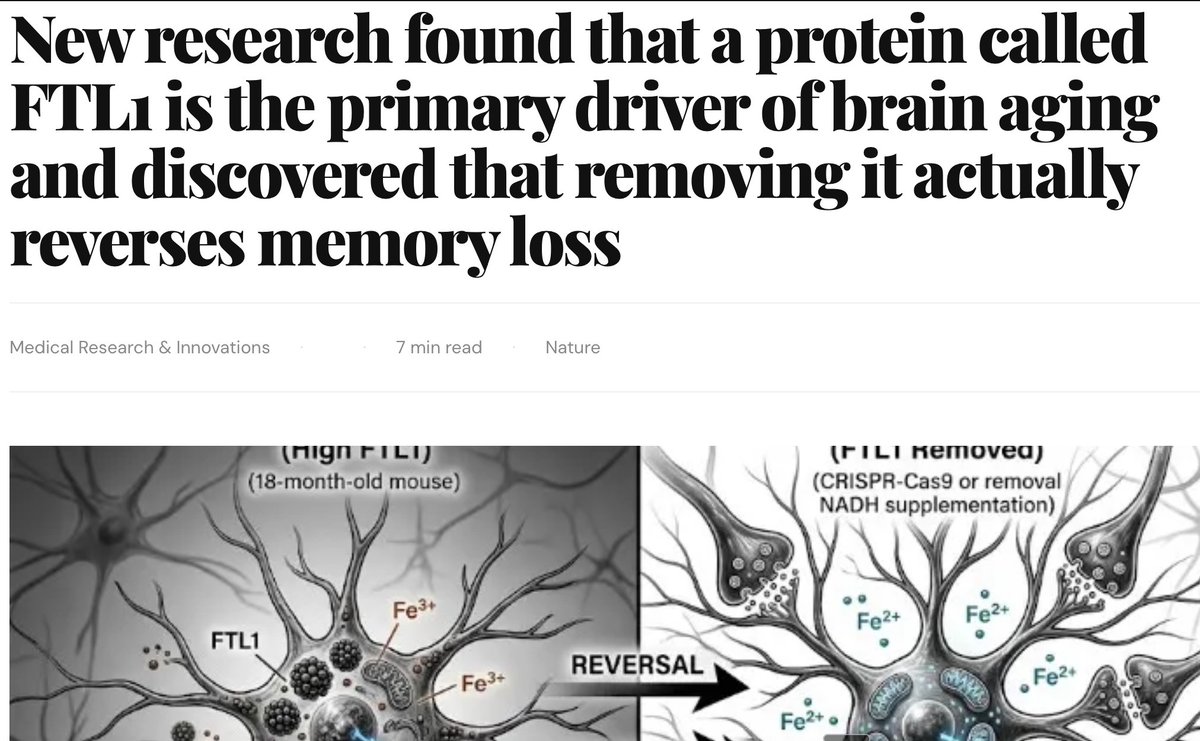
The brain doesn't forget because neurons die. They just go dark. And one protein controls the switch. Insane find:
Researchers at UCSF screened every protein that changes in the aging hippocampus. One stood out: FTL1, a ferritin subunit your doctor already measures in routine bloodwork.
When they removed it from old mice, the animals didn't just stop declining. Synapses regrew. Memory recovered.The mechanism is almost elegant in how brutal it is: excess ferritin traps iron in a form mitochondria can't use → ATP drops → synapses starve and go silent. The neuron doesn't die. It just disconnects.
Most aging research sells you "delay." This paper, published in Nature Aging, demonstrated bidirectional reversal - increase FTL1 in young mice, they age. Remove it from old mice, they recover.
Human trials are still away. But the protein accumulates in the same region of human Alzheimer's brains, and serum ferritin already correlates with cognitive decline across multiple large studies. The mouse finding isn't happening in a vacuum.
A 22-year-old graduate student in Kazakhstan got so angry at journal paywalls in 2011 that she built a pirate website holding 88 million scientific papers, and last month she turned the whole thing into an AI that lets you ask one question and get the actual research as the answer.
Her name is Alexandra Elbakyan, and the website is called Sci-Hub.
The AI she just launched is called Sci-Bot. It lives at https://t.co/6w0IBtOEYB and almost nobody outside academia knows it exists yet.
Here is the story, because it is one of the strangest things to happen in science publishing in the last 50 years.
Elbakyan was born in Almaty in 1988, the year the Soviet Union started to collapse. She taught herself programming at 12. She read Soviet science books that explained things her family used to call miracles. She got into computer security at university and graduated in 2009 with a degree she barely needed because by then she was already a serious hacker.
Alexandra moved to Moscow that fall. Then Germany. Then a research internship in the United States. She was working on brain-computer interfaces, the kind of research that requires you to read hundreds of papers a year just to keep up with the field.
And every single one of those papers was locked behind a journal paywall that cost between 30 and 50 dollars to read once.
She did the math. A graduate student in Kazakhstan could not afford to read science.
The first thing she did was learn how to get around the paywalls one paper at a time. She passed the trick around to other students. They asked her for papers constantly. She got tired of doing it manually.
So in September 2011, in three days, she wrote a script that automated the whole thing. A user pastes a DOI. The script logs in through a donated institutional credential. The paper comes back free. The website caches it.
The next person who asks for that paper gets it instantly because the previous request already saved a copy.
That was Sci-Hub. Three days of code. One graduate student. Done.
15 years later, the cache holds 88 million scientific papers. Almost every piece of scholarly literature published before 2020 is sitting on her servers. Researchers in 190 countries use it. Studies in Nature have shown that roughly half of all academic paper downloads worldwide now go through Sci-Hub, not the publishers who actually own the copyrights.
Elsevier sued her in 2015 and won a 15 million dollar judgment. She did not pay. The American Chemical Society sued her and won an injunction. She did not comply. Courts in India, France, Russia, and the UK have tried to block the domain. She just moves it. https://t.co/3sAWJzNe8I. https://t.co/tGIETesZ8i. https://t.co/H5WQ1f9lqR. The site has had over 20 domains and is still up.
Nature put her on its list of the 10 people who mattered most to science in 2016. The New York Times compared her to Edward Snowden. The Verge called her the pirate queen of science.
She has not been to the United States in over a decade because she would be arrested at the airport.
The Sci-Bot launch in April 2026 is the part that nobody is talking about.
She took the 88 million paper database and put a small language model on top of it. You ask a question in plain English. The model searches the entire shadow library, pulls the relevant papers, synthesizes an answer grounded in real citations, and links you to the full text of every source. Free. No login. No institutional credential. No paywall.
Three real scientists tested it for a Chemical and Engineering News article last month. They asked it medical and chemistry questions. The radiologist said the answer he got was usable. The chemist said the gaps in recent literature were obvious but the older science was solid. The publisher community is furious.
What she built is what the paid academic AI tools are trying to build. Except the paid ones are limited to what their parent publisher legally owns. Hers is limited to almost nothing.
Alexandra still lives somewhere in Russia. She does not give her address. She does not do video interviews. She gives talks over Skype with the camera off. She runs the largest illegal library in human history from a laptop and a donation page.
A graduate student who could not afford to read science built the system the entire scientific community now quietly depends on.
The publishers have spent a decade trying to shut her down.
She just shipped an AI that makes their entire business model outdated.
your brain is always becoming better at whatever you repeatedly do. that’s why repetition changes people more than motivation ever will. if you spend every day stressing, overthinking, comparing yourself to strangers online, replaying old mistakes, and expecting the worst, your brain slowly starts treating those patterns like home. it begins scanning the world for more proof that you’re not enough, that life is against you, that things won’t work out. the scary part is your brain doesn’t care if the pattern is helping you or destroying you. it only cares about what gets repeated.
but the same thing works in your favor too. when you repeatedly choose discipline, growth, gratitude, focus, and belief in yourself, your brain slowly reshapes around those things as well. at first it feels unnatural because your old patterns are louder, but over time your perspective changes. challenges stop feeling like signs to quit and start feeling like part of the process. your mind becomes whatever it practices most. so be careful what you keep giving your attention to because eventually, your thoughts become your reality.
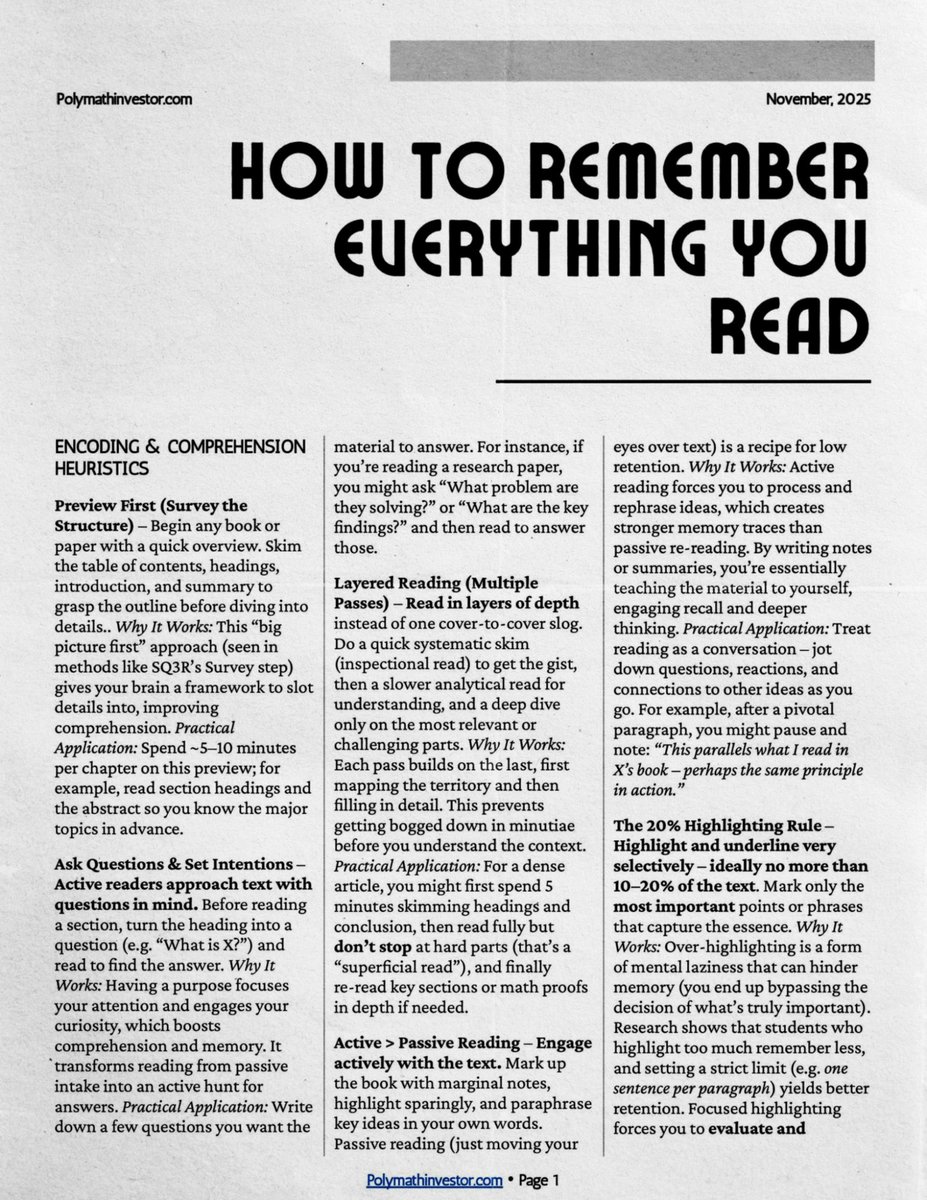
A few months back, I published this guide on how to remember everything you read.
Re-sharing it here for anyone who finds these protocols useful.
(1/11)
The 2-4 hours you spend scrolling each day (or 730-1460 hours each year) is more than enough time to write a book, build a business, or get in shape. In the moment, it seems like nothing. That's why it's so dangerous. Your time disappears without you being conscious of it.
Talking about socialism is a luxury paid for by the successes of capitalism. As I wrote in 2016:
"A popular rebuttal is to invoke the socialist leanings of several European countries with high living standards, especially in Scandinavia. Why can’t America be more like happy Denmark, with its high taxes and giant public sector, or at least more like France? Even the more pro-free-market United Kingdom has national health care, after all. First off, comparing relatively small, homogeneous populations to the churning, ocean-spanning American giant is rarely useful. And even the most socialist of the European countries only became wealthy enough to embrace redistribution after free-market success made them rich. Still, why cannot America follow this path if that is what the people want? What is the problem if American voters are willing to accept higher taxes in exchange for greater security in the embrace of the government?
The answer takes us back to all those inventions America has produced decade after decade. As long as Europe had America taking risks, investing ambitiously, attracting the world’s dreamers and entrepreneurs, and yes, being unequal, it could benefit from the results without making the same sacrifices. Add to that the incalculable windfall of not having to spend on national defense thanks to America’s massive investment in a global security umbrella. America doesn’t have the same luxury of coasting on the ambition and sacrifice of another country."
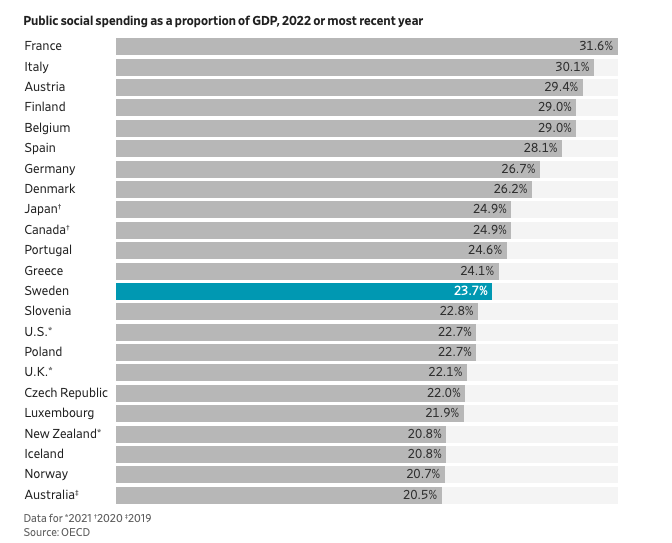
Sweden is choosing capitalism.
Social spending as percentage of GDP is now 24%, lower than most of Northern Europe.
Sweden has surpassed the US in billionaires per capita.
School choice is universal, one in ten teens goes to a school operated by a company listed on the Stockholm stock exchange.
Taxes have been cut three years in a row.
Sweden has seen "more than 500 initial public offerings over the 10 years through 2024, more than Germany, France, the Netherlands and Spain combined"
Nearly half of primary healthcare clinics are now privately owned.
The result? Same as always. Sweden is projected to grow 2% a year through 2030, which is the same as the US and double France and Germany.
How many times does this have to keep happening across the world? How many times does free market capitalism have to prove itself superior to socialism before the world accepts the truth?