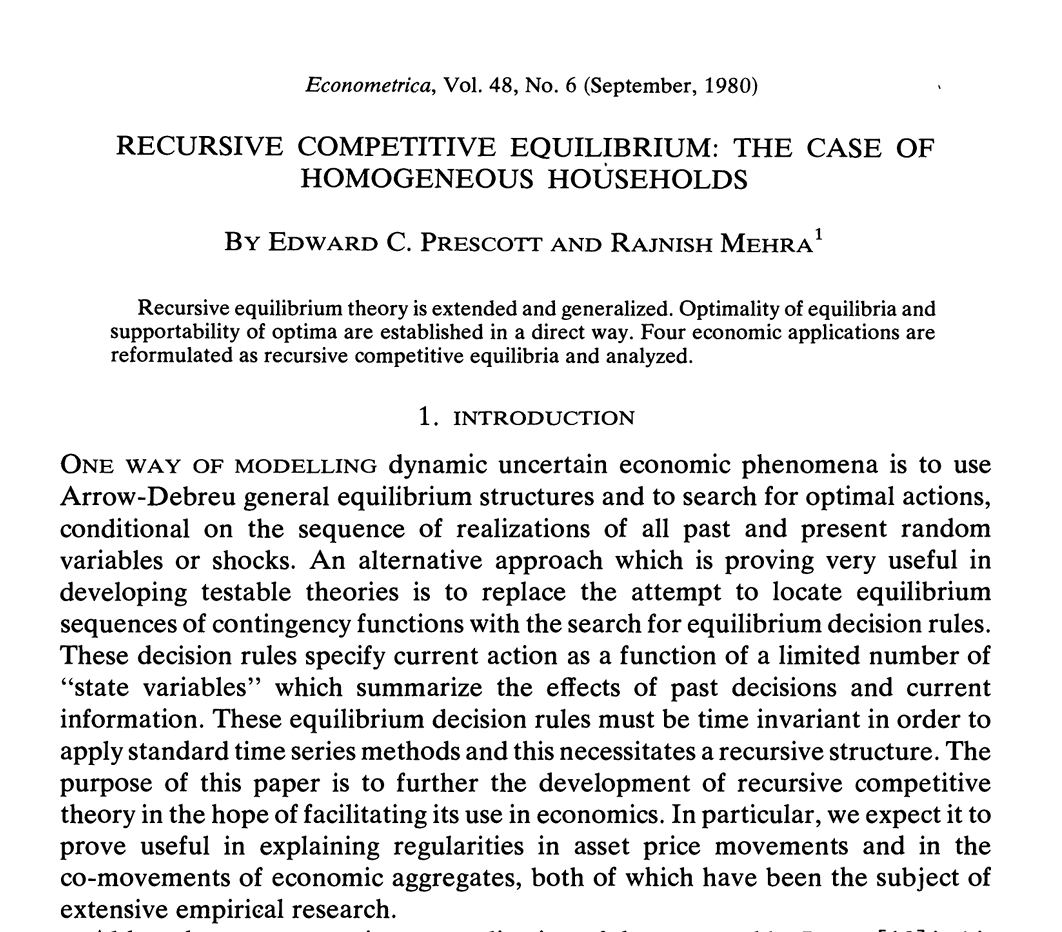
A guide for students of economics: Ten statements that demonstrate that someone does not understand modern economics or what an equilibrium is, and that you can safely ignore everything else they say.
1. “Equilibrium means the economy is stable or at rest.”
Many assume that an equilibrium is a peaceful state with no forces at play. Instead, an equilibrium is just an arrangement of actions and expectations over time that are mutually consistent. It can be locally unstable, explosive, or fragile. Nothing in the definition of equilibrium implies stability.
2. “Equilibrium implies optimality or social efficiency.”
Equilibrium is often conflated with efficiency, but equilibrium merely reflects decentralized consistency, not welfare maximization. Market power, externalities, incomplete markets, nominal rigidities, and frictions routinely produce inefficient equilibria. I often teach a first-year macro graduate course, and not a single one of the equilibria I define is efficient.
3. “Equilibrium is a unique outcome.”
Many often expect models to have one equilibrium. In reality, multiple equilibria arise naturally in dynamic, strategic, and incomplete-market environments. Models of coordination failures, self-fulfilling expectations, bubbles, overlapping generations, and liquidity traps all hinge on the existence of equilibrium multiplicity.
4. “Equilibrium requires perfect foresight or perfect information.”
Equilibrium does not assume agents know the future. In fact, equilibria are often stochastic. The definition of equilibrium only requires that beliefs are consistent with the (perceived) stochastic laws of motion implied by the model. Bayesian learning, noisy signals, ambiguity, and subjective uncertainty all fit well within an equilibrium framework, provided beliefs converge to an internally consistent (but possibly incorrect) distribution.
Bonus point: equilibria are compatible with agents having diverging beliefs that never converge to a single Dirac distribution.
5. “Real economies are rarely in equilibrium, so the concept is unrealistic.”
Equilibrium is not meant to describe the daily state of the world. It is a conceptual device used to understand the outcome of our models under the assumptions we make. Also, see point 1 above.
6. “Equilibrium requires agents to be fully rational in a psychological sense.”
Equilibrium only assumes internal consistency: agents optimize given preferences and constraints. It does not assume realism about human cognition. We can and do define equilibria in models with behavioral biases, bounded rationality, inattention, or rule-of-thumb behavior. We only need to ensure that the resulting actions and beliefs are mutually compatible.
7. “Equilibrium eliminates dynamics or learning.”
Equilibrium is sometimes misinterpreted as a static state in which nothing evolves. In fact, many equilibria are sequences of probability distributions over states driven by shocks, policy rules, and endogenous responses. Learning dynamics (Bayesian updating, adaptive rules, experience-based expectations) can occur within equilibrium if the evolution of beliefs is self-consistent.
8. “Equilibrium renders expectations unimportant.”
A common misconception is that equilibrium mechanically determines outcomes. In reality, expectations are often central: they determine investment, consumption, asset prices, and policy responses. Many equilibria differ only in their expectations. This is why communication, credibility, and forward guidance matter even in fully rational models.
9. “Equilibrium excludes policy intervention.”
Some interpret equilibrium as a laissez-faire concept. In fact, equilibrium analysis is the foundation of modern policy evaluation. Fiscal, monetary, and regulatory interventions work through equilibrium responses (prices, wages, interest rates, quantities) and must satisfy equilibrium conditions to be credible. Equilibrium is a tool for policy design, not a barrier to it.
10. “Equilibriums…”
Aequilibrium is a Latin neuter noun of the second declension, which forms a nominative plural in “a”. It is composed of aequus (equal; the same root as equality or equity) and libra (balance or scales or the name of several currencies over history).
A final thought: “equilibrium” is a term of art. Its meaning in economics differs from its use in the natural sciences or in everyday language. Terms of art are ubiquitous across academic disciplines, and the first act of intellectual diligence when one starts studying a discipline is to learn what they mean.
Terence Tao: "We lived in a world with cognitive friction until very recently, where every task required us to use our brain.
So we didn't really think about it, we just thought this was the cost of doing something intellectual. But now we have AI and the other technologies that can bring these frictions down to zero."
Most research time is not spent having cinematic insights.
It is spent checking cases, chasing references, translating intuition into computation, testing a path, finding it false, and deciding whether the failure taught you anything.
AI changes the cost of that loop.
Terence Tao says that now he can try “crazier things,” and that makes so much difference. Because unconventional ideas are often not rejected by proof, but by inconvenience.
A mathematician may avoid a strange direction not because it is foolish, but because the bookkeeping, coding, or literature search needed to test it is too expensive for a hunch.
This is where cognitive friction becomes scientific friction.
Lowering it does not make taste, judgment, or proof disappear; it makes more weak signals cheap enough to inspect before they are abandoned.
AI is making hesitation less expensive, and that is often where discovery begins.
EL PRECIO DE LA GASOLINA SÚPER EN ECUADOR Y EN ESTADOS UNIDOS
Al 14 y 15 de mayo de 2026, la comparación correcta es entre la gasolina Súper ecuatoriana de 92 octanos y la gasolina premium estadounidense de 91 a 93 octanos.
En Ecuador, el galón de gasolina Súper se ubicó en USD 4,81, conforme a los precios oficiales publicados por EP Petroecuador. En Estados Unidos, el promedio nacional del galón de gasolina premium fue aproximadamente USD 5,39, según la American Automobile Association (AAA). La diferencia nominal fue de alrededor de USD 0,58 por galón.
La diferencia de fondo está en la capacidad de pago. En 2025, el PIB nominal per cápita de Ecuador fue aproximadamente USD 7.200, mientras que el de Estados Unidos fue aproximadamente USD 90.000, de acuerdo con las proyecciones del Fondo Monetario Internacional. Esto significa que el ingreso nominal per cápita estadounidense fue alrededor de 12,5 veces superior al ecuatoriano.
Por tanto, Ecuador paga una gasolina Súper de precio casi estadounidense, pero con ingresos promedio de una economía mucho más pobre. La comparación nominal puede parecer cercana, pero la carga económica real para los hogares ecuatorianos es mucho más severa.
Econ. Marco Flores T.
Mayo 15 de 2026
Fuentes oficiales:
• EP Petroecuador.
• American Automobile Association (AAA).
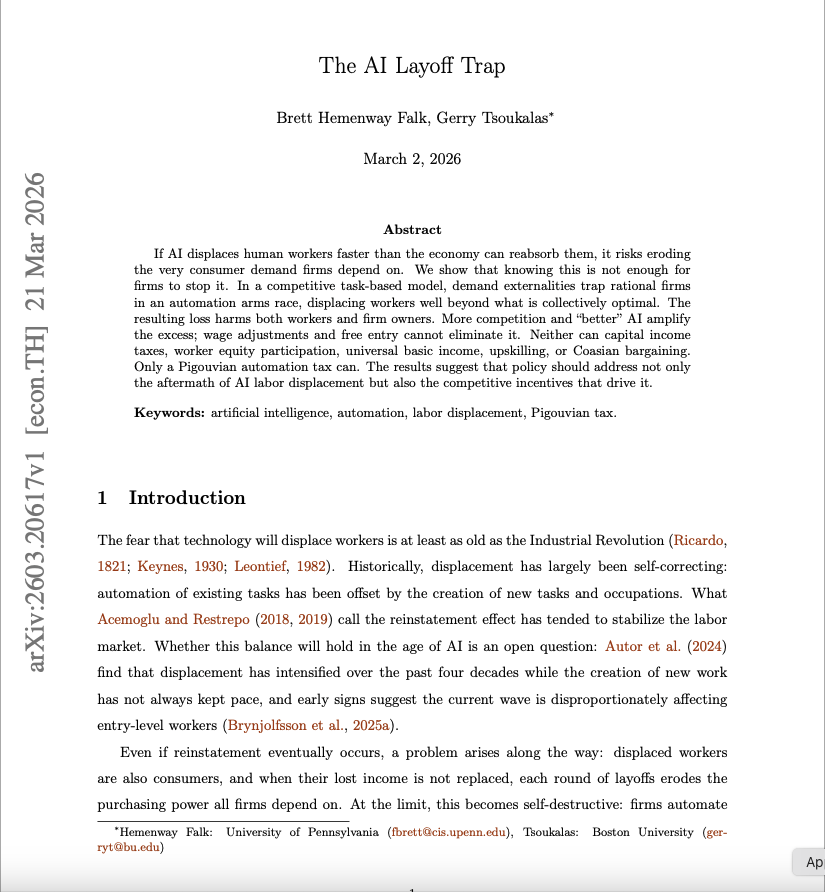
Two economists just published a mathematical proof that AI will destroy the economy.
Not might. Not could. Will — if nothing changes.
The paper is called "The AI Layoff Trap." Published March 2, 2026. Wharton School, University of Pennsylvania. Boston University. Peer reviewed. Mathematically modeled.
The conclusion is one sentence.
"At the limit, firms automate their way to boundless productivity and zero demand."
An economy that produces everything. And sells it to nobody.
Here is how you get there.
A company fires 500 workers and replaces them with AI. A competitor fires 700 to keep up. Another fires 1,000. Every company is behaving rationally. Every company is following the incentives correctly. And every company is building a trap for itself.
Because the workers who were fired were also customers.
When they lose their jobs faster than the economy can absorb them, they stop spending. Consumer demand falls. Companies respond by cutting costs — which means automating more workers — which means less spending — which means more falling demand — which means more automation.
The loop has no natural exit.
The researchers tested every proposed solution. Universal basic income. Capital income taxes. Worker equity participation. Upskilling programs. Corporate coordination agreements.
Every single one failed in the model.
The only intervention that worked: a Pigouvian automation tax — a per-task levy charged every time a company replaces a human with AI, forcing them to price in the demand they are destroying before they pull the trigger.
No government has implemented this. No major economy is seriously discussing it.
Meanwhile the numbers are already tracking the curve. 100,000 tech workers laid off in 2025. 92,000 more in the first months of 2026. Jack Dorsey fired half of Block's workforce and said publicly: "Within the next year, the majority of companies will reach the same conclusion."
Nobody is doing anything wrong. Companies are following their incentives perfectly. That is exactly the problem.
Rational behavior. At scale. Simultaneously. With no mechanism to stop it.
Two economists built the math. The math leads to one place.
Source: Falk & Tsoukalas · Wharton School + Boston University ·
https://t.co/4m8E9jQNYm
Superb applied history by @Dr_Keefer of Europe's collective decision to become a loser in the energy wars of the 2020s. This decision stemmed from luxury beliefs. The contrast with the European response to the energy crisis of the 1970s is ... striking. https://t.co/6FkvQwwMFQ 6/6
A short research note on how production systems, technological change and institutional coordination shape long-run economic development.
Dev. is not only about adopting technology, but about transforming productive structures.
https://t.co/OnShr8fOLO
#Economics#Development
Diversification has become more difficult in recent years. Stocks and bonds are now more likely to fall together, making diversification harder and market stress more significant. Read our new blog on what this means for managing risk. https://t.co/vhzVMq2N5j
Miami constituye un experimento natural fascinante. Una ciudad con una población mayoritariamente latina (cercana al 70%) que, bajo un marco institucional predecible y un estado de derecho funcional, se ha consolidado como un hub comercial y financiero de alcance global, con un crecimiento dinámico y una gran capacidad para atraer inversión.
La misma gente que en nuestros países opera entre la informalidad, la volatilidad regulatoria y la debilidad del Estado, cuando se inserta en un sistema de reglas claras y seguridad jurídica, produce resultados sustancialmente distintos: crecimiento sostenido, sofisticación financiera, integración logística global, innovación y acumulación de capital humano. Solo como ejemplo , la empresa que construyó prácticamente Brickell es de una peruana.
El Perú tiene un enorme potencial, disponemos del talento, una resiliencia empresarial casi inquebrantable y una enorme capacidad de adaptación. Sin embargo, la erosión institucional y política restringe la transformación de ese potencial en crecimiento sostenido.
La prioridad estratégica de los próximos años debe ser consolidar, con sentido de urgencia, una reforma política estructural. Lo dije hace dos años y hoy está más vigente que nunca. Sin una arquitectura institucional sólida, el crecimiento sostenido será transitorio y vulnerable a shocks.
Con instituciones robustas, nuestra misma gente puede avanzar más rápidamente en la senda de desarrollo.
Nunca fue tan vigentes Acemoglu y Robinson.
@jpjaramillo25 El GC dispuso que se use al medidor de agua para el establecimiento de esta tasa? 6 millones es un precio razonable mensual para la recolección? Existe evidencia con validez externa robusta que nos diga que es una buena idea usar el medidor de agua?