I’m Paul.
DevOps / platform lead by day.
Relearning spoken English by night.
This account is the unpolished half:
incidents, interviews, and the commands that still save the night.
@konig0000 Choosing the model is the slide.The page is usually later: eval missed a bad answer, a tool timed out, or the deploy had no rollback.“Reliable in production” is the layer I still have to walk.
@uday_devops Paperwork: almost everything. The box: almost none.
AI writes the reports. I use the time it frees to think about architecture, performance, and stability — and to ask questions while I experiment on my own machine.
A stranger called about an overseas role.
I said yes, mostly to see if I could still pass an interview.
I passed.
Housing included. Pay was real.
One day off a week. No statutory holidays.
Then the recruiter stopped answering the questions that mattered.
The offer arrived anyway.
I walked.
@uday_devops Thanks so much! I really appreciate the encouragement. Locking in and giving it my all over the next few days. Time to make this breakthrough happen!
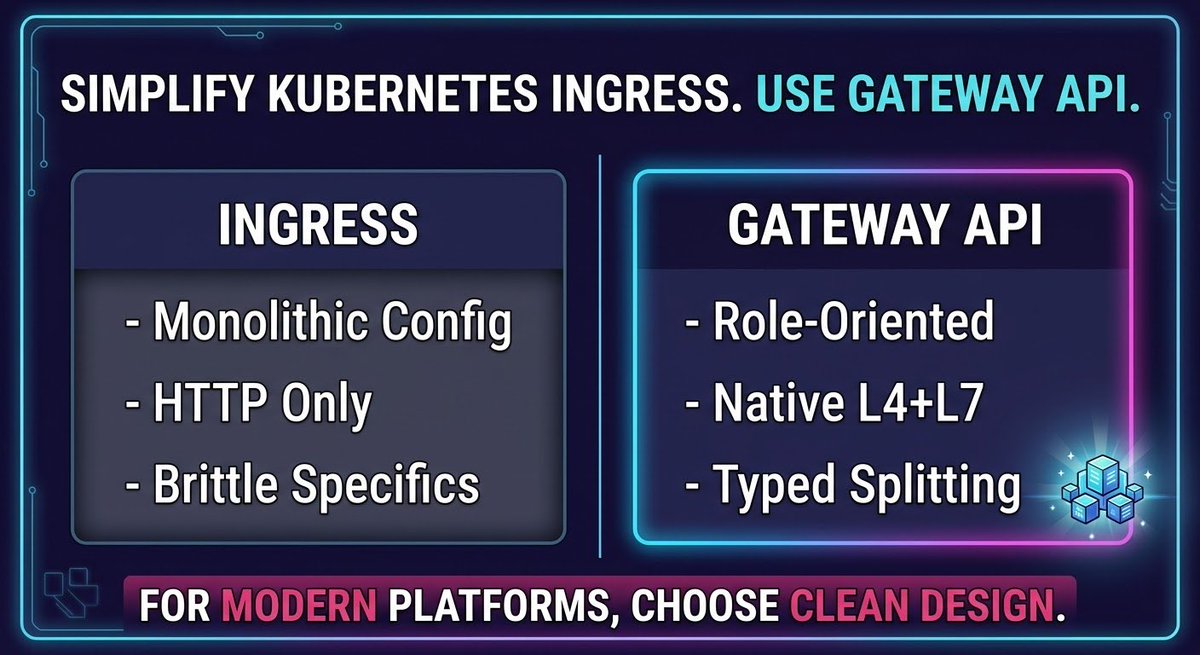
Stop putting 30 annotations inside a single Kubernetes Ingress YAML.
That’s why Gateway API exists.
Ingress:
• Monolithic config
• HTTP/HTTPS only
• Fragile controller-specific hacks
Gateway API:
• Role-oriented separation (Gateway vs Route)
• Native L4 + L7 support (TCP/UDP/gRPC)
• Typed, portable traffic splitting
If you're building a modern platform in 2026, ditch the annotation spaghetti.
@uday_devops Marketing. Nobody buys code. They buy solutions they know exist. Marketing acquires users and sparks word of mouth. The cleanest codebase means nothing if nobody knows your product exists—you have a hobby, not a business.
@uday_devops Exact same playbook for DevOps:
Deploy it.
Break it.
Debug it.
Master it.
Zero shortcuts. You only get good by fixing the messes you created.
Eliminating the ETL/sync pipeline for AI agents is massive. But running ad-hoc vectorized analytical queries on an Aurora instance means one rogue agent query could kill production OLTP latency. This is only viable if strictly isolated to dedicated read replicas.
A painful part of working with your data has always been that your live data and historical data are stuck in separate systems: the order a customer just placed lives in your database, while their last five years of orders sit in a data lake in S3.
And answering a real question usually needs both at once (is this a normal purchase for them, or should we flag it?), and to do that you had to move the data together first, copying history out of the data lake into your database (or the other way around), because the database couldn’t read it where it lived.
That meant guessing ahead of time which data you’d want, keeping a second copy of it all, building pipelines to move it, and constantly syncing so the two didn’t drift apart. A lot of plumbing, and slow going, all before you could answer one question. And even then, the answers were only as fresh as your last sync.
That now changes with Aurora PostgreSQL, which can call your live data and historical data in S3 together, in a single query. No copying, no pipelines to keep in sync.
And it’s fast, because we’ve built in DuckDB, a popular open source engine that’s really good at reading and analyzing data right where it’s stored. DuckDB reads the open formats like Parquet and Iceberg already sitting in your data lake, so there’s nothing to convert or move.
As folks build AI agents into their apps, the data their agent needs will depend on the task in front of it. Being able to query that specific data live, instead of copying it over just in case, is gonna be a big help for builders. https://t.co/R8h2Hcp1K7
We don't need higher benchmark scores. We need proactive interaction. Right now, AI is purely passive, waiting for a prompt like an overgrown search bar. The real leap happens when AI initiates. Give it secure context—read access to emails, calendars, and daily workflows—so it can surface what matters before we ask. Like the AI in Her: what made Samantha compelling wasn't raw compute, but initiative.
Thursday.
The docs are due tomorrow.
Good week: one or two pages.
Bad week: a pile nobody reads.
Either way the timesheet wants 5 person-days.
No real work? We invent some.
Idle looks like a layoff signal.