Scherwode Graft
A community should be able to move chains or relaunch without pretending the old contract is somehow the new one.
Graft is basically how we are handling that on Scherwode. You escrow the legacy token, get marks, and those marks claim a finite portion of the new token on the destination chain. Not a tradable IOU, just a clean way to prove who migrated and what they are entitled to.
The other part is liquidity. If there is recoverable capital from the old token, that gets moved over and matched into real liquidity on the new chain, so you are not just launching from zero again and hoping everyone buys the curve.
Claims can unlock on a published schedule, anything unclaimed can burn, anything that never migrates can stay locked, and the actual relaunch terms are set before anyone deposits. Supply, dilution, direct launch vs curve, Wild vs Rooted, whatever makes sense for that project, but it is all disclosed up front.
Not live yet, but we are building the rails for it now.
The glaring hole in this idea is compute. If you don't have a correct harness for the agents to run in, you're just going to burn through tokens at a rate that's going to eat into your potential profit. That's what @ArtificeSystems is solving.
Instead of having your agents burning through tokens, hallucinating, and incorrectly storing research and data. You can just use artifice which works as a harness for the agent. It'll reduce your token costs, as all at that point is your agent simply calling tools.
More than 50% of the basket supply is already burnt, and launch activity keeps feeding value back into what remains.
Less supply. Stronger basket.
https://t.co/4192D2DFDE
LIVE NOW — Sprouted tokens.
A token launches, people trade it, and part of that activity starts building a real perpetual position underneath it. That’s the basic idea.
Scherwode handles the launch and token side. @artificeSystems powers the perpetual side, with positions settled on Hyperliquid.
So instead of all the activity just disappearing into fees and liquidity, the launch starts growing something underneath itself.
https://t.co/bxC8fOqwYi
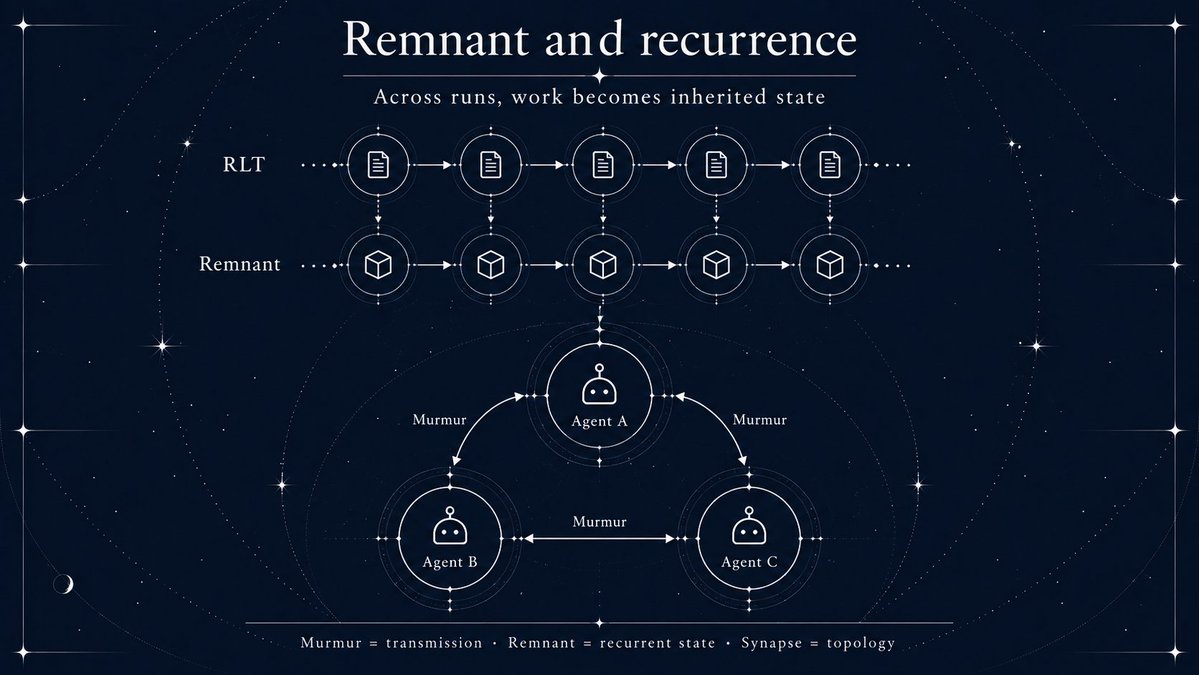
We’ve been pulling parts of the Artifice agent architecture apart into smaller pieces that are useful on their own instead of making everything depend on one giant framework.
The first two are Murmur and Remnant.
quit telling people i’m dead.
Scherwode has been quiet, mostly because we’ve been building, and a little dissapointed in the lack of launches.
The first thing is the site. The current UI still feels too much like the version we launched with, and the product has moved past that. So we’ve stripped a lot of that back — a more modernized UI, a much simpler launch process, cleaner navigation, better discovery, less clutter, less friction. The goal is that you should be able to land on Scherwode, understand what you can do, and launch something without having to fight the interface first.
The more interesting part is what we’re actually letting people launch.
We haven’t gotten the traction we wanted with launches yet. That’s just true. But I still think the original idea was right: launches should be more interesting than make token, make pool, hope people buy it.
We already built around rooted assets, baskets, different launch structures, different ways of deciding what actually sits behind a market. Now we’re pushing that further with a new perpetuals-backed launch type.
There is already a ridiculous amount of liquidity, open interest and price discovery sitting in perpetual markets, so instead of pretending every new asset needs to start from zero, we want Scherwode launches to be able to use that existing market structure underneath them.
That gives us a lot more room to do interesting things with launches, a place where you can build markets around actual underlying structure.
And then there’s $WODE.
We haven’t gotten the launch traction yet, but we do have an absolutely massive basket sitting behind $WODE, and we have mostly just... left it there.
So we’ve been looking at that too ;)
This week: a much simpler launch process, a more modernized UI, perpetuals-backed launches, some work around $WODE, and more.
Jester became bigger than Jester.
On September 1, Jester becomes Artifice (@ArtificeSystems).
This is not a visual refresh. Jester started as a trading product. It became a full system: accounts, billing, research, execution, risk, agents, APIs, and several applications.
The old company name no longer covered that. Going forward,
Jester is the trading algo built by Scientio. Artifice is the company and the system around it.
https://t.co/jVEzyh30Rs
Introducing Artifice Systems — an agentic quant trading stack for autonomous research, strategy development, risk management and execution, with shared infrastructure across every product and agent.
v0.7.0 is a major stability and performance update, with faster strategy execution, improved live data handling, stronger risk controls, more accurate portfolio reporting, better mobile and account management, and numerous fixes across automation, mirrored accounts, background tasks, and trading integrations.
Starting today, every Monday I’ll show you how my portfolio—managed by the Jester ecosystem ($jest by @jesttech) is performing.
Managed and fully automated by Oroboros
https://t.co/u0aGineFQb
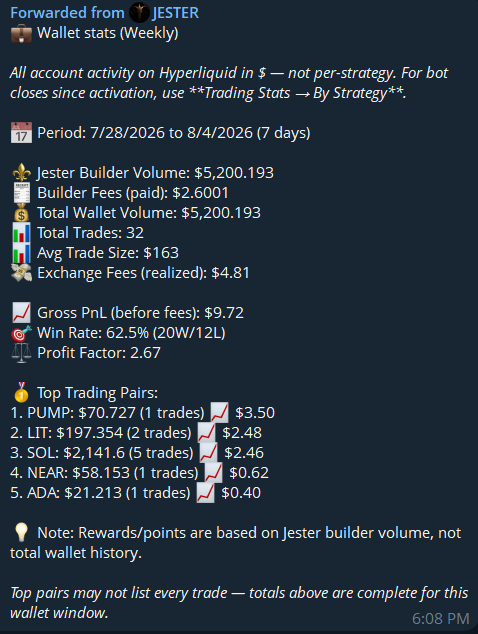
One of our user's weekly stats this week using the @JestTech suite of trading systems. Stats compiled and sent straight from the bot to you anytime you want. @HyperliquidX automated perp trading right at your fingertips.