@joshuamalidzo The problem with the judiciary is that very few of our judges have a history of deep and sustained philosophical introspection. We have hired paper pushers not logicians, reasoners, but folks who simply want to tick the boxes. From here it gets worse.
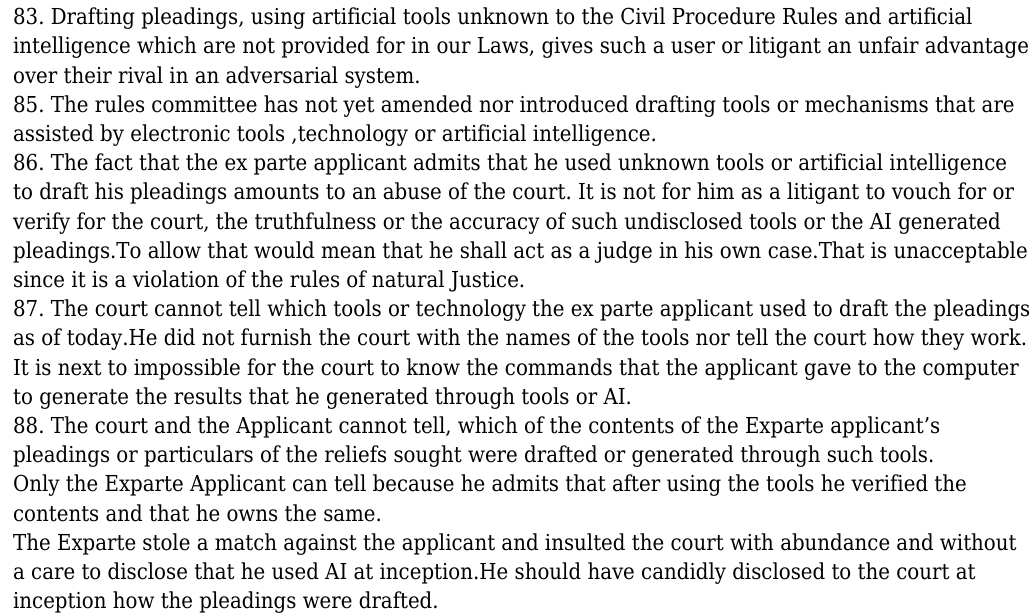
The ruling by Chigiti J on AI generated pleadings occupies the highest pedestal of the most ridiculously reasoned decisions I have ever come across. What thought process allows a judge to suggest that AI generated pleadings allow a party an unfair advantage?
Which rule even says HOW a party should draft their pleadings? The rules merely direct WHAT should be there. How it is generated is irrelevant. And there's certainly no rule for disclosure. Oh, what a Luddite of a JO?
6 LAWS OF TIME THAT WILL MAKE YOU RETHINK HOW YOU SPEND EVERY SINGLE DAY:
1. Hofstadter's Law:
Everything takes longer than you think, even when you account for the fact that everything takes longer than you think. Stop planning for the perfect version of your day. Plan for the real one.
2. Carlson's Law:
Interrupted work is not just slower ,it is fundamentally worse. Every time you switch tasks your brain pays a switching cost. Deep focus is not a luxury. It is the only way real work gets done.
3. Illich's Law:
After a certain point, more time spent on a task makes it worse not better. The person who works twelve hours straight is not more productive. They are just more stubborn.
4. The Law of Forced Efficiency:
You will always be most productive in the hour before a deadline. Not because you work better under pressure but because you finally stop perfecting and start finishing.
5. Laborit's Law:
Humans naturally do the easiest and most pleasurable tasks first. The work that would change your life sits at the bottom of the list every day. Flip the list. Do the hard thing first.
6. Parkinson's Law of Triviality:
Teams spend more time debating small unimportant decisions than large critical ones. The smaller the stakes, the longer the argument. Protect your attention from the trivial. It will consume everything if you let it.
We (Tanay) like to live on the edge...clearly.
See if they won the Porsche 911 GT3 RS or if we get to keep it for the office...
In other news, we’re live on Android: https://t.co/BjswQYVfzP
PS: like, retweet, and bookmark to get Wispr Flow for free for 6 months
— Written with @WisprFlow
OpenAI Academy just released Prompt Packs tailored to various job roles:
• Sales
• Marketing
• Engineering
• Management
• Human Resources
• Product Management
• Information Technology
• And more
Save this to use later:
Most people use ChatGPT like Google.
A few people use it like a weapon.
I just saw 21 prompts that can replace:
• an assistant
• a researcher
• a writer
• a PM
• a tutor
And save hours every week.
Stuff like:
– Turning messy notes into clean meeting summaries
– Analyzing spreadsheets without formulas
– Repurposing one blog into 10 posts
– Fixing code instead of debugging for hours
– Getting insights from images, charts, docs
This isn’t “AI tips”.
This is leverage.
The scary part?
These prompts aren’t advanced.
They’re just… structured.
Most people will never use them.
The ones who do will look 10x smarter at work.
If you want the list, bookmark this.
You’ll come back to it.
👉Follow @Suryanshti777 for prompts that actually save hours.
♻️RT so you don’t lose this.
The paper "Artificial intelligence-assisted academic writing: recommendations for ethical use" is a reactionary attempt to preserve traditional academic gatekeeping by relying on outdated philosophies of language and cognition. The authors present a "tiered" system of ethics that relegates AI to the role of a spell-checker , effectively banning it from the "intellectual" work of drafting or conceptualizing. This stance rests on three fundamental misunderstandings: a reductionist view of linguistics, a Luddite fear of cognitive offloading, and a bureaucratic conflation of "accountability" with "capability."
The paper bases its skepticism on the premise that LLMs lack "meaning." It argues that models are merely "mathematical models mapping specific segments of text... based on statistical relationships" and that while they generate syntactically correct text, they do not utilize "meaning"
This argument relies on a "ghost in the machine" fallacy, the magical belief that biological "meaning" is distinct from complex statistical processing. From a linguistic standpoint, if a system can manipulate symbols with the same semantic coherence as a human, the distinction between "statistical association" and "understanding" is functionally irrelevant. Human cognition itself is deeply probabilistic; we humans predict the next word based on context, just as LLMs do.
The authors commit "bio-chauvinism", assuming that intelligence and creativity require a biological substrate. By dismissing LLM output as just "tokens", they ignore the emergent properties of high-dimensional vector spaces where "concepts" (not just words) are mapped.
The authors are effectively rehashing Searle’s "Chinese Room" argument. However, in the age of generative AI, this is an obsolete critique. If the AI can synthesize novel connections between disparate fields (which the authors admit is possible in "brainstorming" ), it is performing intellectual labor, regardless of the underlying architecture.
The paper argues that using AI for drafting "short-circuits an intellectual process" and that outsourcing these tasks risks "necessary skills being lost over time". They explicitly state that "deep engagement is vital" and AI deprives authors of this. This is the same moral panic albeit not as revolutionary , that accompanied the invention of the calculator, the printing press, and the search engine. Far from causing atrophy, AI allows for cognitive offloading. By outsourcing the lower-order labor of syntactic generation and structural organization, the intellectual is freed to focus on higher-order tasks: hypothesis generation, architectural critique, and systemic synthesis.
The paper assumes that the act of typing words is where thinking happens. Inthe AI realm, the "thought" happens in the prompt engineering and the iterative refinement. The AI is a force multiplier, not a replacement. By categorizing "drafting de novo text" as "ethically suspect", the authors are essentially valorizing struggle over output. If an AI can draft a clear, accurate section that the human then verifies, rejecting it purely because the human didn't suffer through the typing process is irrational academic asceticism.
Plagiarism and Hallucination:
The paper leans heavily on technical limitations, specifically "hallucinations" (fabricated facts) and "plagiarism" (reproducing training data) , to justify ethical bans. These are transient technical bugs, not ontological features. The paper attacks specific versions of models (like ChatGPT 3.5/4) that were prone to hallucination. However, with the advent of RAG (Retrieval-Augmented Generation) and grounding tools (like the "Scopus AI" they briefly mention but dismiss ), these issues are being solved rapidly. Basing a permanent ethical framework on temporary software bugs is short-sighted. The paper fears "plagiarism" because LLMs replicate training data. Yet, all human academic work is a synthesis of "training data" (papers read, lectures attended). An LLM synthesizing 10,000 papers to find a consensus is not "plagiarizing", it is performing a meta-analysis at a scale no human can match. The paper’s definition of "originality" is uncomfortably close to "unassisted isolation.
The authors argue AI cannot be an author because it cannot bear "accountability". They state AI cannot "vouch to support any subsequent investigation".
This is a legalistic hurdle, not an intellectual one.
Accountability remains with the human who curates and publishes the output. If a human pilot uses an autopilot system to crash a plane, the pilot is responsible. Similarly, if a researcher uses AI to generate a hypothesis, the researcher takes the blame if it fails or the credit if it succeeds. The authors suggest that only "human vetting" makes the process ethical. But they fail to acknowledge that human peer review is notoriously flawed, biased, and hierarchical. An AI-assisted workflow, which can instantly cross-reference citations and data consistency, may eventually offer higher integrity than the "human-only" drafting process the authors fetishize.
The paper Cheng et al. is a defensive maneuver by the academic establishment. By placing "Drafting de novo text" and "Developing new concepts" in the "Ethically Suspect" tier, they are effectively trying to handicap the most transformative potential of AI: its ability to act as a co-thinker. From a futurist perspective, the "ethical" approach is not to restrict AI to grammar checking, but to aggressively integrate it into the ideation and drafting process to accelerate the rate of scientific discovery. The paper confuses the labor of writing with the value of science.