Improving reading in schools is hard but doable. The answer is not a glossy resource, but instead enacting brilliant talk routines that open up the curriculum.
The R.E.A.D.S. framework is an approach to support teacher judgement to do does just that:
https://t.co/3KRca9OOjN
Get all students talking without chaos. Fishbowl Debate puts some in the center for real talk while others watch and learn. Everyone gets a voice, everyone listens. See how: https://t.co/B4ZtXsAAl2 🎦
Just like some people struggle to learn certain academic skills, some people struggle to learn certain social-emotional skills.
#sel#learning#futureready#teaching
How can I help students evaluate situations to identify the potential benefits and consequences of different decisions?
Social-Emotional Learning Part III: Responsible Decision Making
https://t.co/SffFLxVsIk
#blendedlearning#edchat#edutwitter#SEL#Education
Join me at #ISTELive in Orlando!
🗣️ 12 sessions - https://t.co/HIj2O0C310
🎲 Board Game Night - https://t.co/TleX3YDJ0k
📝 Sharing Doc - https://t.co/IhSTKubLkV
#edtech
Feedback is like gardening. Water early practice that needs to grow and prune errors before misconceptions take root. Effective feedback isn't about judging performance—it's about directing deliberate practice & moving pupils closer to the learning goal.
[email protected]
If you’re teaching phonemic awareness, this is a really helpful resource to have on hand 👇
It walks through how to correctly pronounce all 44 phonemes in English. This makes a BIG difference when we’re modeling sounds for students. 👄
🎥 Watch here: https://t.co/0Ruw3RttBZ
🚨 NEW POST 🚨
‘Improving reading with the R.E.A.D.S Framework’
“It is not a rigid sequence to follow step by step, but a flexible repertoire. It is a helpful prompt for the teacher to consider which mode of discussion is most valuable...”
https://t.co/uCwzdtjLUY
An easy way to get unstuck is to get up and take a walk.
We generate more creative ideas during and after walking outdoors—and even on a treadmill facing a blank wall.
Divergent thinking rarely happens when we're tethered to a desk. Moving our bodies frees our minds.
When a pupil is in a dysregulated state,this is not the time for reasoning & questions.
What happened?
Why did you do this?
You should have known better.
The highest part of the brain (prefrontal cortex) thinking,reasoning,decision making & reflecting is offline.
A Masterclass on Responsive Teaching
In this clip, Karina Stocker breaks down a major misconception about explicit instruction and explains how guided practice is supposed to be a dynamic, live experiment.
When students respond, that is your cue to make an immediate, real-time decision:
🔹Do you fade your prompts and release responsibility?
🔹Or do you step back in with more scaffolding because you moved too quickly?
The doing is the learning. We ned to stop following the script blindly and start responding to the learners in front of us.
Listen to the full episode 👇
https://t.co/uxD6vzMg3u
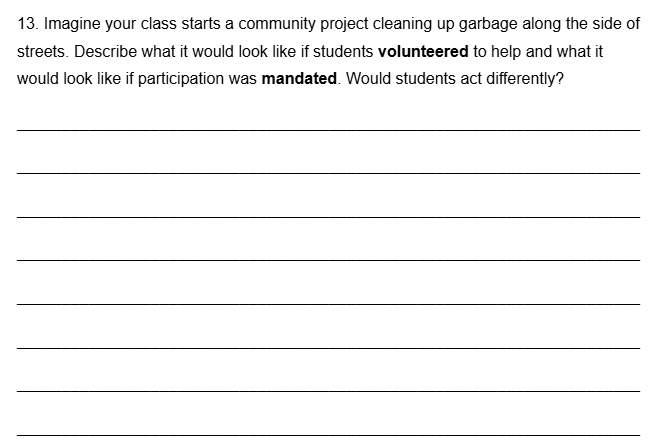
This is a nice question to ask after students previously learned the words volunteer and mandatory. It is not asking dictionary definitions. Rather it is making students think about the words volunteer and mandatory and how behavior would change based on if students volunteer or are mandated to work on a project. An added benefit is that students are differentiating between the two words as well. I expect students to use these two words or forms of the word in their answer.
4 Strategies to build your pupils' vocabulary schema!
All learning is connected, and these strategies make sure those connections and strong. If you'd like to know more about practical ways to use the "best bets" for learning from research, contact [email protected]