25 Years Later: A Cherished Reunion to Remember
Exactly one year ago, on 27 June 2025, I had the great honor and privilege of reuniting with President and Sister Nielson my 1st mission parents, in their homeland of Alberta, Canada, after 25 years.
I love you Pres & Sis Nielson.
Peter Obi is presidential. His aura is out of this world. Read my pinned tweet. I described the type of 21st century president Nigeria needs.
This is the perfect definition of soft power. It is time for Nigeria to reclaim its its long-lost glory & pride abroad. A healthy president in over a decade is a huge flex. An international man can & will only restore Nigeria’s global image.
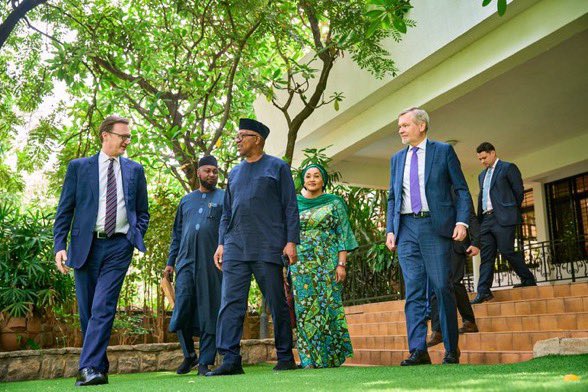
It’s barely 24 hours since the ADC held their party Convention, & the man already held meetings with several diplomatic missions.
He met the High Commissioner of Britain. Then he found additional strength to hold meetings with the embassies of Germany, Canada, & France as well. Sometimes I wonder where he gets his energy from? For a 64-year-old, Obi is stronger than most of us. I’m impressed by his hunger & passion to move Nigeria forward.
This is FDI. This is Passport Ranking. I see the president of the United States visiting Nigeria once more. This is how you market “Brand Nigeria.” You put your best foot forward!
If I can follow him? YOU TOO CAN! 👏👏
Fuel subsidy GONE
Education subsidy GONE
Electricity subsidy GONE
Healthcare subsidy GONE
Yet, borrowings ballooned
Debt servicing ballooned
National debt ballooned
City Boys got Gold-plated iPhones. There are more City Boy buses than ambulances
WHAT DID HE DO WITH THE SAVINGS
VIDEO📸; PETER OBI IN ZUBA🇳🇬🔥🔥
Some people climb trees just to see this man @PeterObi
I’ve never seen capacity like this!!!
If you’re an OBIDIENT you should be proud📌
Watch Those helpless APC Lizards come to weep in the comment section😅🤣💔
ITS HAPPENING AGAIN OBI OR NOTHING 📌📌🇳🇬🇳🇬
Prosperity cannot come by taxing Poverty
As I travel the world and meet leaders who have transformed their nations, one lesson is clear: lasting economic and social progress begins with national consensus. Transformative leaders—those who successfully unite their people around a shared vision—share a defining quality: honesty. Government must be transparent and truthful because citizens deserve nothing less from those who lead them. True leaders do not exploit their people to enrich themselves and a few cronies; they build trust, unity, and shared purpose - the foundation of sustainable progress.
It is against this standard of honest leadership that Nigeria’s current approach to taxation must be measured. If taxation is to function as a genuine social contract, it must be rooted in sincerity, fairness, and concern for the welfare of the people. Every tax policy should be clearly explained, including its impact on incomes and its expected contribution to national development. Without this transparency, taxation becomes a tool of confusion and burden rather than a mechanism for growth and development.
Nigeria must rethink taxation if it is serious about economic growth, national unity, and shared prosperity. The purpose of sound fiscal policy is not merely to raise revenue; it is to make the people wealthier so that the nation itself becomes stronger. Yet today, Nigerians are asked to pay taxes without clarity, explanation, or visible benefit.
The solution begins with empowering small and medium-sized enterprises in every community. When small businesses thrive, jobs are created, incomes rise, and the tax base expands naturally. You cannot tax your way out of poverty - you must produce your way out of it.
This makes the ongoing tax fraud saga particularly alarming. For the first time in Nigeria’s history, a tax law has reportedly been forged. The National Assembly itself has admitted that the version gazetted is not what was passed into law. Yet citizens are being asked to pay higher taxes under this manipulated framework—without transparency, without explanation, and without corresponding benefits.
There is no virtue in celebrating increased government revenue while the people grow poorer. Taxing poverty does not create wealth; it deepens hardship. Any tax system that makes citizens poorer violates the fundamental principles of good governance and sound fiscal policy.
Nigeria needs a fair, lawful, and people-centred tax system—one that supports production, rewards enterprise, protects the vulnerable, and restores trust between government and citizens. Only then can taxation become a true tool for unity, growth, and shared prosperity. -PO
BREAKING:
“I am contesting for the presidency because Nigeria faces pressing challenges that demand practical solutions. I am well prepared, dedicated, and committed to restoring hope and taking responsibility. I may have my imperfections, but dishonesty is not one of them. I will put smiles on the faces of Nigerians.”
— Peter Obi to CNN
An Igbo man's soul has 3 characteristics:
1). Igba mbọ - to constantly strive and never giving up.
2). Njepu - to explore the world by traveling to new places seeking knowledge of new things.
3). Akọ na uche - to be wise, clever and discerning.
Retweet to educate someone
All the oceans you see are potential ports. So what is happening with Ibom? Look at the Port Harcourt terminal started by Shagari—it’s still not functioning as it should, just like the Warri and Calabar ports. There is a deliberate effort to keep these ports and the economy from opening up.
Are you aware that the Nigerian Ports Authority (NPA) is the only port authority in the world with an office and a guest house in London for managing a port in Nigeria? Can you believe that?
The reason for ongoing inefficiency is that some people benefit from it.
Nigeria is fortunate to have ports all over the country, but they are deliberately kept underutilized to maintain the status quo. This prevents the economy from opening up, where people’s talent and hard work could create opportunities, leaving nothing for those who thrive on confusion.
For instance, it takes three months to clear goods at Nigerian ports, whereas it takes only two days in Cotonou (Togo), and similarly in Ghana and Ivory Coast. I have traveled to Singapore and other countries specifically to study their ports and understand what works for them.
Twenty years ago, the busiest port in terms of operations was Singapore. Today, ports like Shanghai and Rotterdam have risen to prominence. These things change quickly.
We are going to dismantle this confusion and get the country to work. It’s not rocket science—managing ports is not difficult. I will bring in the private sector to build and manage ports in collaboration with the government, as is the practice worldwide. There is no reason Nigeria should not be exporting at least N300 billion worth of products.
The other candidates say I’m stingy, but they don’t understand that investments and savings are crucial for development.
-His Excellency, Peter Obi.
When Nigeria returned to democratic governance in 1999, it maintained an average GDP growth of about 6.72% for 16 years from 1999-2014. The impressive growth trajectory, unfortunately, was not sustained by the then-new government and our GDP growth collapsed to 2.79% in 2015 and