@CorsairSupport Honestly i have just refunded it. Once is bad enough but twice. At this point the trust is gone. I will no longer spend 3k with corsair. Do better.
@CorsairSupport This is the second replacement to a broken PC . On first time start up. After waiting a month for this to arrive. This is nearly a 3k machine. You should be embarrassed sending this out.
@CORSAIR I've just had my second pc from you. And just like the first it's broken. You QC need sorting. Beyond pissed off. Nearly 3k,
1 month wait for the replacement and on start up it's horrendous.
===== PUBLIC MATCH REVIEW =====
Fixture: GV San José v Universitario de Vinto
Date: 2026-07-27
Kick-off: 20:00 Europe/London
Country: Bolivia
League: División Profesional
Match status: Result pending
===== FROZEN PRE-MATCH REVIEW =====
===== GV San José v Universitario de Vinto =====
0. Fixture / Context Audit
Bolivia División Profesional, GV San Jos�� v Universitario de Vinto, 27/07/2026, 20:00 Europe/London; frozen review clock 19:22. The supplied Soccerway evidence validated the exact teams, date and selected order before kick-off, returning 11 starters per side and verified benches. Formations are GV 4-1-4-1 and Universitario 4-4-2. XI PASS / BENCH PASS applies. No target-match event is used. Source:
1. Source Quality Check
The supplied Bolivian rolling routes reconcile the current all-competition chronology. Copa Bolivia 2026 had not begun, so the eligible window contains league matches only. GV have four described performances; Universitario have two, both away and directly relevant. Incident accounts identify penalties, red cards, goalkeeper mistakes and score-state collapse.
1A. Rolling Recent-Match Coverage — dates and scores only
GV San José:
- 19/07/2026 — GV San José 0-0 The Strongest
- 15/07/2026 — Blooming 1-1 GV San José
- 11/07/2026 — Real Oruro 3-1 GV San José
- 07/07/2026 — GV San José 3-2 Real Tomayapo
Universitario de Vinto:
- 18/07/2026 — Always Ready 4-0 Universitario de Vinto
- 08/07/2026 — Real Oruro 4-1 Universitario de Vinto
1B. Basic Baseline Contradiction Check
Fixture suitability: SUITABLE
Suitability reason: Both teams have at least two current matches, direct descriptive coverage and confirmed functional selection; Universitario's two matches are venue-relevant away evidence.
API coverage: TEAMS/FIXTURES/RESULTS complete for División Profesional 2026; EVENTS not requested, so API red-card absence is unavailable.
Home baseline: 16/16; P10 W1 D4 L5 GF10 GA17; home P5 W1 D2 L2 GF6 GA7.
Away baseline: 13/16; P10 W3 D1 L6 GF15 GA20; away P5 W1 D0 L4 GF4 GA11.
Baseline contradiction: GV's six home goals in five matches resist a two-goal claim, although Universitario's eleven away concessions make that resistance materially answerable.
2. Direct Source Evidence
GV San José
- Against The Strongest, GV protected a 0-0 but conceded three clear first-half opportunities, including two shots off the posts. The visitor retained second-half territorial control. GV's one major chance came when a long pass released Ronaldo Monteiro to round the goalkeeper before a defender blocked. This strengthens defensive survival only modestly and shows limited creation against elite opposition; it does preserve a direct release route, with Monteiro now available from the bench.
- At Blooming, GV were second-best in the first half but controlled the ball and pressed after the interval. Alex Cáceres drove the attacks and repeatedly tested the goalkeeper; substitute Juan Goyeneche added an aerial threat, then converted a penalty after Cáceres was fouled. Walter Araujo's red came at 89, after the equaliser, so it did not create the scoring route. Cáceres, Goyeneche and Araujo all start here.
- Against Real Oruro, GV led when Goyeneche's low cross reached Araujo. A bad clearance produced the equaliser before red cards to Moisés Calero at 68 and Sebastián Villarroel at 74. The final two concessions then came through a corner/header with goalkeeper error and a late goal. The 1-3 materially overstates eleven-versus-eleven defensive weakness; its transferable positive is GV's low delivery and box occupation. Villarroel returns in the XI, while Calero is absent.
- Against Real Tomayapo, GV overturned an early deficit through three box mechanisms: Lencinas headed a cross, Monteiro controlled before beating the goalkeeper, and Jhoni Ramallo headed a 95th-minute winner after a lengthy VAR review. The lateness and disputed pre-goal contact reduce certainty, but the repeated crossing/aerial route is genuine. Lencinas and Jhoni start; Monteiro remains a verified bench replacement.
Universitario de Vinto
- At Always Ready, Universitario reached half-time level only after goalkeeper Bruno Poveda interventions and the crossbar. A second-half penalty opened the game, then Jesús Maraude dribbled through defenders for the second and supplied Triverio for the third within eight minutes; a fourth followed late. The collapse combined penalty, one-versus-one defending and a run through the box. Poveda and most of the defensive/midfield core start again, so the target vulnerability is not removed by wholesale selection change.
- At Real Oruro, in the same Jesús Bermúdez target venue, Universitario initially pressed down the right through Joel Calicho and equalised through his long-range strike. It then conceded a free-kick rebound headed in, another service into the area which was flicked home, and a fourth after Real Oruro had been reduced to ten. Calicho starts, preserving one away scoring outlet; the repeated failure against deliveries, second balls and box runs is directly compatible with GV's current attack.
Selection synthesis
GV's confirmed XI retains Araúz, Landa, Araujo, Avilés, Cáceres, Lencinas, Galindo, Jhoni and Goyeneche, preserving the delivery, aerial occupation and second-phase pressure described across the window. Monteiro supplies the evidenced direct replacement route. Universitario retain Poveda, Alcocer, Camacho, Rodríguez, Torrico, Jara, Llano, Calicho and Lazarte around a 4-4-2. The personnel changes do not directly answer their two repeated away breakdowns.
3. Hidden Football Context
3A. Context that helps explain the teams
GV had 8.2 days' rest and Universitario nine. The target is the same Oruro venue where Universitario conceded four to Real Oruro, so altitude, surface and box-delivery transfer require little assumption. Opponent strength also matters: GV's low creation against second-ranked The Strongest should not erase mechanisms which now meet a defence repeatedly exposed away.
3B. Review-altering flags
GV's 3-2 contained a 95th-minute VAR-confirmed winner, its Blooming equaliser was a penalty, and its 1-3 was altered by two dismissals. Those corrections prevent raw-score reasoning. The release instead rests on preserved crossing, aerial and second-ball functions meeting Universitario's directly repeated weakness.
4. Inference
GV's home scoring baseline is modest and its recent 0-0 shows the attack can be contained by superior resistance. However, Universitario have provided two current away comparisons: one second-half collapse to dribbling and box runs, and one same-venue defeat driven by free-kick rebounds, aerial service and failure even against ten. Those weaknesses align with GV's most repeatable mechanisms, and the confirmed XI preserves Cáceres, Goyeneche, Lencinas, Jhoni and Araujo, with Monteiro on the bench. The two-goal route therefore survives the strongest counter-case without needing Universitario to score.
Strongest positive evidence: Universitario's same-venue failure against deliveries and second balls directly matches GV's preserved crossing and aerial finishers.
Strongest counter-case: CANDIDATE-CRITICAL — GV scored only six in five home matches and created little against The Strongest.
Distortion reconciliation: MATERIAL — corrected penalties, red cards and the late VAR winner remove scoreline inflation but leave the target-compatible box mechanisms intact.
Evidence bridge: PASS — both away vulnerability and the selected home functions are directly evidenced in the same current environment.
5. Missing Evidence
- BACKGROUND — GV over 1.5: no full chance-volume account is available, but repeated described mechanisms bridge it.
- CANDIDATE-CRITICAL — Home win: GV's ability to suppress Calicho's surviving away route is unresolved.
- CANDIDATE-CRITICAL — BTTS Yes/over 2.5: Universitario have only one evidenced current scoring mechanism.
- BACKGROUND — All expressions: API EVENTS were not run; descriptive reports supply the material known dismissals.
6. Final Football-Only View
GV do not possess a general dominance case, but they do have a specific two-goal route: repeated service into the area, aerial occupation, Cáceres-led second-phase pressure and a proven direct bench option. Universitario's last two away displays failed against those exact types of action, including at this venue, with the same core still selected. Universitario can threaten through Calicho, which keeps the home win and match-total expressions below clearance, but it does not defeat GV's independent two-goal mechanism.
7. Confidence Level
Confidence level: Medium — direct same-venue vulnerability and confirmed role continuity support one expression, while GV's modest baseline prevents a higher rating.
8. Independent Core-Market Clearance
Single-candidate framework: single-core-markets-v2.2.
Prompt output contract: football-intelligence-v2.3.
Home win gate: HOLD — GV's two-goal route is stronger, but Calicho and GV's defensive instability preserve an equalising counter-route.
Away win gate: FAIL — Universitario have no current away control, resistance or lead-protection evidence.
BTTS Yes gate: HOLD — GV's leg passes; Universitario's single Calicho-based route remains the weaker, unresolved leg.
BTTS No gate: FAIL — GV have not established an affirmative mechanism that suppresses Universitario throughout the target environment.
Home team over 1.5 gate: CLEAR — preserved GV box routes directly match Universitario's repeated same-venue and away vulnerabilities.
Away team over 1.5 gate: FAIL — one long-range scoring route does not transfer into a second away goal.
Match over 2.5 gate: HOLD — GV 2+ is supported, but Universitario 1+ and a GV 3+ route remain insufficiently complete.
Open-game danger: Yes — Universitario's surviving right-sided outlet weakens home-win control, while leaving GV's independent two-goal route intact.
Frozen pre-match mechanism record:
Final clearance decision: Team over 1.5 goals — GV San José
Required football mechanism: Repeated Cáceres/Goyeneche delivery, aerial occupation and second balls must exploit Universitario's unstable box defence at this venue.
Comparable transfer evidence: Real Oruro's same-venue aerial and second-ball success, reinforced by Always Ready's dribble-and-box-run collapse.
Relevant functions and roles: Defence: mixed; progression: Cáceres; creation: wide delivery/second balls; finishing: Goyeneche, Lencinas, Jhoni; replacement: Monteiro.
Strongest candidate opposition: CANDIDATE-CRITICAL — GV's modest home scoring and limited creation against The Strongest oppose a two-goal release.
Counter-case resolution: RESOLVED — Universitario's repeated target-compatible away failures are materially weaker resistance than The Strongest and meet preserved GV functions.
Compact-resistance check: NOT EVIDENCED
Away-transfer check: NOT APPLICABLE — the released expression concerns the home team's goals.
BTTS weakest-leg check: NOT APPLICABLE — BTTS is not the released expression.
Pre-match failure condition: GV fail to turn wide pressure and set plays into repeated box entries against Universitario's unchanged defensive core.
Final football candidate: Team over 1.5 goals — GV San José.
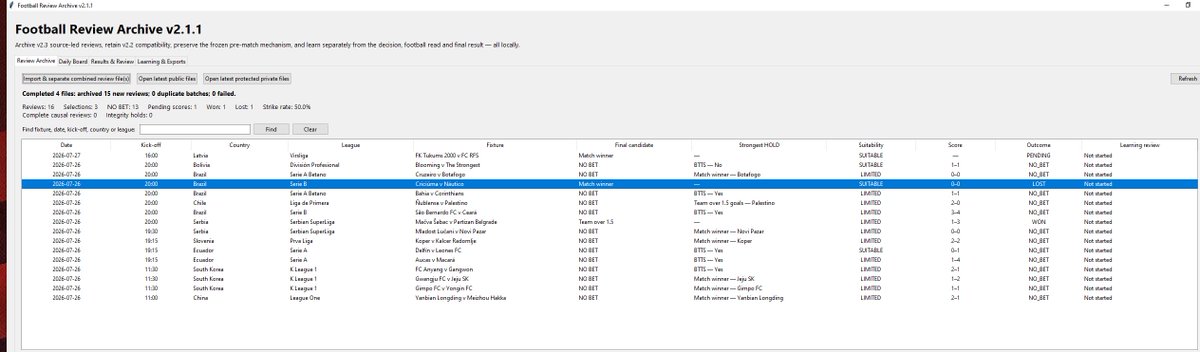
===== PUBLIC MATCH REVIEW =====
Fixture: BK Häcken v AIK
Date: 2026-07-27
Kick-off: 18:00 Europe/London
Country: Sweden
League: Allsvenskan
Match status: Result pending
===== FROZEN PRE-MATCH REVIEW =====
===== BK Häcken v AIK =====
0. Fixture / Context Audit
Sweden Allsvenskan, BK Häcken v AIK, 27/07/2026; scheduled 18:00 London kick-off; review frozen 17:49 Europe/London. Exact teams, date and selected home/away order passed, and the supplied match state remained pre-kick-off. Soccerway returned confirmed 11-v-11 starters and assigned benches: XI PASS / BENCH PASS, with Häcken 4-2-3-1 and AIK 4-3-1-2. The rolling lock contains three eligible league matches per team and no exposed official cup or continental match in the window. The API packet supplies contradiction context only; mechanisms come from dated reports and are tested against the confirmed functions.
1. Source Quality Check
1A. Rolling Recent-Match Coverage
BK Häcken — 19/07/2026 W 2-0; 11/07/2026 L 3-4; 06/07/2026 L 2-4.
AIK — 18/07/2026 W 2-0; 11/07/2026 W 2-1; 05/07/2026 W 2-1.
1B. Basic Baseline Contradiction Check
Fixture suitability: SUITABLE
Suitability reason: Both teams have three eligible matches, descriptive mechanisms across the window and confirmed functional selections.
API coverage: TEAMS/FIXTURES/RESULTS complete; EVENTS not requested, so red-card absence cannot be asserted from the packet.
Home baseline: 4/16; P13 W6 D5 L2 GF27 GA22; home P6 W3 D2 L1 GF14 GA13.
Away baseline: 7/16; P13 W6 D3 L4 GF18 GA18; away P7 W3 D3 L1 GF11 GA9.
Baseline contradiction: AIK’s strong away record and nine conceded in seven materially oppose assuming Häcken’s recent high-event matches automatically yield a home goal or open game.
2. Direct Source Evidence
BK Häcken
- At Halmstad, Häcken showed a more stable version of their attacking model. Adrian Svanbäck created an early cutback chance, Mikkel Rygaard’s delivery found Gustav Lindgren for the opener, and Brice Wembangomo’s pass released Lindgren for the second. Andreas Linde also had to make saves before Häcken established control, so the shutout was earned but not evidence that all opposition access had been suppressed. Improved build-up, rotations among the front four and counterpressing gave the side both chance access and its first clean sheet of this three-match window. The result is not incident-inflated and provides the principal counter to automatic open-game assumptions.
- The 3-4 derby loss at Örgryte preserved Häcken’s scoring functionality but exposed control limits. Julius Lindberg finished from Abdoulaye Doumbia’s supply, Svanbäck scored from Lindberg’s work, and Doumbia added a third after longer attacks had moved the opposition. Those three combinations spread finishing and creation across the target attacking unit rather than one exceptional scorer. An opponent pressing adjustment disrupted that momentum, while Häcken’s own assessment identified defensive duels and positioning. No documented red card or penalty drives the score; attack and vulnerability both remain material.
- Against Djurgården, Häcken grew into the game and Lindberg equalised after a constructed move; debutant substitute Bamir Sadiku later scored as Häcken continued attacking. Sadiku is assigned to the target bench, so this specific replacement finish remains available, although it is supporting rather than primary evidence. Two conceded set pieces, weak second-ball work and repeated counter exposure were decisive before a late fourth. This is target-compatible vulnerability against AIK’s vertical play, but it also confirms that Häcken can create after conceding rather than disappearing from the contest.
AIK
- AIK’s 2-0 against GAIS was decided by a concentrated second-half spell rather than proven ninety-minute dominance. Kevin Filling supplied Taha Ayari for the opener, then finished a quick combination from close range less than ten minutes later. The reciprocal Ayari-Filling connection matters because both are confirmed starters; GAIS having been slightly better before the interval prevents the score becoming generic control evidence.
- At Mjällby, Kristoffer Nordfeldt saved a major chance and, seventeen seconds later, Axel Kouamé launched the transition that Victor Andersson finished. The sequence is unusually useful because it links an evidenced defensive survival directly to the counter route rather than merely listing scorers. AIK added another late counter finished by Adrian Helm before conceding. The 2-1 depended on goalkeeper intervention and two transition moments rather than territorial superiority, but it is highly relevant against Häcken’s documented counter weakness; both deciding substitutes are on the target bench.
- At IFK Göteborg, AIK responded after trailing: Ayari supplied Johan Hove for the equaliser and later released Kouamé for the winning goal. Göteborg were reported to have driven long periods, so the 2-1 again does not prove AIK control. It does repeat the same preserved transition/through-ball route and shows AIK can score after the opponent has established attacking territory.
3. Hidden Football Context
3A. Context that helps explain the teams
Häcken’s target XI retains Rygaard’s delivery, Svanbäck and Lindberg’s receiving/finishing, Doumbia’s supply and Lindgren’s box arrival. AIK retain Nordfeldt behind Hove, Kouamé, Ayari and Filling, while the exact bench includes the Andersson/Helm pathway that decided the Mjällby transition game. Selection therefore preserves both scoring mechanisms without treating formation alone as proof.
3B. Review-altering flags
AIK’s three wins all contain state-dependent qualifications: two were achieved after opponents had substantial attacking phases, and Mjällby turned on a save-to-counter swing. Häcken’s two four-goal concessions contain genuine duel, set-piece and counter failings rather than one removable incident, but the Halmstad clean sheet shows improvement is possible. These corrections weaken either winner more than they weaken the two independent scoring legs.
4. Inference
Häcken can create through rotations, width and Rygaard-led service; preserved starters scored in all three current matches. AIK can attack the space that those rotations and Häcken’s weak second-ball/counter defence leave, with Ayari, Hove, Kouamé and Filling retained and an evidenced replacement path on the bench. AIK’s away defensive baseline and Häcken’s Halmstad clean sheet are material resistance, but neither suppresses the opposite scoring leg: Häcken repeatedly created even while losing, while AIK’s transition route repeated in two away wins and a home win. The reports are less convincing for either side controlling the whole game, making BTTS more resistant than a winner.
Strongest positive evidence: Both scoring legs have repeated, target-compatible mechanisms and the confirmed XI/bench preserves their primary functions.
Strongest counter-case: CANDIDATE-CRITICAL — AIK’s away defence and Häcken’s Halmstad clean sheet oppose treating one concession by each as automatic.
Distortion reconciliation: MATERIAL — AIK’s scorelines lose control weight, while their repeated transition mechanism and Häcken’s genuine defensive faults remain.
Evidence bridge: NOT REQUIRED — current descriptive coverage is balanced and each required scoring leg is directly evidenced.
5. Missing Evidence
- BACKGROUND — EVENTS were not requested, limiting red-card verification for every expression.
- BACKGROUND — No non-selected fitness limitation is inferred; exact XI/bench selection resolves availability, not performance.
- CANDIDATE-CRITICAL — Neither side has a stable ninety-minute control route; this holds both match-winner expressions.
- CANDIDATE-CRITICAL — AIK’s defensive suppression under sustained target-level pressure is not directly proved; this holds BTTS No.
6. Final Football-Only View
Häcken’s attacking functions remain intact, while their current counter, second-ball and set-piece exposure aligns with AIK’s repeated vertical route. AIK’s wins should not be mistaken for continuous control, yet the Ayari/Hove/Kouamé/Filling connections and the confirmed bench pathway give them a credible scoring leg when Häcken advance. AIK’s away resistance and Häcken’s recent clean sheet moderate totals and winner claims, but they do not outweigh repeated creation at both ends. The balanced football conclusion is scoring access for each side rather than control for either.
7. Confidence Level
Confidence level: Medium — both scoring legs have balanced descriptive support and exact functions, but score-state qualifications and AIK’s strong away defensive baseline remain material.
8. Independent Core-Market Clearance
Single-candidate framework: single-core-markets-v2.2.
Prompt output contract: football-intelligence-v2.3.
Home win gate: HOLD — Häcken’s attack is credible, but AIK’s repeated counter route and away resistance prevent a control advantage.
Away win gate: HOLD — AIK have a deciding transition route, yet Häcken’s repeated scoring makes away lead protection candidate-critical.
BTTS Yes gate: CLEAR — preserved creation on both sides directly meets genuine, target-compatible defensive exposure and survives the clean-sheet counter-case.
BTTS No gate: FAIL — no affirmative mechanism is evidenced to suppress either preserved scoring route.
Home team over 1.5 gate: HOLD — Häcken can create repeatedly, but AIK’s away baseline and recent resistance leave the second goal unresolved.
Away team over 1.5 gate: HOLD — AIK repeatedly score twice, but Häcken’s Halmstad improvement and state-dependent AIK finishes weaken second-goal transfer.
Match over 2.5 gate: HOLD — both score is supported, but a resistant second goal for either side is not independently complete.
Open-game danger: Yes — it weakens both winner controls and supports the already-established two scoring legs.
Frozen pre-match mechanism record:
Final clearance decision: BTTS — Yes
Required football mechanism: Häcken create through rotations and delivery; AIK exploit the resulting transition and second-ball spaces with preserved vertical functions.
Comparable transfer evidence: Häcken scored through current roles in three distinct states; AIK’s route repeated away at Mjällby and Göteborg.
Relevant functions and roles: Linde/Helander defence; Rygaard/Doumbia progression; Svanbäck/Lindberg creation; Lindgren finishing; Nordfeldt plus Ayari/Hove/Kouamé/Filling and bench transitions.
Strongest candidate opposition: CANDIDATE-CRITICAL — AIK have conceded only nine in seven away matches and Häcken just produced a structurally improved clean sheet.
Counter-case resolution: RESOLVED — those resistance signals are outweighed by repeated current access against defensive weaknesses that specifically fit the opponent.
Compact-resistance check: NOT EVIDENCED
Away-transfer check: PASS — AIK’s transition/through-ball scoring mechanism repeated in two current away matches.
BTTS weakest-leg check: PASS — AIK’s leg is weaker, but repeated away scoring and Häcken’s matching vulnerability directly support it.
Pre-match failure condition: Either side maintains compact rest defence and prevents the opponent’s preserved progression from reaching its first decisive attacking phase.
Final football candidate: BTTS — Yes.
===== PUBLIC MATCH REVIEW =====
Fixture: Rosenborg v Fredrikstad
Date: 2026-07-27
Kick-off: 18:00 Europe/London
Country: Norway
League: Eliteserien
Match status: Result pending
===== FROZEN PRE-MATCH REVIEW =====
===== Rosenborg v Fredrikstad =====
0. Fixture / Context Audit
Country: Norway
League: Eliteserien
Norway Eliteserien, Rosenborg v Fredrikstad, 27/07/2026; scheduled 18:00 London kick-off; review frozen 17:49 Europe/London. The selected home/away order and date passed exact-fixture validation; play had not begun. Soccerway supplied confirmed 11-v-11 starters, nine assigned substitutes per side and 4-3-3 versus 3-4-3 formations: XI PASS / BENCH PASS. The competitive chronology lock produced two eligible league matches per team from 22/06 onward; older matches and non-competitive games are excluded. The API packet is baseline evidence only, while the confirmed line-up is used only to test whether evidenced functions remain selectable.
1. Source Quality Check
1A. Rolling Recent-Match Coverage
Rosenborg — 18/07/2026 W 3-0; 12/07/2026 W 3-0.
Fredrikstad — 17/07/2026 L 0-1; 11/07/2026 L 0-2.
1B. Basic Baseline Contradiction Check
Fixture suitability: SUITABLE
Suitability reason: Both teams have two eligible current competitive matches and usable descriptive accounts; the short window contains no current-performance void.
API coverage: TEAMS/FIXTURES/RESULTS complete; EVENTS not requested, so red-card absence cannot be asserted from the packet.
Home baseline: 10/16; P13 W4 D3 L6 GF15 GA18; home P7 W3 D2 L2 GF12 GA9.
Away baseline: 12/16; P13 W4 D2 L7 GF15 GA23; away P7 W1 D1 L5 GF6 GA15.
Baseline contradiction: Rosenborg’s negative overall goal difference and Fredrikstad’s compact display at Bodø oppose treating two 3-0 results as automatic superiority.
2. Direct Source Evidence
Rosenborg
- At Start, Rosenborg began with front-foot access: Emil Ceïde and Adrian Pereira threatened, Iver Fossum’s run won the penalty Amin Chiakha converted, and the wide-to-box route was visible. The opener rewarded an actual penetration rather than an isolated foul, but it still came from the spot and cannot establish open-play finishing by itself. After the interval Rosenborg tired, Start took territory and made Leopold Wahlstedt and Tomáš Nemčík defend serious situations. That phase reveals a possible loss of midfield control under sustained pressure, even though the back line survived. The second and third goals arrived at 90+3 and 90+5 against a side throwing players forward. The 3-0 is therefore materially inflated by a penalty opener and two chase-state counters; it supports a deciding route and transition punishment, not three-goal control.
- Against Kristiansund at home, Rosenborg produced the cleaner transferable performance. Pereira’s overlapping and cutbacks, Ceïde’s shooting, David Ďuriš’s box movement and Ole Selnæs’s delivery repeatedly connected progression to finishing. Jonas Svensson scored from a partial clearance, Ďuriš converted a rebound after Ceïde’s attempt, and Selnæs crossed for Chiakha. The first two goals also show why pressure mattered: a clearance and a goalkeeper rebound were attacked before Kristiansund could reset, giving Rosenborg a second-phase route alongside direct crossing. The report recorded 75% possession and seven first-half shots on target; those totals corroborate rather than replace the described mechanism. Rosenborg also hit the post, missed a penalty and continued creating at 3-0, important evidence that the attack did not depend on a fragile one-chance conversion rate. This was sustained multi-route pressure rather than a score manufactured by a single incident.
Fredrikstad
- Fredrikstad found genuine first-half access against Lillestrøm: Henrik Skogvold headed narrowly over, a goal was disallowed for offside and Simen Rafn struck the inside of the post. Those are three distinct arrivals, so the blank is not evidence of zero threat. Lillestrøm improved after the break, however, and scored first from the edge of the area and then from a cross. Fredrikstad did not translate its better phase into a goal before control changed, nor did the account establish a productive chase response. It supports some attacking arrival but not repeatable finishing, sustained territorial control or an equalising route once Fredrikstad trailed.
- Away to Bodø/Glimt, Fredrikstad’s clearest current strength was compact resistance. The back line blocked and cleared, Martin Borsheim saved, and Rafn cleared off the line; the only concession was a VAR-awarded penalty in first-half stoppage time. That correction matters: the block prevented an open-play goal against strong territorial pressure, rather than merely benefiting from a low-event match. Late efforts from Skogvold at the near post and Jonas Nysveen from range show that Fredrikstad still sought an outlet, but they do not establish sustained box access. The 0-1 strengthens the defensive counter-case because the margin was incident-dependent, while the sparse attack leaves Fredrikstad’s scoring leg unproved.
3. Hidden Football Context
3A. Context that helps explain the teams
The Kristiansund match was Freyr Alexandersson’s official Rosenborg debut and the target XI retains the principal functions seen there: Pereira and Svensson for width, Selnæs and Fossum for progression, the Ceïde supply lines, and Chiakha/Ďuriš in scoring areas. Fredrikstad’s target 3-4-3 restores Oskar Ohlenschlaeger after his Bodø absence and keeps Rafn, Skogvold and Borsheim, so the review allows a modest improvement in connectivity without converting selection into performance evidence.
3B. Review-altering flags
Rosenborg’s Start score must not be read literally, while Fredrikstad’s Bodø resistance must not be dismissed because of defeat. Exact benches are assigned, so both managers have identifiable replacement options, but no unevidenced substitute route is used to clear a market. Comparable rest is not a differentiator in the competitive packet.
4. Inference
The home performance joined overlaps, progression, second balls, crossing and several box finishers. Those functions survive the confirmed XI. Fredrikstad can plausibly delay the first goal: its Bodø block survived open play and Borsheim plus the back line handled extended pressure. That checks Rosenborg’s team total more than the winner route. Fredrikstad’s away baseline is weak, its two current accounts show no sustained finishing mechanism, and Rosenborg have both settled-possession and late transition ways to decide a match. A narrow home win remains compatible with the evidence, so the winner requires less than a repeat of either 3-0.
Strongest positive evidence: Rosenborg’s sustained, multi-route home creation is preserved by the confirmed progression, width and finishing roles.
Strongest counter-case: CANDIDATE-CRITICAL — Fredrikstad’s compact resistance at Bodø could reduce Rosenborg’s volume and delay the decisive goal.
Distortion reconciliation: MATERIAL — the Start margin is down-weighted, leaving the Kristiansund mechanism and one genuine Start deciding route.
Evidence bridge: NOT REQUIRED — both sides have current descriptive evidence and the chosen route does not depend on guessing an uncovered team.
5. Missing Evidence
- BACKGROUND — Event enrichment is absent, limiting red-card checks for all seven expressions.
- BACKGROUND — No independent training-load detail is used; this affects confidence, not the Rosenborg winner mechanism.
- CANDIDATE-CRITICAL — Fredrikstad lack a repeated current scoring route; this blocks BTTS Yes and Fredrikstad over 1.5.
- CANDIDATE-CRITICAL — Only one current Rosenborg match shows undistorted two-goal home access; this holds Rosenborg over 1.5 and over 2.5.
6. Final Football-Only View
Rosenborg carry the clearer and more transferable route: home pressure can arrive through width, central progression, crosses, rebounds and box occupation, and the confirmed XI retains those functions. Fredrikstad’s compact Bodø resistance makes a routine multi-goal call too strong, but their current attacking material does not provide an equally credible deciding or equalising route. Correcting the Start score still leaves Rosenborg better equipped to create the match’s decisive event and to exploit a later chase state if Fredrikstad must open.
7. Confidence Level
Confidence level: Medium — both teams have usable current accounts and exact XI/bench evidence, while the short window and Fredrikstad’s demonstrated compact resistance prevent a higher grade.
8. Independent Core-Market Clearance
Single-candidate framework: single-core-markets-v2.2.
Prompt output contract: football-intelligence-v2.3.
Home win gate: CLEAR — Rosenborg retain multi-route home creation; Fredrikstad’s resistance is credible but their deciding and equalising routes remain materially thinner.
Away win gate: FAIL — Fredrikstad show neither comparable away control nor a repeatable route to decide this target environment.
BTTS Yes gate: HOLD — Rosenborg’s scoring leg passes, but Fredrikstad’s current finishing route is not independently established.
BTTS No gate: HOLD �� Fredrikstad’s weak attack helps, but Rosenborg have not established an affirmative suppression mechanism against this restored front.
Home team over 1.5 gate: HOLD — Fredrikstad’s compact Bodø resistance and the distorted Start margin leave the second home goal insufficiently resistant.
Away team over 1.5 gate: FAIL — no current repeatable two-goal route or comparable away transfer is evidenced.
Match over 2.5 gate: HOLD — Rosenborg provide a possible two-goal side, but the required Fredrikstad contribution or undistorted 3-0 route remains incomplete.
Open-game danger: No
Frozen pre-match mechanism record:
Final clearance decision: Match winner — Rosenborg
Required football mechanism: Rosenborg sustain pressure through preserved width and progression, then decide via crossing, second balls or transition without requiring two goals.
Comparable transfer evidence: The undistorted Kristiansund home performance transfers directly; Fredrikstad’s Bodø display supplies the resistance test rather than an opposing winner route.
Relevant functions and roles: Wahlstedt/Nemčík defence; Selnæs/Fossum progression; Pereira/Ceïdes creation; Chiakha/Ďuriš finishing; assigned benches preserve replacements.
Strongest candidate opposition: CANDIDATE-CRITICAL — Fredrikstad defended compactly against stronger Bodø/Glimt and conceded only an incident-dependent penalty.
Counter-case resolution: RESOLVED — Rosenborg’s preserved multi-route home mechanism can win narrowly, while Fredrikstad lack a comparable current deciding response.
Compact-resistance check: EVIDENCED-RESOLVED
Away-transfer check: NOT APPLICABLE — the selected expression is a home winner.
BTTS weakest-leg check: NOT APPLICABLE — BTTS is not the released expression.
Pre-match failure condition: Rosenborg fail to move Fredrikstad’s block and concede the first decisive transition before establishing sustained box access.
Final football candidate: Match winner — Rosenborg.
===== PUBLIC MATCH REVIEW =====
Fixture: FK Tukums 2000 v FC RFS
Date: 2026-07-27
Kick-off: 16:00 Europe/London
Country: Latvia
League: Virsliga
Match status: Result pending
===== FROZEN PRE-MATCH REVIEW =====
===== FK Tukums 2000 v FC RFS =====
0. Fixture / Context Audit
Fixture: FK Tukums 2000 v FC RFS, Latvia Virslīga, 27 July 2026, 16:00 Europe/London. The review clock is 15:15, 45 minutes before kick-off. The app-selected teams, date and home-away order match the supplied automatic Soccerway validation. The confirmed-XI gate passed: 11 starters per side, five home substitutes, nine away substitutes, and formations of 5-3-2 and 4-2-3-1 respectively. No duplicate lineup search or target-match event evidence was used.
1. Source Quality Check
The supplied routes produced usable current descriptions for both teams, while official records reconciled league, cup and UEFA chronology. The exact-fixture XI and benches are confirmed. API event enrichment was not run, so silence in that packet cannot establish red-card absence.
1A. Rolling Recent-Match Coverage
FK Tukums 2000:
- 18 July: Riga FC 3-1 FK Tukums 2000
- 11 July: FK Tukums 2000 1-2 SK Super Nova
- 5 July: FK Grobiņa 3-1 FK Tukums 2000
- 1 July: FK Tukums 2000 1-2 SK Super Nova
FC RFS:
- 23 July: FC RFS 4-1 Vestri
- 20 July: FS Jelgava 0-1 FC RFS
- 16 July: FC RFS 2-0 Glentoran
- 12 July: FC RFS 2-0 FS Jelgava
1B. Basic Baseline Contradiction Check
Fixture suitability: SUITABLE
Suitability reason: Four eligible matches and usable descriptive accounts cover each team, with complete all-competition chronology and confirmed selections.
API coverage: TEAMS/FIXTURES/RESULTS complete; EVENTS not requested, limiting only claims that a match had no red card.
Home baseline: 9/10; P23 W3 D8 L12 GF38 GA47; home P11 W3 D4 L4 GF22 GA16.
Away baseline: 1/10; P23 W19 D2 L2 GF55 GA16; away P12 W11 D0 L1 GF22 GA8.
Baseline contradiction: Tukums’s 22 home goals and 16 conceded in 11 oppose treating away control as routine; RFS must survive a live home route.
2. Direct Source Evidence
FK Tukums 2000
- At Riga, Tukums absorbed early corner pressure, then found useful transition and shooting access. Immediately after VAR cancelled a Riga goal for handball, Anmanis released a three-against-two counter and Leoni finished; Shibata later shot over when well placed. Two late headed goals turned a level game into a two-goal defeat. The margin therefore overstates separation, but the sequence directly exposes late aerial and lead-protection fragility.
- Against Super Nova in the cup, Toba was dismissed after 20 minutes. Ten-man Tukums still led through Samoilovs’s penalty before conceding an equaliser and a 90+4 winner. The red card materially weakens the defeat as evidence of normal 11-v-11 inferiority and shows resistance; because the goal was a penalty, it does not establish a repeatable open-play route.
- At Grobiņa, Tukums’s response after falling behind came mainly through longer-range efforts. Grobiņa’s second followed a counter launched from an aerial duel, while Baturins made three saves before the third; Samoilovs’s late edge-of-box strike was consolation. This supports goalkeeper exposure, vulnerability when play turns, and some individual shooting threat, but not sustained box access.
- In the league meeting with Super Nova, Tukums were active despite less possession: seven first-half shots, three on target, and a Derkach burst from the left produced the lead. A penalty immediately before half-time and a defensive scramble/deflection just after it reversed the game. Four further shots, two on target and six late corners showed genuine attacking access, but no equaliser and another self-damaging defensive spell.
FC RFS
- Against Vestri, RFS built a three-goal first-half lead through Panic, Ikaunieks and Ndjiki, then Lemajic restored the margin after the visitors scored. The involvement of midfield, creative and box-finishing functions is useful current evidence that the selected attack has more than one deciding route. Vestri’s lower competitive level weakens direct opponent transfer, so this is mechanism evidence rather than proof of the target result.
- At Jelgava, newcomer Sylla supplied the deciding goal and RFS protected the lead to full time. That is the cleanest current, venue-compatible 11-v-11 evidence for an away-win route. Jelgava also struck the crossbar, however, so the match proves survival and lead protection rather than complete suppression or comfortable control.
- Against Glentoran, Ndjiki beat his defender from the left before creating the first close-range finish. The second came when pressure exploited a goalkeeper-centre-back build-up error, leaving Ndjiki and Ikaunieks two-against-one. The first finish contained a loose contact and the second depended on an opponent error, but the wide-isolation and pressure mechanisms transfer toward Tukums’s documented scramble and transition failures.
- RFS’s cup win over Jelgava began with an opposing dismissal in the second minute; goals arrived later against ten men. That distortion is material and prevents the match from proving normal 11-v-11 control, repeatable two-goal output or away transfer. It is excluded from the core positive case rather than allowed to inflate it.
3. Hidden Football Context
3A. Context that helps explain the teams
The confirmed 5-3-2 retains Tukums functions seen recently through Baturins, Reingolcs, Joksts, Shibata, Anmanis, Samoilovs and Leoni. Yet Riga starters Derkach and Dusalijevs are absent, while Deruzinskis drops to a five-player bench. Dusalijevs returned to RFS on 22 July and is now among its substitutes.
RFS’s 4-2-3-1 preserves Nerugals and the defensive unit, Panic/Rakic for progression, Ikaunieks/Ndjiki as creators and Lemajic/Sylla in the attacking line. Kigurs, Odisharia and Talla offer a deeper replacement pathway.
3B. Review-altering flags
RFS played Vestri four days earlier and travel for the return on 30 July. That creates management risk, but the confirmed selection retains the functions required here rather than showing broad rotation. No pre-kick-off fixture-state conflict is evidenced.
4. Inference
Tukums can exploit space: the Riga counter and Super Nova access make a home response credible; the baseline rejects passive resistance. Yet today’s narrower route meets repeated failures to protect states through aerial, transition, penalty and scramble concessions.
RFS need not suppress completely. Their preserved XI joins multiple current deciding functions to direct away lead protection. Wide isolation, construction pressure and Lemajic’s box presence meet documented Tukums vulnerabilities. Jelgava’s thin margin blocks goals clearance, but not the winner: RFS have more recovery and scoring routes than Tukums have control after scoring.
Strongest positive evidence: RFS combine a current away lead-protection result with preserved, varied attacking functions that match Tukums’s demonstrated defensive failure modes.
Strongest counter-case: CANDIDATE-CRITICAL — Tukums breached Riga in transition, while Jelgava’s crossbar shows that RFS’s latest away control allowed an equalising route.
Distortion reconciliation: MATERIAL — Tukums’s cup red weakens that loss and Jelgava’s cup red inflates RFS’s win; neither distorted match drives the clearance.
Evidence bridge: PASS — current 11-v-11 away lead protection and target-compatible deciding routes answer home resistance without assuming total suppression.
5. Missing Evidence
- BACKGROUND — all expressions: API EVENTS were not requested, so red-card absence in ordinary league matches remains unverified.
- BACKGROUND — away win/away over 1.5: the detailed Jelgava account establishes survival but offers limited evidence of sustained away control.
- CANDIDATE-CRITICAL — away over 1.5/match over 2.5: no latest direct away comparison proves RFS can repeat its route into a second goal.
- CANDIDATE-CRITICAL — BTTS markets: today’s changed Tukums starting functions have no prior-match descriptive sample as a unit.
6. Final Football-Only View
RFS hold the stronger football case. Their confirmed side preserves defensive, progression, creation and finishing functions, while its wide and pressure routes address specific Tukums failures. Tukums’s transition threat and productive home baseline keep open-game danger alive, so neither a clean sheet nor a second RFS goal is secure enough for goals-market clearance. The direct away lead-protection evidence does, however, show RFS can survive that route, making the away winner the single expression that clears its material counter-case.
7. Confidence Level
Confidence level: Medium — current descriptive evidence and confirmed XI/benches cover both sides; RFS’s thin Jelgava margin and unresolved second-away-goal transfer prevent High.
8. Independent Core-Market Clearance
Single-candidate framework: single-core-markets-v2.2.
Prompt output contract: football-intelligence-v2.3.
Home win gate: FAIL — Tukums show transition access, but repeated defensive concessions and no current lead-protection evidence oppose home control.
Away win gate: CLEAR — RFS combine current away lead protection with preserved deciding routes matching Tukums’s aerial, scramble and pressure-related failures.
BTTS Yes gate: HOLD — Tukums’s scoring access is real, but selection changes and RFS’s preserved defensive spine leave the home leg unresolved.
BTTS No gate: HOLD — RFS can suppress, yet Tukums scored in every current-window match and breached Riga through transition.
Home team over 1.5 gate: FAIL — Tukums never reached two goals in the four-match window and now omit or bench recent attacking contributors.
Away team over 1.5 gate: HOLD — RFS have multiple routes, but their latest direct away comparison produced one goal; second-goal transfer remains unresolved.
Match over 2.5 gate: HOLD — a 2+1 path is credible, but neither RFS’s second away goal nor Tukums’s scoring leg is fully secured.
Open-game danger: Yes — Tukums’s transition access limits winner control, though RFS’s broader deciding and recovery routes preserve the away-win clearance.
Frozen pre-match mechanism record:
Final clearance decision: Match winner — FC RFS
Required football mechanism: RFS’s preserved spine and multiple attacking functions create the deciding goal, then control or survive Tukums’s transition response.
Comparable transfer evidence: The 1-0 win at Jelgava supplies current 11-v-11 away lead protection, although Jelgava’s crossbar prevents a suppression claim.
Relevant functions and roles: Defence: Nerugals plus back four; progression: Panic/Rakic; creation: Ikaunieks/Ndjiki; finishing: Lemajic/Sylla; replacement: Kigurs/Odisharia/Talla.
Strongest candidate opposition: CANDIDATE-CRITICAL — Tukums breached Riga in transition and RFS’s latest away control was thin enough to permit an equalising route.
Counter-case resolution: RESOLVED — RFS need not suppress completely; direct away lead protection and target-compatible scoring routes outweigh Tukums’s single main resistance route.
Compact-resistance check: NOT EVIDENCED
Away-transfer check: PASS — RFS protected a current 11-v-11 away lead at Jelgava.
BTTS weakest-leg check: NOT APPLICABLE — the released expression is a match winner.
Pre-match failure condition: RFS cannot establish territory or create against the 5-3-2 before travel-driven management, while Tukums convert the first clean transition.
Final football candidate: Match winner — FC RFS
===== PUBLIC MATCH REVIEW =====
Fixture: Criciúma v Náutico
Date: 2026-07-26
Kick-off: 20:00 Europe/London
Country: Brazil
League: Serie B
Match status: Result pending
===== FROZEN PRE-MATCH REVIEW =====
===== Criciúma v Náutico =====
0. Fixture / Context Audit
Brazil Série B, Criciúma v Náutico, 26/07/2026, 20:00 Europe/London; review frozen at 19:28. The exact Soccerway match validates competition, date and app-selected order. Its rendered line-up page supplied 11 starters for each team, with 12 Criciúma and nine Náutico substitutes: home 3-4-3 against away 4-2-3-1. The target match had not supplied any event evidence. All reasoning is therefore frozen before kick-off and uses the confirmed teams.
1. Source Quality Check
The all-competition rolling routes align with the supplied league chronology. Multiple exact-match descriptions exist for both sides, including comparable Criciúma home control and Náutico away response states.
1A. Rolling Recent-Match Coverage — dates and scores only
Criciúma: 21/07/2026 Novorizontino 0-1 Criciúma; 18/07/2026 Criciúma 2-0 Vila Nova; 08/07/2026 Ponte Preta 1-2 Criciúma; 04/07/2026 Criciúma 1-0 Sport.
Náutico: 23/07/2026 Náutico 2-1 Londrina; 16/07/2026 CRB 2-1 Náutico; 12/07/2026 Avaí 2-0 Náutico; 05/07/2026 Náutico 0-0 Juventude.
1B. Basic Baseline Contradiction Check
Fixture suitability: SUITABLE
Suitability reason: Confirmed XIs, balanced current coverage and direct home/away mechanism evidence support a target-specific review.
API coverage: TEAMS, FIXTURES and RESULTS complete for Série B; EVENTS not requested, so API red-card and incident checks are unavailable.
Home baseline: 1/20; P19 W11 D6 L2 GF23 GA12; home P9 W6 D3 L0 GF12 GA4.
Away baseline: 14/20; P19 W7 D3 L9 GF24 GA24; away P10 W3 D2 L5 GF16 GA17.
Baseline contradiction: Criciúma’s modest 12 home goals and Náutico’s 16 away goals preserve narrow-draw and away-scoring resistance to a home-winner case.
2. Direct Source Evidence
Criciúma
- Vila Nova 2-0: Criciúma broke an initially balanced midfield contest when Fellipe Mateus drove quickly from the intermediate line and finished after ten minutes. They then protected central space, endured Vila Nova’s higher second-half press and used the spaces behind it for wing-back and winger counters. Marcelo Hermes converted that route late. Pedro Santos and the defensive unit preserved the lead under aerial and set-piece pressure.
- Novorizontino 0-1: this win materially flatters Criciúma. Castán’s early error required Pedro Santos to intervene, Carlão hit the post, and Bianqui missed a late one-on-one. Substitute Diego Gonçalves then scored after a long release, with VAR overturning an offside decision. It confirms late transition and goalkeeping survival, but not comprehensive control.
- Sport 1-0: after Waguininho’s first-half goal, Criciúma protected a lead and countered, but Sport created late chances and Airton made decisive saves. This is supporting evidence for the game-state plan, yet goalkeeper dependence is down-weighted because Pedro Santos, not Airton, starts here.
Náutico
- Londrina 2-1: in heavy rain, Jean Carlos directed delivery and combination play; Kauan Maranhão scored from his service and Jean converted a penalty. Náutico led by two but remained exposed, with Muriel required as Londrina generated a strong response. This restores a genuine creation route without resolving defensive game control.
- Avaí 2-0: Náutico conceded from an early corner, then held more possession and pursued the equaliser without converting. Avaí could defend the lead and attack the vacated space; the second arrived only when Muriel joined a final attack. The first-goal game state, not the inflated final margin, is the useful comparison.
- CRB 2-1: Náutico controlled portions of territory but produced too few clear openings. Jean Carlos supplied the cross for Kauan Maranhão’s headed equaliser, confirming that their restored creator-finisher connection travels; they later allowed the decisive delivery into their own area. The game supports one away scoring route while again showing that possession does not guarantee control of the decisive boxes.
Confirmed-XI effect
Criciúma retain Pedro Santos, Castán, Rodrigo, Fellipe Mateus, Hermes, Otero, Waguininho and Lepo from the evidenced home structure. Náutico retain Jean, Kauan, Muriel and the central defenders, but suspended Igor Fernandes is replaced by an improvised Matheus Ribeiro at left-back. That creates a target-compatible outside route for Criciúma without removing Náutico’s central creative threat.
Fellipe’s inside carrying can draw the improvised full-back corridor before Hermes advances outside, while Otero can switch the point of attack. If Náutico narrow to protect Jean’s central zone, Lepo and Waguininho provide the opposite outlet. These are confirmed-role continuities already visible in Criciúma’s home lead-and-counter pattern, not projected reinforcements.
This lets Criciúma vary the first-goal route without changing their protection structure, an important distinction from merely accumulating attackers against Náutico’s credible central counter-threat.
3. Hidden Football Context
3A. Context that helps explain the teams
Criciúma have 4.9 recovery days and Náutico 3.8, with the visitors playing a third league match inside 14 days. The home 3-4-3 can turn into a lead-protection shell while Hermes and Lepo remain transition outlets. Náutico’s revival is closely linked to Jean Carlos returning to connect with Kauan, giving them better delivery than the preceding score sequence alone suggests.
3B. Review-altering flags
Criciúma’s latest away clean sheet contained major opponent chances, so it cannot be treated as fresh proof of total defensive dominance. Their stronger comparison is the Vila Nova home game: the confirmed core created an early lead, survived pressure and found a second through space outside. Náutico’s improvised left-back matters because it meets that flank route; however, Jean’s current influence keeps an equaliser route alive.
4. Inference
Match winner — Criciúma has a direct route: progress inside or outside, score first, compress centrally, then attack the space behind Náutico’s response. The confirmed core executed it at home against third-ranked Vila Nova. Náutico’s Avaí loss supplies the mirror state: early concession, unconverted possession and transition exposure.
Jean and Kauan create a real equaliser route, and Criciúma have needed saves while protecting leads. The counter remains background because Pedro Santos and the same core survived stronger Vila Nova pressure, while Náutico’s improvised left-back meets Criciúma’s evidenced flank route. This clears only the winner, not a required second goal.
Strongest positive evidence: Criciúma’s confirmed core already created, protected and extended a home lead against stronger current opposition.
Strongest counter-case: BACKGROUND — Jean Carlos and Kauan Maranhão restore an equalising route, reinforced by Náutico’s productive away baseline.
Distortion reconciliation: MATERIAL — the Novorizontino clean sheet is down-weighted; the Vila Nova home mechanism carries the decision.
Evidence bridge: PASS — Náutico’s loss at Avaí supplies a comparable first-concession, possession-chasing and transition-exposure pattern.
5. Missing Evidence
- BACKGROUND — Jean Carlos’ ability to sustain his restored influence against Criciúma’s central block; affects Match winner — Criciúma and BTTS — Yes.
- BACKGROUND — Matheus Ribeiro’s functional level at improvised left-back; affects Match winner — Criciúma and Team over 1.5 goals — Criciúma.
- CANDIDATE-CRITICAL — Repeatable second-home-goal production beyond one current example; affects Team over 1.5 goals — Criciúma and Match over 2.5 goals.
- BACKGROUND — Depth of Náutico’s nine-player bench if chasing; affects away-positive expressions.
6. Final Football-Only View
Criciúma possess the clearer game-state pathway: their retained 3-4-3 core can find a first goal, protect central zones and release wide players into the spaces created by Náutico’s response. Náutico’s Jean–Kauan connection prevents an assumption of easy suppression, but their current away evidence shows possession can remain blunt after conceding while defensive space expands. The home side’s route survives that counter-case. It establishes relative winning control, though neither a second Criciúma goal nor a both-teams-score conclusion is independently secure.
7. Confidence Level
Confidence level: Medium — Both teams have direct current descriptions and confirmed functions; the unresolved Náutico scoring route is material but not decisive for home-winner clearance.
8. Independent Core-Market Clearance
Single-candidate framework: single-core-markets-v2.2.
Prompt output contract: football-intelligence-v2.3.
Home win gate: CLEAR — Criciúma’s retained core has a comparable score-first, protect and counter route against stronger opposition.
Away win gate: FAIL — Náutico’s restored creation does not establish away control or lead protection against this home structure.
BTTS Yes gate: HOLD — Jean and Kauan support Náutico’s leg, but Criciúma’s suppression can still deny it.
BTTS No gate: HOLD — Criciúma can suppress, but Jean’s restored delivery prevents an affirmative clean-sheet conclusion.
Home team over 1.5 gate: HOLD — The repeatable winner mechanism may end at one goal; home output remains modest.
Away team over 1.5 gate: FAIL — No current comparable evidence supports two Náutico goals against elite home resistance.
Match over 2.5 gate: HOLD — A supported home winner does not complete a 2+1 or 3+0 construction.
Open-game danger: Yes — it strengthens Náutico’s equaliser route but also Criciúma’s decisive transition route after a home lead.
Frozen pre-match mechanism record:
Final clearance decision: Match winner — Criciúma
Required football mechanism: Score first through midfield or flank progression, compress centrally, then counter N��utico’s advanced response.
Comparable transfer evidence: Vila Nova home control aligns with Náutico’s first-concession and transition exposure at Avaí.
Relevant functions and roles: Pedro protects; back three suppress; Hermes and Lepo progress; Fellipe and Otero create; Waguininho finishes.
Strongest candidate opposition: BACKGROUND — Jean-to-Kauan service offers an equaliser, but lacks proof against Criciúma’s current home block.
Counter-case resolution: RESOLVED — same home core survived stronger pressure and retained a second-goal transition.
Compact-resistance check: EVIDENCED-RESOLVED
Away-transfer check: NOT APPLICABLE
BTTS weakest-leg check: NOT APPLICABLE
Pre-match failure condition: Criciúma concede first, removing the evidenced lead-protection and counter sequence.
Final football candidate: Match winner — Criciúma.
===== PUBLIC MATCH REVIEW =====
Fixture: Mačva Šabac v Partizan Belgrade
Date: 2026-07-26
Kick-off: 20:00 Europe/London
Country: Serbia
League: Serbian SuperLiga
Match status: Result pending
===== FROZEN PRE-MATCH REVIEW =====
===== Mačva Šabac v Partizan Belgrade =====
0. Fixture / Context Audit
Serbian SuperLiga, Mačva Šabac at home to Partizan Belgrade, 26/07/2026, 20:00 Europe/London; review frozen at 19:31. The supplied exact-match Soccerway extraction passed team, date, home/away, XI and bench validation. It shows Mačva in a 4-4-2 and Partizan in a 4-1-4-1. This review uses that supplied selection evidence without repeating the lineup search. Only completed official matches before the review clock are considered; no target-match event is used.
1. Source Quality Check
1A. Rolling Recent-Match Coverage
Eligible completed official matches, newest first:
Mačva Šabac
- 17/07/2026 — Red Star Belgrade 5-0 Mačva Šabac
Partizan Belgrade
- 23/07/2026 — Partizan Belgrade 4-0 UNA Strassen
- 18/07/2026 — Zemun 2-2 Partizan Belgrade
1B. Basic Baseline Contradiction Check
Fixture suitability: LIMITED
Suitability reason: Mačva has one eligible match and Partizan two, although each side has usable current descriptive evidence and chronology is reconciled.
API coverage: TEAMS/FIXTURES/RESULTS complete; EVENTS was not requested, so API evidence cannot establish the absence or effect of red cards.
Home baseline: 14th; P1 W0 D0 L1 GF0 GA5; home P0 W0 D0 L0 GF0 GA0.
Away baseline: 8th; P1 W0 D1 L0 GF2 GA2; away P1 W0 D1 L0 GF2 GA2.
Baseline contradiction: Mačva has no home sample, while Partizan’s sole league-away match confirms two goals but not defensive control or lead protection.
2. Direct Source Evidence
Mačva Šabac
- Red Star kept Mačva almost permanently in its own half. The five goals came through a run beyond the line, two headed/crossing sequences, Kone’s own goal, a five-metre finish after another wide break, and a saved header whose rebound was left unprotected. The first also required a defender to hold Duarte onside, while the second converted a cross through a headed redirection rather than an isolated finish. Mačva’s substitutions did not change the territorial pattern and there was no corresponding sustained attacking threat. Red Star’s class and the own goal materially inflate the raw margin, but neither explains away Mačva’s repeated difficulty defending width, depth and the next box action. The target XI retains Rakić, Vidakov, Sladojević and Terzić from that selection; Kone is now on the bench, so his individual errors are corrected more heavily than the collective access. The new 4-4-2 means unit performance is not assumed unchanged.
Partizan Belgrade
- At Zemun, Partizan controlled the opening 20–25 minutes and Aleksić converted that pressure, while other chances went unused. Their tempo then fell into what Saša Ilić called “anarchy,” permitting an equaliser. Ugrešić restored the lead after Jeh and Traoré helped renew the initiative and pressure, with further chances again left unused. Zemun’s 93rd-minute equaliser followed a Roganović–Milošević misunderstanding and a ricochet off Petrušić. That unusual finish softens the concession, but the preceding relaxation leaves lead protection unresolved. Aleksić, Ugrešić, Jeh and Roganović all start here; Ugrešić and Jeh move from the effective replacement phase into the initial unit, preserving the directly comparable away attacking route while changing its timing.
- Against UNA Strassen, Partizan led 2-0 before the visitor’s 51st-minute red card: Kojzek scored in the fifth minute and Zubairu added the second in the 29th after sustained control. Zubairu and Ugrešić then made it 4-0. The dismissal materially reduces the evidential weight of the last two goals and the second-half ease, but not the 11-v-11 two-goal threshold or the early territorial superiority. This was home rather than away and the opponent transfer is not treated as identical; it corroborates, rather than creates, the Zemun route. Zubairu and Ugrešić start; Kojzek is a confirmed substitute, leaving both finishing and replacement pathways present despite rotation.
Selection and approach
- Ilić said Partizan’s best spell was the first half-hour at Zemun, demanded the intensity and rhythm needed to break opponents, and indicated further early-season rotation. Mačva’s staff said the Red Star result had to provide lessons in aggression, confidence and responsibility, promised a braver home display, and reported several unnamed significant absences. The confirmed XIs resolve who is available now, but not how well the rearranged functions will perform. Mačva’s confirmed bench offers alternatives, but no eligible account demonstrates a successful in-match defensive repair.
3. Hidden Football Context
3A. Context that helps explain the teams
Partizan arrive three days after European action, whereas Mačva had nine days after facing Red Star. Rotation is therefore logical rather than automatically negative. The 4-1-4-1 still contains Vukotić and Krunić for progression, Aleksić and Ugrešić between lines, and Zubairu plus Trifunović around Djurdjević. Mačva’s new 4-4-2 keeps substantial personnel continuity but alters the collective arrangement and places Abdullahi with Ilić as the selected finishing pair.
3B. Review-altering flags
The thin Mačva window is the main limitation. Red Star is a materially stronger opponent, so the 0-5 cannot be transferred literally. Conversely, Partizan’s attacking claim does not depend solely on that defeat: it has a two-goal away mechanism and a separate two-goal 11-v-11 confirmation. The short Partizan turnaround matters more to winner control than to the preserved two-goal route.
4. Inference
Partizan reached two goals through pressure phases at Zemun and before UNA’s red. The XI retains the league scorers, European second scorer, progression and attacking replacements. Mačva’s elite-opponent mismatch limits literal transfer, but its conceded width, depth and second actions fit Partizan’s route; benching Kone corrects one individual distortion, not every access.
Winner control remains weaker because Partizan lost rhythm and failed to protect a lead, while Mačva’s home resistance is unknown. Mačva’s scoring route is unproved, blocking BTTS and a supported 2+1.
Strongest positive evidence: Partizan reached two goals in a direct away comparison and again before the red card against UNA Strassen with current scorers retained.
Strongest counter-case: BACKGROUND — Mačva’s sole account came away to superior opposition, but Partizan’s independent current two-goal evidence reduces reliance on that transfer.
Distortion reconciliation: MATERIAL — Mačva’s own goal and UNA’s red card reduce headline margins; the relevant pre-distortion two-goal and access mechanisms remain.
Evidence bridge: PASS — direct Partizan away production, preserved functions and target-compatible access bridge Mačva’s thin home evidence without assuming a Mačva goal.
5. Missing Evidence
- BACKGROUND — Mačva’s untested home resistance affects Match winner — Partizan Belgrade and Team over 1.5 goals — Partizan Belgrade.
- CANDIDATE-CRITICAL — Partizan’s inconsistent lead management affects Match winner — Partizan Belgrade.
- BACKGROUND — Unnamed Mačva absences and replacement quality affect the home win, BTTS and home-team-total expressions.
- BACKGROUND — Unrequested EVENTS data leaves undisclosed-card absence unverified across all expressions.
6. Final Football-Only View
Partizan possess the clearer attacking route: current creators and finishers reproduced a two-goal threshold both away and before a numerical advantage. Mačva’s rearrangement and home setting prevent the Red Star score from being copied, but do not remove the documented wide, depth and second-action access. Partizan’s uneven rhythm and lead protection leave the away winner short of clearance, while Mačva’s scoring leg remains too weakly evidenced for BTTS or the match total.
7. Confidence Level
Confidence level: Medium-Low — exact XI and useful Partizan mechanisms are offset by Mačva’s one-match window, absent home evidence and opponent-strength transfer.
8. Independent Core-Market Clearance
Single-candidate framework: single-core-markets-v2.2.
Prompt output contract: football-intelligence-v2.3.
Home win gate: FAIL — No current Mačva deciding mechanism is established, and the new 4-4-2 proves selection rather than performance.
Away win gate: HOLD — Partizan’s superiority route is credible, but lead protection and Mačva’s home resistance remain unresolved.
BTTS Yes gate: HOLD — Partizan’s scoring leg is supported; Mačva’s scoring leg lacks a direct current mechanism.
BTTS No gate: HOLD — No affirmative Partizan suppression mechanism exists, and Zemun exposed unstable defensive control.
Home team over 1.5 gate: FAIL — Mačva has no evidenced current route to a first goal, much less a repeatable second.
Away team over 1.5 gate: CLEAR — Partizan repeated two goals across away and pre-red 11-v-11 evidence with scorers and creation functions retained.
Match over 2.5 gate: HOLD — A 2+1 needs an unproved Mačva goal; a 3+0 route is not directly repeated.
Open-game danger: Yes — Partizan’s tempo loss and lead-management errors weaken away-winner control without cancelling its attacking route.
Frozen pre-match mechanism record:
Final clearance decision: Team over 1.5 goals — Partizan Belgrade
Required football mechanism: Sustained pressure accesses wide, depth and second actions twice through retained Aleksić, Ugrešić and Zubairu functions.
Comparable transfer evidence: Two away at Zemun and two before UNA’s red; Mačva conceded repeated cross, depth and rebound access.
Relevant functions and roles: Defensive spine rotated; Vukotić/Krunić progression; Aleksić/Ugrešić creation; Zubairu/Djurdjević finishing; Kojzek, Jeh and Traoré replacement.
Strongest candidate opposition: BACKGROUND — Mačva’s only eligible evidence is an away mismatch and its current 4-4-2 may improve resistance.
Counter-case resolution: RESOLVED — clearance rests primarily on Partizan’s direct two-goal evidence, while Mačva’s access pattern supplies compatible support.
Compact-resistance check: NOT EVIDENCED
Away-transfer check: PASS — Zemun supplies direct away two-goal production with both scorers starting.
BTTS weakest-leg check: NOT APPLICABLE
Pre-match failure condition: A genuinely compact Mačva home 4-4-2, absent from current evidence, would remove the target-vulnerability support.
Final football candidate: Team over 1.5 goals — Partizan Belgrade.