Sub-microwatt inference claims make great headlines. But when the microphone, leakage and battery convertor alone draws 100x more, the inference number disappears into the system total. Wake-up is judged on customers by system power, programmability and integration.
Blog 1 of our Akida Pico series: https://t.co/DQlteQf8u4
One Akida chip is efficient. Eight are something else.
Our ML engineer put eight AKD1500 M.2 cards in one mini-PC to see what happens when edge AI scales out instead of up.
What we learned about big models, small models, and the host: https://t.co/MyoFvKSkht
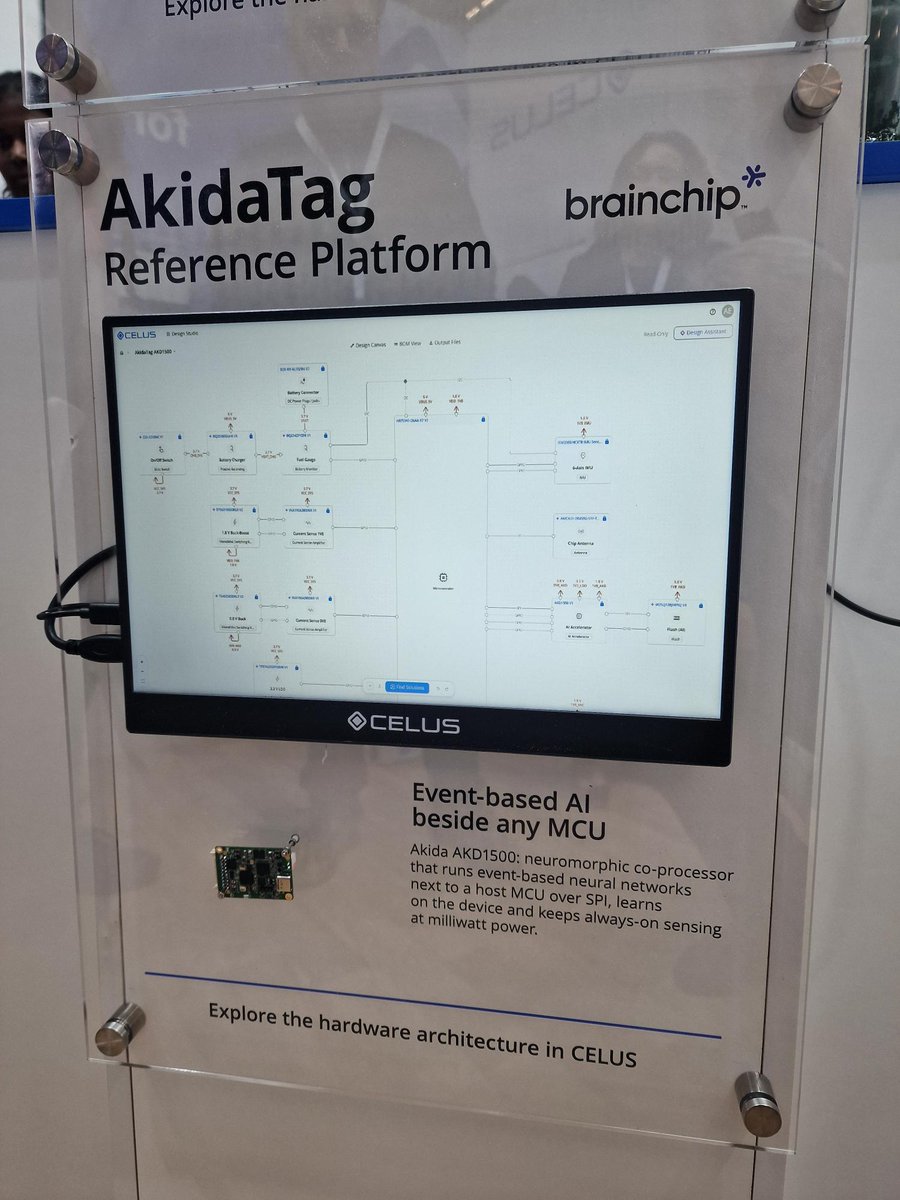
BrainChip x CELUS, live Dec 7: From Reference Design to Your Product.
Nikunj and Antonio turn AkidaTag, our AKD1500 edge AI reference platform, into a custom design live, MCU swap and BOM included.
8 AM PT / 5 PM CET. Link below.
https://t.co/XdS3wTmrK5
Prototype on one thing. Rework the model for another. Repeat.
That’s the usual path to production. AKD1500 skips it: same chip, same MetaTF flow, from first kit to production board.
Flowchart picks your starting point. Learn more about the guide here https://t.co/X9Ojrk0VbU
Alf and Gilles are back from #electronicafair 2026 in Munich, where Physical AI was the headline.
Their top takeaway: every joint and fingertip needs its own sensing, local, always on, running at milliwatt power.
Event-based vision is ready for real products too.
Adding AI to an edge device usually means replacing the processor you already ship, or adding an accelerator with its own power and thermal budget.
There’s a third option: keep your host, add a dedicated AI co-processor.
AKD1500’s two differentiators:
1. Sparsity-driven low power: skips inactive values instead of computing them
2. On-chip learning: adapts to users after shipping
Read the Blog: https://t.co/q5It5R8AKv
New on the BrainChip Investor Podcast: Edge AI CEO Jay Kim joins Troy Dahms to discuss the licensing agreement, the path from IP to silicon, and the future of AI on the edge. Link below.
https://t.co/p0jOPM4XK8
Our CEO Sean Hehir joined Brian Thomas on The Digital Executive Podcast to talk neuromorphic computing and why low-power AI at the edge matters for wearables, medtech, automotive and defense.
Listen on Podcasts: https://t.co/WoA99CE5j2
🧠 Don’t replace the FPGA. Add a signal layer next to it.
In trading, tail latency often matters more than the average. The blog covers what to benchmark before you commit.
📖 Read the blog: https://t.co/bCTYxWrpzP
Low-bit weights make each multiply cheaper. They don’t make the multiplies go away.
We filed a patent application on a way to group first and multiply once per group. The blog is honest about what’s still to be measured.
📖 Read the blog: https://t.co/S9Aux7FTtu
Your Raspberry Pi shouldn’t need the cloud to learn a new keyword.
AKD1500 + Raspberry Pi 5, pre-loaded. Teach it a keyword, gesture, or object on the device. Data stays local.
Same chip goes into your product. No re-porting.
Links below 👇
Read the Announcement → https://t.co/ZL1WMeLoN3
Order Now → https://t.co/XLJg2mTpgi
Thank you, Semiconductor Australia. CEO Sean Hehir presented to a room of industry, government and investment leaders, and our booth showcased BrainChip products.
The mood was energy and excitement about the industry’s bright future.
Thanks to everyone who stopped by.
See what Sean shared on stage: https://t.co/yhv6JDH6mJ
💤 Pinned GPU, tiny model, mostly idle. Sound familiar?
Our CPO on where a pool of Akida devices pays off beside your CPU and GPU: always-on streams screened at low power, GPU cued only on events.
📖 Read the blog: https://t.co/NCpR2cvwLc
AKD1500 SPI is now available in the BrainChip store.
Single chips or 5-packs, ready to pair with your existing MCU over SPI.
Learn More: https://t.co/F8lacHCGYC
Introducing the AKD1500 SPI Edge AI Co-Processor.
Always-on AI with on-chip learning for MCU-based products, over a standard SPI interface.
Keep your MCU. Add the AI.
Read the Announcement:
https://t.co/LYek7IwEht
“You can’t do everything in the data center.”
Sean Hehir on @ausbiztv Australia on why AI is moving to the edge, and why Sequora runs both Transformers and SSMs while we bet on SSMs long term.
Watch the Full interview:
https://t.co/lNmuKkpDC0
Tomorrow in Sydney: edge AI that doesn’t just recognize, it understands and responds.
Sean Hehir is presenting and joining a panel at Semiconductor Australia, and the team is on the expo floor to talk Akida and Sequora.
Details below.
https://t.co/W43e74Uan5
📦 AI hardware doesn’t have a math problem. It has a delivery problem.
Sequora starts from one question: what should you actually accelerate?
📖 Read the blog: https://t.co/mW0IYKhKk6
🔋 Your biggest chip is doing the smallest job.
Watching a sensor all day to confirm nothing happened shouldn’t need the big processor awake. Give that job to a small sensing brain and let the big one sleep.
📖 Read the blog: https://t.co/vyhwwJqFRz
#EdgeAI