This paper revealed the shocking prevalence of neuropsychiatric conditions in patients with mast cell activation syndrome (MCAS).
Here are the numbers...
Mast cell-derived cytokines like IL-12 can mediate neuroinflammation. IL-12 can do this by altering neurotransmitter systems and activating microglia (the primary immune cells of the CNS).
Let us know what you think of this study by dropping a comment below.
Read the full study here:
https://t.co/Yn5GxoSl6O
Inappropriate MC activation can make the blood-brain barrier (BBB) leaky. The BBB describes the barrier-like properties of blood vessels in the brain. This could allow pro-inflammatory cytokines and antibodies into the brain.
Too much histamine can affect peripheral neurons and also interact with immune and glial cells in the CNS. This could indirectly drive a wide array of issues categorized as:
- neurologic
- psychiatric
- dysautonomia
A subset of individuals with depression (1), sleep disorders (2), bipolar disorder (3), or mood disorders (1) have all been found to have elevated pro-inflammatory cytokines in their blood.
The study below is yet another example of why immunopsychiatry is an area of active research.
Literature Cited:
1. Felger JC. Curr Neuropharmacol. 2018. PMID: 29173175
2. Zielinski MR, Gibbons AJ. Front Cell Infect Microbiol. 2022. PMID: 35392608
3. Dolsen MR, Soehner AM, Harvey AG. Psychosom Med. Jan 2018. PMID: 28914726
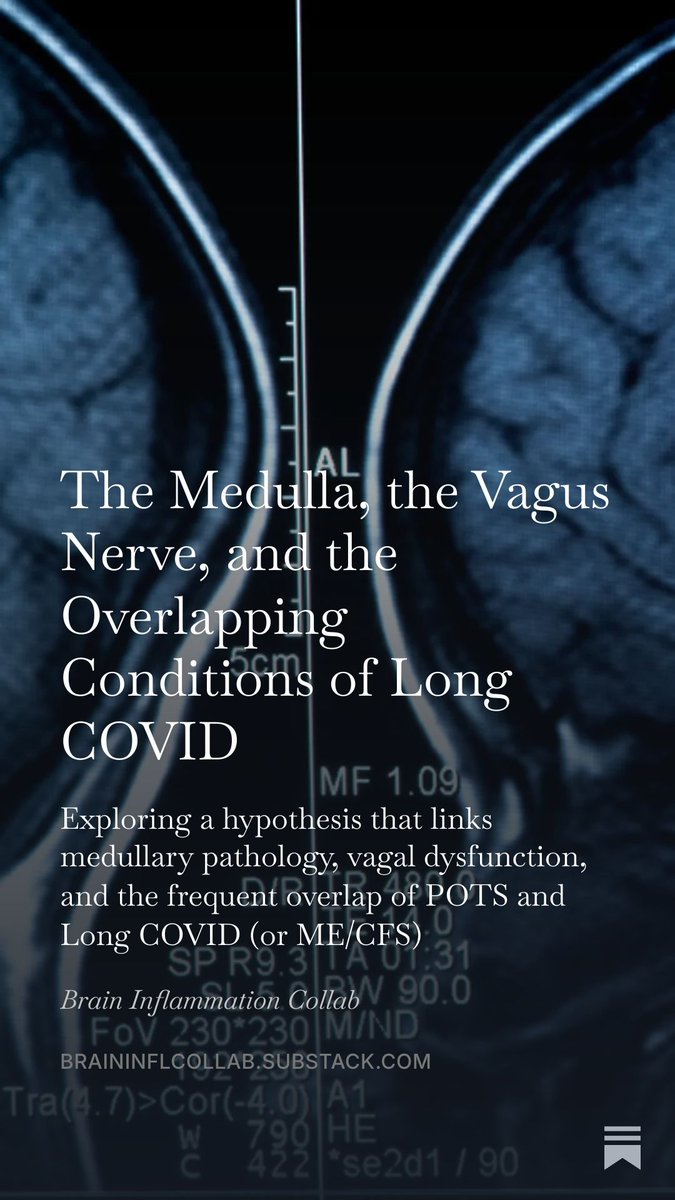
Key brainstem regions help control heart rate, blood pressure, breathing, and the body’s inflammatory “brake” through the vagus nerve.
In this article, we examine neuroimaging and post-mortem findings in COVID-19, a recent neuroimmune hypothesis for POTS, the medulla’s role as an inflammatory thermostat, and how connective tissue laxity or mast cell activation may amplify vulnerability in a subset of patients.
Read more here: https://t.co/CrszagG4IF
Thank you again for allowing us to host you in our webinar series and for inspiring this week's Substack article. We admire the academic and clinical contributions you are making in the dysautonomia world!
For those who haven't yet watched Dr. Blitshteyn's @dysclinic recent webinar, it's outstanding.
https://t.co/Gw00gwzHf3
Thanks to @BrainInflCollab for discussing my papers on #POTS, #MECFS and #LongCOVID as neuroimmune disorders and a possible CNS localization of POTS/dysautonomia to the dorsolateral medulla! 🧠
Read more about these emerging topics here:
https://t.co/qsZet122NQ
https://t.co/Y78T90z2MB
New research highlights something many of us already know too well: females with autoimmune diseases are far more likely than males to have their symptoms dismissed as psychiatric or psychosomatic.
In a study of over 6,600 people:
- 43% of females reported a previous psychiatric misdiagnosis vs 33% of males.
- 34% of females reported psychosomatic labels vs 22% of males.
Even after adjusting for other factors, females were:
- ~50% more likely to receive a psychiatric misdiagnosis.
- ~75% more likely to receive a psychosomatic misdiagnosis.
Females also waited longer for a correct diagnosis, often 1 to 2 years, while many males were diagnosed in under 3 months.
Patient partner Shaista Tayabali put it clearly: “The differences between the sexes in misdiagnoses for people with autoimmune diseases are stark… as women, we still often have a harder time having our symptoms believed and therefore addressed accurately.”
If your symptoms persist, evolve, or affect multiple systems, keep advocating for proper investigation. Your experiences are valid and deserve to be heard.
Share this if it resonates.
Full article in the comments.
You have 23 chromosomes from your biological mother and 23 from your biological father, or two copies of every gene.
However, males technically don't have two copies of EVERY gene.
After having her daughter at age 27, Sebrina Smith-Henry was constantly thirsty, with dry mouth and skin, body aches, and chronic fatigue. It took about 7 years of symptoms before she received a diagnosis.
Sebrina was in and out of a military hospital while her husband was in service, but she explained, “I had never had a doctor put all the pieces together before then… and you never saw the same doctor twice there.”
It wasn’t until a chance encounter with a nurse that things began to change. Her daughter, then 7, was participating in a clinical study at Duke University Children’s Hospital. The study required long hours at the hospital, and a nurse allowed her to sleep in a guest room.
After waking up 8 hours later, the nurse checked her vitals and said, “You need to tell your doctor about all these things that are happening to you."
A new doctor outside the military network examined her skin, eyes, and scalp. He ran tests and told her, “I think we found the answer.” She was diagnosed with:
- Rheumatoid arthritis
- Sjögren’s
- Lupus
Managing her autoimmune diseases has her feeling better at age 59 than she did at 46.
Common signs include joint pain, rashes, extreme fatigue, dryness, anemia, and more.
If your symptoms linger without answers from your doctor, maybe it’s time to find another doctor. Always keep advocating for yourself.
Read more: https://t.co/EILQxq9nRV
There are currently no licensed treatments specifically for Sjögren’s disease. However, results from phase III clinical trials suggest this may soon change.
Ianalumab produced a meaningful reduction in systemic disease activity, reduced oral dryness, and improved salivary flow compared with placebo.
This monoclonal antibody is a dual-action biologic that:
1. Depletes antibody-producing B cells, and
2. Inhibits the activation and survival of those cells (via BAFF-receptor blockade).
In January, the FDA granted Novartis Breakthrough Therapy designation for ianalumab to expedite its review and potential licensing. If approved, the drug could become available around mid-2027.
Clinical trials are also evaluating ianalumab’s efficacy and safety in other autoimmune diseases, including lupus.
We at the Brain Inflammation Collaborative are particularly interested in both Sjögren’s disease and lupus because of the well-documented increased risk of neuropsychiatric complications, which stem from the effects of systemic inflammation on the brain.
Read more here: https://t.co/MluB6uxGTA
Validated survey instruments provide a reliable way to measure symptoms and overall quality of life. But one of the biggest misconceptions about health tracking is that a single score can tell you specifically what's wrong.
It doesn't.
Instead, measuring scores over time can help catch setbacks and improvements to help you to adjust care. In this way, your trend reports help answer questions like:
• Am I improving over time?
• Have my symptoms been getting worse?
• What does "normal" look like for me?
• When did things begin to change?
A single score is a snapshot.
A series of scores over time tells a story.
That's why unhide® doesn't just show your latest survey result; it helps you see your health over time.
Your reports aren't designed to diagnose a condition. They're designed to help you recognize patterns that may otherwise be difficult to see.
Explore: https://t.co/MLQRmvT2ZH
In 2017, Alina Sternberg, a psychiatrist, was hit with crushing fatigue and brain fog.
Neurologists told her the symptoms were caused by depression.
"No, I can enjoy my life, and I know what depression is... I’m a psychiatrist!”
It took 6 years to discover the culprit...🧵
ME/CFS, Long COVID, PTSD, rheumatoid arthritis, and multiple sclerosis have one thing in common.
Prof Dmitry Pshezhetskiy explains, "patients frequently report remarkably similar symptoms," such as:
- brain fog
- disturbed sleep
- poor concentration
- overwhelming fatigue
- autonomic dysfunction
- dramatic reduction in everyday functioning
Researchers at the University of East Anglia and Oxford BioDynamics investigated the causes of many shared symptoms. Here is what they found.
Using 3D genome analysis rather than linear DNA sequences, the team discovered little overlap in individual genes. "But when we analyzed how those genes interact in complex biological networks, a completely different picture emerged. Suddenly, the diseases appeared deeply connected," noted lead researcher Prof Dmitry Pshezhetskiy.
The shared systems involve:
- stress responses
- immune signaling
- mitochondrial energy production
Different triggers, from viral infection to trauma, may converge on these circuits to drive the overlapping symptoms. "What we discovered is something approaching a biological unifying theory of fatigue," Pshezhetskiy said.
Read more: https://t.co/jfikJ7GL9G