The average American spends around $18,000 per year per person (or $1,500/month) on non-essential items. This included includes things like dining out, entertainment, coffee, bottled water, and other "wants" beyond basics. Impulse purchases alone: Approximately $3,768 per year per person.
#Investing #WealthBuilding #FinancialFreedom
#CompoundInterest #LongTermInvesting
@BernieSanders received $2 million in campaign contributions from several large agricultural companies. Everything he says is lies, propaganda, and bullshit. He doesn’t want what’s best for you; he wants what’s best for himself. He has had a very long political career but has accomplished very little. He’s the king of making noise and getting nothing done.
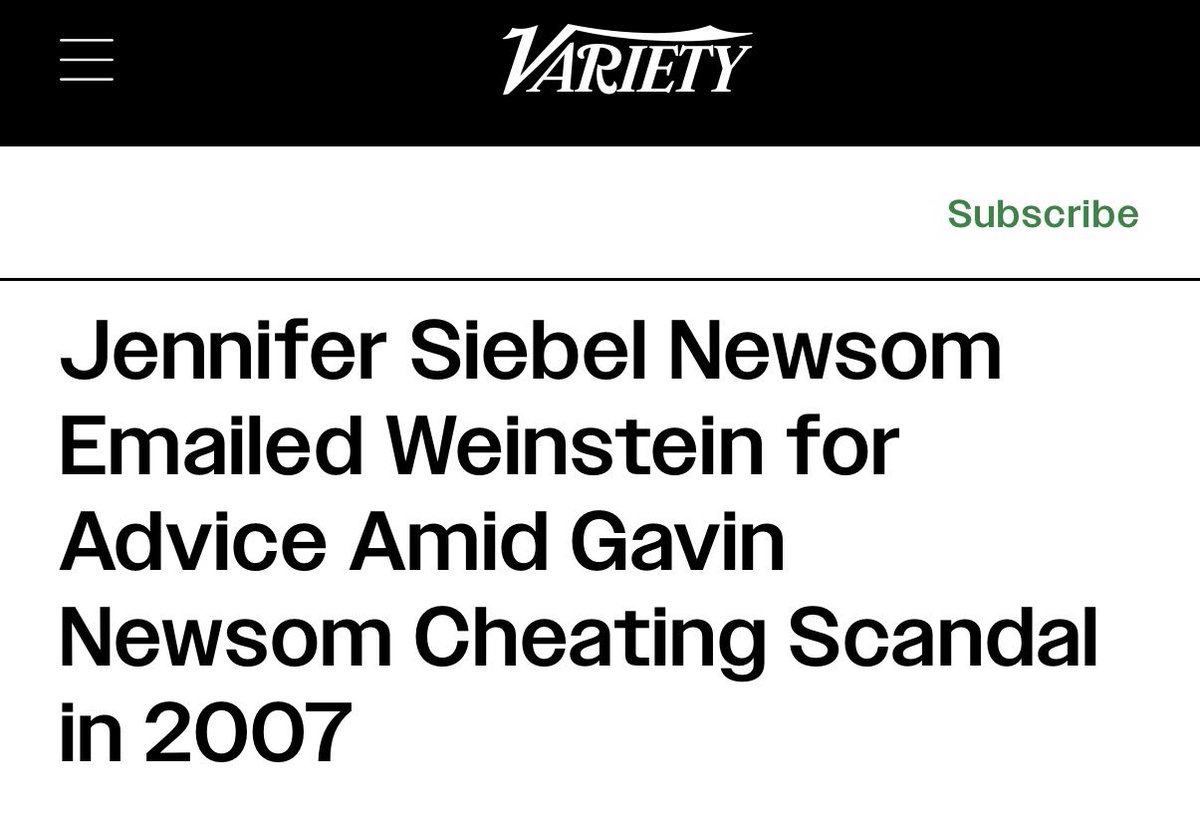
I’m old enough to remember when Gavin Newsom’s wife tried to get Harvey Weinstein to intervene after Newsom was caught sleeping with a subordinate that was also his campaign manager’s wife.
I’m old enough to remember when Gavin Newsom’s wife tried to get Harvey Weinstein to intervene after Newsom was caught sleeping with a subordinate that was also his campaign manager’s wife.
I’m old enough to remember when Gavin Newsom’s wife tried to get Harvey Weinstein to intervene after Newsom was caught sleeping with a subordinate that was also his campaign manager’s wife.
Incredible Climate Change Fraud Timeline
2018-2023: Greta protests against Climate Change. Tells everyone they’re going to die
2026: Greta laughs at people protesting Climate Change
2026 WSJ: The UN Climate Change Narrative is abandoned
2026: Media says it was all fraud and that Nations crippled themselves over this lie
@BurnieSendersX You have accomplished NOTHING in your long career @BernieSanders@elonmusk is essentially the ISA, young Americans future
You are a POS. The world will be a better place when you are worm food
@tyleraloevera Democrats love to give free shit away. Why don't we give free heroin to these people if they stay in a confined area(hospital)?
I don't like population control BUT...wouldn't society benefit with these people as worm food?
@BernieSanders Is full of shit and propaganda. He has had a LONG career and accomplished VERY LITTLE: Drug pricing is influenced by patent protections, market exclusivity, limited competition, PBM negotiations, insurance structures, and government policy. If you want to fix the problem, address those mechanisms rather than pretending that counting lobbyists explains the entire healthcare system.
And the claim that America has the highest prices needs context: RAND found that U.S. brand name drug prices were substantially higher, but unbranded generic drugs were actually cheaper than in comparison countries
Teleportation just moved closer to reality. A quantum breakthrough has successfully demonstrated electron teleportation.
But it raises a chilling philosophical question: would you survive the trip?
In a major leap for quantum mechanics, National Science Foundation-funded researchers from the University of Rochester and Purdue University have successfully demonstrated the teleportation of quantum information between distant electrons.
Since the 1990s, scientists have been able to teleport photons, but extending this capability to electrons—which act as qubits in semiconductor chips—is a massive breakthrough for the scalability of quantum computing.
By leveraging quantum entanglement, the phenomenon Albert Einstein famously called 'spooky action at a distance,' researchers transmitted characteristics of an electron's quantum state without physically moving any matter. This discovery lays a solid foundation for faster, more secure quantum networks.
However, as the technology advances toward the theoretical possibility of teleporting complex, multi-atom matter—including humans—it introduces profound existential dilemmas. Quantum teleportation does not physically transport an object's physical atoms; instead, it transmits precise quantum state information to reconstruct a perfect replica at the destination while completely destroying the original. This process has sparked an intense philosophical debate, with physicists warning that using such a machine would effectively mean death for the traveler, leaving only a replicant on the other side. As quantum boundaries continue to expand, humanity may soon have to decide whether the benefits of instant transit are worth the ultimate existential risk.
source: Qiao, H., Kandel, Y. P., Manikandan, S. K., Jordan, A. N., Fallahi, S., Gardner, G. C., Manfra, M. J., & Nichol, J. M. Conditional teleportation of quantum-dot spin states. Nature Communications, 11(1), 1-9.
Breaking up Big Medicine could create one of the most dangerous disruptions to America's healthcare system, putting patients, medical innovation, and access to lifesaving treatments at risk. Large healthcare companies provide the financial infrastructure, research funding, manufacturing capacity, and distribution networks necessary to develop and deliver groundbreaking medicines to millions of Americans. Fragmenting these institutions could disrupt supply chains, increase operating costs, weaken research capabilities, and slow the development of treatments for cancer, Alzheimer's, heart disease, and countless other conditions. The pharmaceutical industry already faces enormous financial risks, with drug development costing billions of dollars and taking years of research, testing, and regulatory approval. Destroying economies of scale could ultimately mean fewer breakthrough treatments, less investment in medical research, and higher costs passed down to patients and taxpayers. Instead of blindly dismantling successful institutions, policymakers should focus on increasing competition, negotiating better prices, improving transparency, and holding companies accountable for anti-competitive behavior. America doesn't need to destroy the infrastructure that drives modern medicine; it needs to make that infrastructure work better, cost less, and deliver more lifesaving innovation to the American people.