New essay on the economics of structural change and the post-commodity future of work.
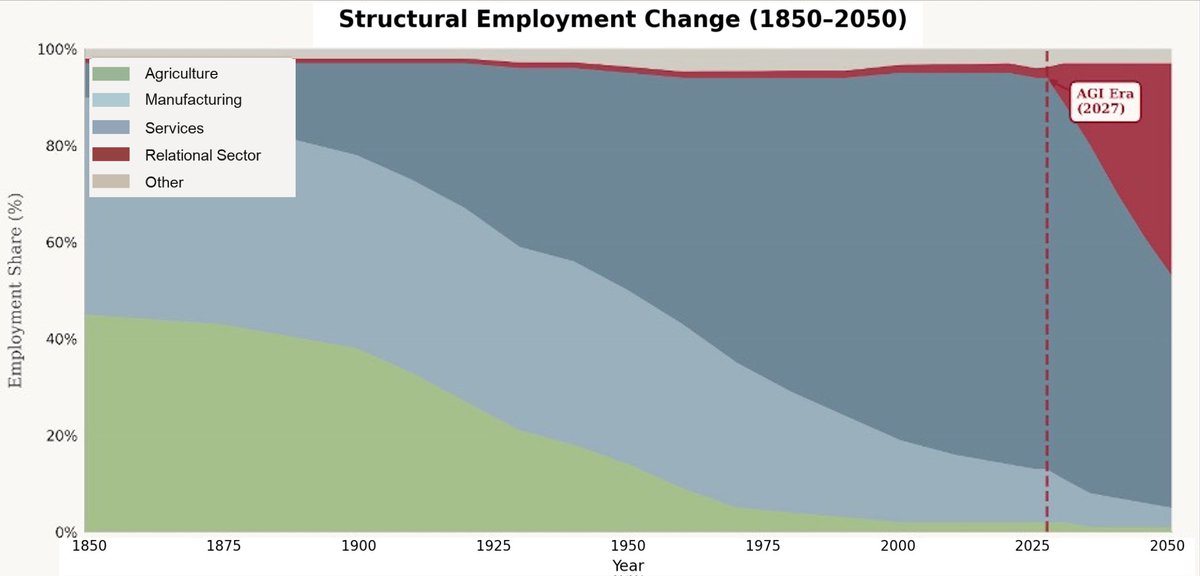
1. Almost any question about the impact of advanced AI on the economy needs to start at the same place: what is still scarce? Answer that, and the analysis becomes pretty straightforward. This essay explores what becomes scarce if AI really can replicate most of what humans do in production, and what this mean for the future of jobs.
2. My conjecture, working through the economics: labor reallocates across sectors, and the sector it reallocates to has properties that keep labor a meaningful share of the economy. Ultimately this is about the structure of demand itself. For this, we have to go back to Girard, Augustine and Rousseau: once people's base needs are met, their preferences shift to comparative motives (e.g., status, exclusivity, social desirability). This motive is inherently non-satiated.
4. The key paper is Comin, Lashkari, and Mestieri (Econometrica 2021). As people get richer, they don't buy proportionally more of everything. They shift spending toward sectors with higher income elasticity. They estimate income effects account for 75%+ of observed structural change.
5. The ironic consequence: the sector that gets automated becomes a smaller share of the economy, not a larger one. Agriculture got massively more productive and its share of employment collapsed. Manufacturing too. The "stagnant" sectors absorb the spending and the jobs.
6. So the question is: which sectors have high income elasticity in a post-AGI world? I argue it's what I call the relational sector. Categories where the human isn't just an input into production, it is part of the value.
7. Why does the relational sector have high income elasticity? Because human desire has a mimetic, relational dimension. We don't just want things for their intrinsic properties. We want what others want, and we want it more when others can't have it. Girard, Rousseau, Augustine, and Hobbes all saw this.
8. In work with Kristóf Madarász, we showed this experimentally: WTP roughly doubles when a random subset of others is excluded from the good. And in new work with Graelin Mandel, AI involvement kills the premium. Human-made art gains 44% from exclusivity; AI-made art only 21%.
9. This all comes together for the core argument. The sector that absorbs spending as AI makes commodity production cheap is one where human provenance is part of the value, and demand for it grows faster than income. Exactly the profile that keeps labor meaningful.
10. To be clear about the claim: I'm NOT saying aggregate labor share must rise. It may fall. The claim is about sectoral composition, i.e., where expenditure and employment go once commodities get cheap, and the fact that the sector that will absorb reallocated labor maps to a substantial component of human preferences and desire.
11. If you're interested in the formal model, a linked companion technical note works out all the economics.
Read the essay here: https://t.co/NcjVgn2o8g
@db_econ The key to the vibe of these neighbourhoods is just trees right? Here’s a set of Gurner townhouses in Melbourne four year apart. It’s now a veritable forest on the street.
@BenPhillips_ANU@peter_tulip Thanks Ben. I think (hope) Luke means I am a veteran of many policy wars / debates (I.e. I’ve done several tours of duty).
@ChrisEconomist@peter_tulip The alternative is to pro rata the discount that applies based on how long the asset was held under both the old and the new regimes. So if the discount went from 50% to 30%, then an asset bought 10 years before the change and held for 10 years after gets a discount of 40%
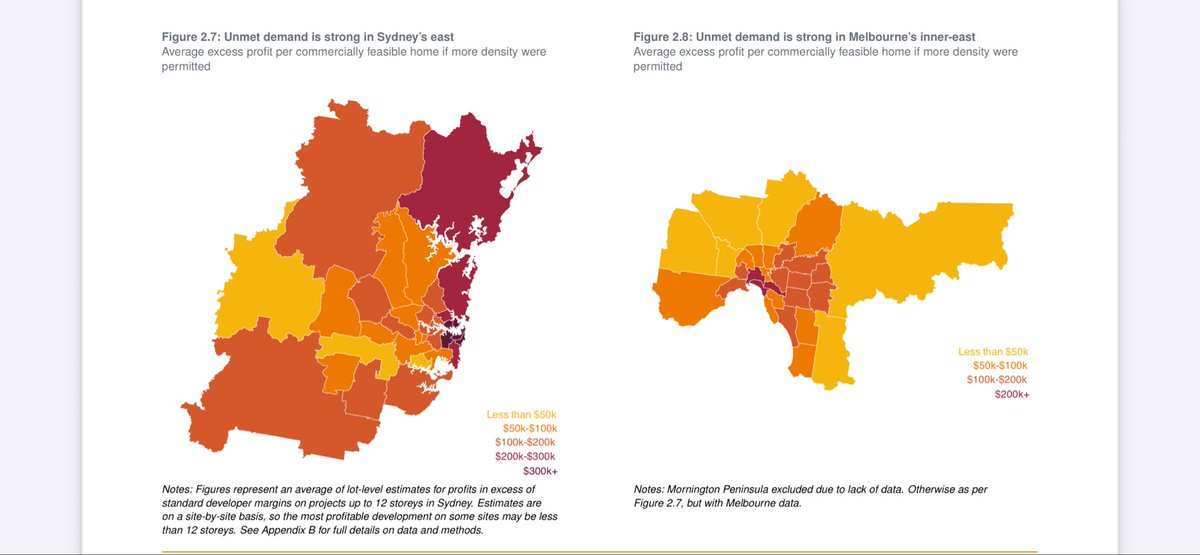
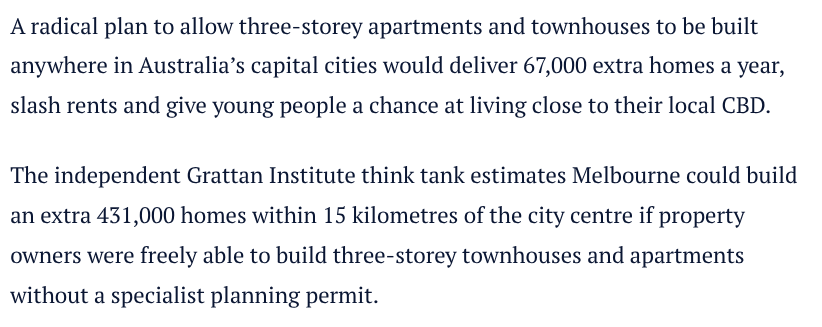
Yesterday at our 'How to tackle Sydney's housing crisis' event, Grattan housing policy expert Matthew Bowes laid out where planning reform stands - and what still needs to change in NSW.
Read the findings and download the report here: https://t.co/zIxDGyWSlL
@Jack_Dostine @TMFScottP Thanks. The short answer is no.
But that’s because the prices people are willing to pay for particular forms of housing vis-a-vis what those same homes would cost to build (if permitted on that land) is a better measure of unmet demand.
@TMFScottP Yep! The cheapest housing in any suburb is a townhouse or an apartment.
Some people prefer a freestanding home (the most expensive option) whereas others prefer to trade off space / land for location.
@TMFScottP You should be free to make the choice you want, including a house.
I think the correct position is that people should be free to choose the option that suits them best.
At the moment we have state planning systems that ban a lot of those choices people would otherwise make.
@TMFScottP The whole point of that research I linked to at the start is we presented people with trade offs and then asked them which they’d prefer!
I’d prefer an 8 bedroom mansion in Potts Point, but i and most other people can’t have that.
@TMFScottP But if not, have a look at the link and let me know what you think.
I reckon that letting people live where they want (we don’t get more townhouses or apartments if no one wants to live in them) is the better approach.
@TMFScottP I think we’ve had this conversation before Scott?
Lowering migration would make housing (somewhat) cheaper. But it would also make us poorer, especially as we’d all have to pay higher taxes to enjoy the services we have now.
https://t.co/8U69v6bDSi