Yesterday’s victory in Maryland was just the beginning!
Governor Moore signed SB309/HB500, officially ending the "tax penalty" on Marylanders protecting their wealth. Starting July 1, the geographical barriers are gone, buy sound money anywhere in the state, tax-free!
What’s next on the horizon? Next year, we’re leveling up the fight to include:
- 0% Sales Tax on all precious metals (removing the current $1k threshold).
- Legal Tender status for gold and silver.
- Elimination of State Capital Gains on sound money.
We’re just getting started, help us take this momentum into next year's session!
🚨 MARYLAND MAKES HISTORY 🚨
Tonight we celebrate one of the BIGGEST sound money victories in the country.
✅ SB309 & HB500 SIGNED
✅ Bullion Sales Tax REPEALED
✅ $1,000 Sales Tax Exemption RESTORED
This victory didn’t happen because of lobbyists alone.
It happened because CITIZENS organized, testified, educated legislators, and fought for constitutional money.
Maryland is now setting the example for the rest of the nation.
Join us LIVE tonight as we break down:
• What passed
• What it means for gold & silver buyers
• What states are next
• How citizens can replicate this nationwide
WATCH LIVE ⬇️
https://t.co/osqAXAkDh2
#SoundMoney #Gold #Silver #Maryland #Bullion #ConstitutionalMoney #C4SM
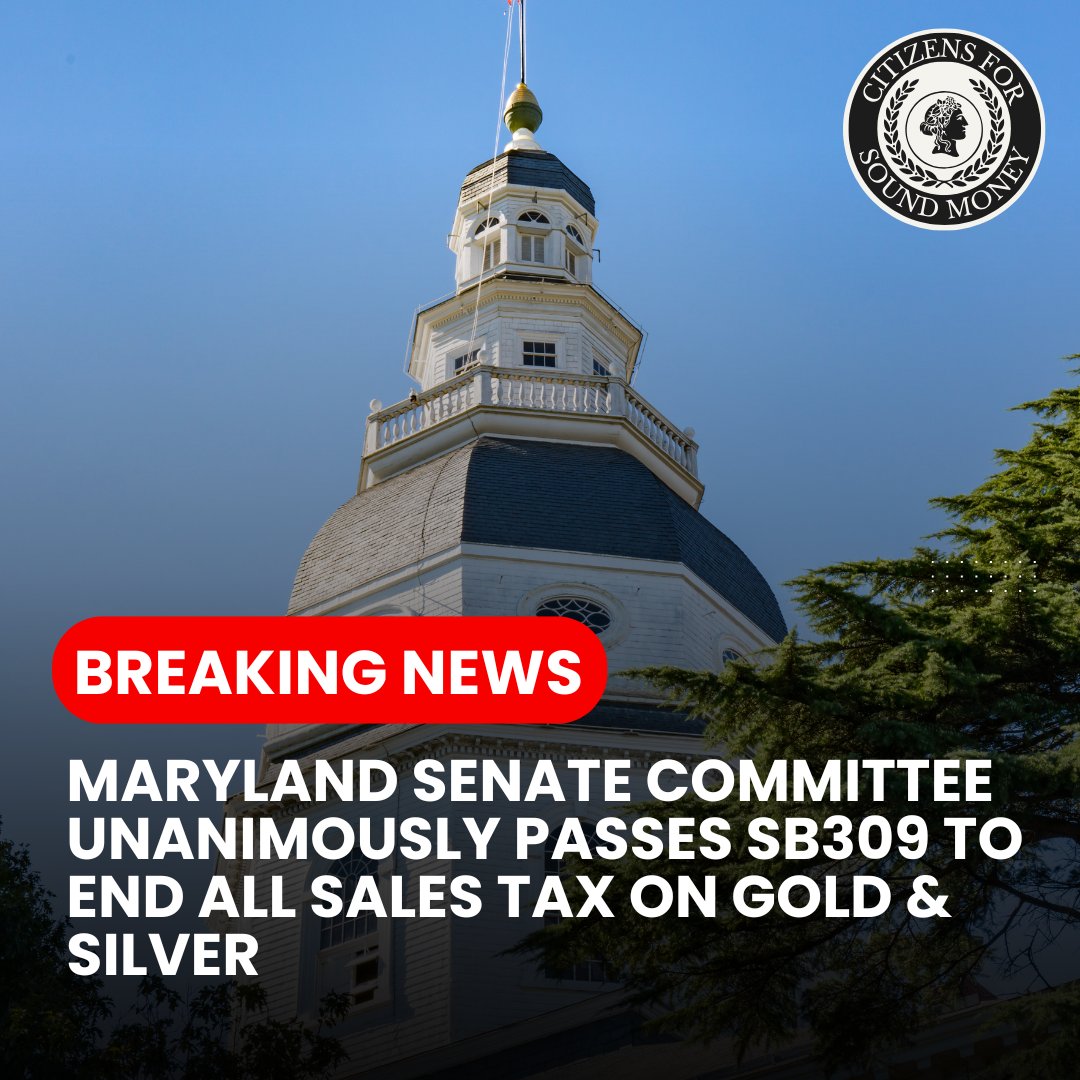
BREAKING: ANOTHER UNANIMOUS WIN FOR SOUND MONEY IN MARYLAND!
The momentum is officially a tidal wave! SB309 just passed out of committee with a UNANIMOUS vote, moving Maryland one step closer to ELIMINATING all sales tax on gold and silver!
Even more exciting: The bill is gaining massive bipartisan support, picking up several new Democratic sponsors as the state unites behind financial freedom and protecting citizens' purchasing power.
Next stop: The Senate floor!
BIG NEWS: Maryland is officially moving toward sound money!
HB1312 just PASSED out of committee with a UNANIMOUS vote! This bill recognizes gold and silver as legal tender, bringing financial constitutionalism back to the Old Line State.
In partnership with the Sound Money Association of Maryland, we lobbied and testified to ensure the importance of this bill was heard. This victory is a testament to the power of grassroots advocacy!
Next stop: The House floor for a full vote, then off to the Senate.
The momentum for honest money is unstoppable. States are reclaiming their power!
Whenever my portfolio reaches new (significant) highs I remind myself of the lessons I learned from previous cycles.
The portfolio all-time high number isn't real.
1. I am unlikely to sell the top. I am even less likely to sell the top on everything at once. Some amount of drawdown from that peak number is pretty much inevitable.
2. I will likely lose money buying a larger pullback too early. Especially if the market has been rewarding shallow dip buys and conditioning me to do so, it's likely that I eat some drawdown if I've been trend following and take the same setup(s) again. It's the cost of doing business (hammer it until it stops working) but adds to the drawdown from the all-time high number.
3. There are unlikely to be reliable 'hedges' on the long side. When tides turn, correlations generally converge towards 1 and everything tends to nuke at once. News, tokenomics, fundamentals don't meaningfully matter - liquidity is king and I shouldn't play favourites. Some short-term idiosyncratic outperformance may emerge, but it is neither 'sticky' nor reliable. This means if I'm spread thin among many positions, they'll all be hammering my portfolio simultaneously (while also reducing my ability to manage any one position particularly carefully given there are N number of them moving at once, all requiring attention).
4. If I am 'late' to sell or assume I can sell on the way down, I should also assume that my execution will suffer. Specifically, if liquidity becomes sparse, volatility picks up, and flows are one-sided, I should assume my exit prices are going to be suboptimal. This effect is compounded if I'm holding perp positions that get displaced by a bunch of liquidations, and/or I am holding a bunch of some illiquid shitcoins (rare). In both cases, market impact is greater which generally means worse fill prices. Liquidity is always there - until you need it most. Trying to realise paper gains amidst paper thin liquidity can lead to drastically different outcomes compared to whatever number was on the screen previously.
5. I am unlikely to conveniently flip bearish at the right time and 'make back' the unrealised gains via shorting. Generally speaking, the whole 'just flip your positions and trade the other side' is grossly overstated and is a clout-preserving fantasy rather than a description of reality.
6. Taxes matter. Boring, yes. But I saw a lot of friends and peers suffer massively from tax burdens created by those huge unrealized gains. It happens every single cycle, and the consequences can range from mildly annoying roundtrip to bankruptcy and lifetime financial devastation.
Do not use the portfolio all-time high number as a goal or an anchor. It is neither of those things.
It is a false idol that will cost you dearly for taking it for granted when it's there, and chasing its footprints once it's gone.
Too long; didn't read. I ain't reading all that. I'm happy for u tho. Or sorry that happened.
Time is on the Side of Gold
Since 1700, around 750 currencies have been introduced, but only 20% exist today, all significantly devalued.
Looking back to 1850, for instance, the major currencies around then look drastically different from today.
Despite the existence of the dollar, pound, and Swiss franc at that time, many of the major currencies of that era no longer exist.
· French Franc
· Dutch Guilder
· Austro-Hungarian gulden
· Prussian Thaler
· Ottoman Lira
All gone to name a few.
While some people may question or even ridicule the emergence of central bank digital currencies, this development is indeed the next step in the evolution of the monetary system.
The most pressing question is whether some of these digital currencies will be backed by tangible assets.
We have already witnessed initiatives by countries globally to re-establish gold as a medium of exchange and unit of account, complementing its well-regarded role as a reliable store of value.
Such as:
1. Ghana is buying oil with gold instead of U.S. dollars
2. Russia and Iran are working on a new stablecoin backed by gold to compete with the dollar
3. Last April we learned that Vladimir Putin is discussing the idea of pegging the rouble to gold and other goods.
4. It is reported that BRICS is considering backing its new currency with gold and other valuable commodities, including rare-earth metals. Over 30 countries, many of which are notable commodity powerhouses, have expressed interest in joining BRICS.
5. Zimbabwe's has recently introduced a new gold-backed digital currency
Currently, numerous emerging markets are grappling with a debt crisis. As of early May, the debt of 18 developing nations had reached distressed levels.
The total debt in these emerging markets has surged to a record high of over $100 trillion, representing about 250% of GDP. This is a significant increase from $75 trillion recorded in 2019.
As this is playing out in emerging markets, the United States is going through a circus in Washington as we have all been watching the debt ceiling drama play out.
Last week, @RayDalio suggested that he doesn't foresee lawmakers allowing the United States to default.
However, he expressed concern that they will still fail to produce a viable long-term resolution for the debt situation, which could eventually result in a disastrous financial collapse.
Today, @Frank_Giustra said that servicing costs on the United States debt is unsustainable and said inflation is here to stay unless we see a restructuring of the monetary system.
As the shadow of a $305 trillion global debt looms larger and the trend of de-dollarization accelerates, central banks, the very issuers of fiat currency, are stocking gold aggressively.
Ask yourself why.
With zero counterparty-risk, gold serves as the bedrock of stability for many central banks around the world.