Interventional physiatrist Education/private practice/Clinical research. Spine & Nerve Podcast (linked). fatherhood. wine. Bay Area sport. Views are my own.🇵🇭
Specialty Switching Without Guardrails: What We Would Never Accept from Physicians Is Happening Every Day
A physician cannot move from orthopedic surgery to cardiology, or from emergency medicine to oncology, without additional training and new board certification. That reflects a basic truth that medicine has recognized for over a century: clinical competency in a specialty is specific, takes time to acquire, and cannot be assumed from credentials earned somewhere else.
NPs and PAs face no equivalent requirement.
In January 2026, the AMA released survey data showing that more than one-third of both NPs and PAs have changed specialties at least once during their careers. Among nurse practitioners, 13 percent have done so twice or more. Nearly 80 percent of those surveyed said specialty switching was common. Sixty-five percent said it was easy. The AMA's 2024 Board of Trustees report explained why: NP and PA certifications are described as "extremely broad, allowing wide latitude in the patient population, specialty or setting in which they can practice," with "little to no guardrails limiting the specialties in which nurse practitioners and physician assistants may practice."
Only 24 percent of NPs currently deliver primary care, per the most recent federal data. The overwhelming majority of NP programs are designed to train primary care practitioners. The gap between what NPs are trained for and where they actually practice is filled by specialty switching, and enabled by a certification structure with no specialty guardrails whatsoever.
The post-master's certificate market makes this even more concrete. Accredited programs exist that allow a credentialed NP to add a new specialty with as few as 300 clinical hours of primarily online coursework, completable in 12 months. Regis College's specialty-add track is one documented example. A physician changing specialties completes additional years of residency and new board examinations. These are not comparable processes by any measure.
Think about what this means in practice. An orthopedic spine surgeon does not walk into a labor and delivery unit on day one managing a high-risk obstetric patient. A pediatrician does not show up to see a new glioblastoma consult having never managed a neuro-oncology case. We do not accept that from physicians because the stakes are too high. Yet NPs and PAs are making these kinds of transitions every day, and under full practice authority expansion, they would be doing so without physician oversight of any kind.
The prior authorization reform movement makes this contradiction impossible to ignore. Physicians and patients spent years fighting back against utilization review decisions made by reviewers without the expertise to evaluate the cases in front of them. That fight produced real results. In Texas, @DrGregBonnen, a neurosurgeon from Friendswood, authored HB 3459, which passed in 2021 and created the Texas gold card law. One of its key provisions: before an adverse determination is made, the peer-to-peer reviewer must be a Texas-licensed physician of the same or similar specialty as the treating physician. The principle that clinical decisions require specialty-matched expertise is now written into Texas law, and that law has inspired similar legislation across the country.
The same legislature that codified this principle for utilization review imposes no equivalent requirement on the NP or PA delivering the care. HB 3459 covers state-regulated plans representing roughly 20 percent of the Texas market, so it is not universal, but the logic behind it is sound and already well established. We just are not applying it consistently.
The entities benefiting most from this unlimited specialty flexibility are not independent physician practices. They are hospital systems, private equity-backed urgent care platforms, and multi-specialty groups that slot NPs trained in one area into roles requiring competency in another and capturing the labor cost difference. Independent physician practices are the primary competitive victims of that substitution model. Niran Al-Agba and Rebekah Bernard documented this dynamic in detail in their book "Patients at Risk," and it has only accelerated since publication.
🎙️ New episode alert! Had an incredible conversation with Dr. @ScottPritzlaff on the Spine & Nerve Podcast. We dove deep into the challenges and future of #PainMedicine. A must-listen for anyone in #MedTwitter or curious about the field’s evolution!
https://t.co/IjYuayo9VX
Give the episode a listen to dive into these critical topics, and join us in shaping the future of pain medicine. Big thanks to Dr. Pritzlaff for sharing his insights and sparking a crucial discussion.
https://t.co/0GSwhN0EQi
#MedEd#PainManagement#painmedicine#physiatry
🎙️ New episode alert! Had an incredible conversation with Dr. @ScottPritzlaff on the Spine & Nerve Podcast. We dove deep into the challenges and future of #PainMedicine. A must-listen for anyone in #MedTwitter or curious about the field’s evolution!
https://t.co/IjYuayo9VX
Recruitment is a hot topic, too. #Fellowships are going unmatched, and Fewer applicants overall and specifically from #anesthesiology are joining pain medicine, driven by high demand and pay. How can we reframe our field to attract people passionate about holistic patient care?
@MVGutierrezMD@TheDrROBO Agreed. But a willingness to partner with industry has to be there as well.
There is a lot of technology flowing into our worlds (I know my corner of pain is a bit of an outlier) that has financial backing to help with education and offsetting costs for physician attendees
@MVGutierrezMD@TheDrROBO I know the costs are high for conference space (I help my wife throw a dental conference), but that likely means they aren’t optimizing their sponsor relationships.
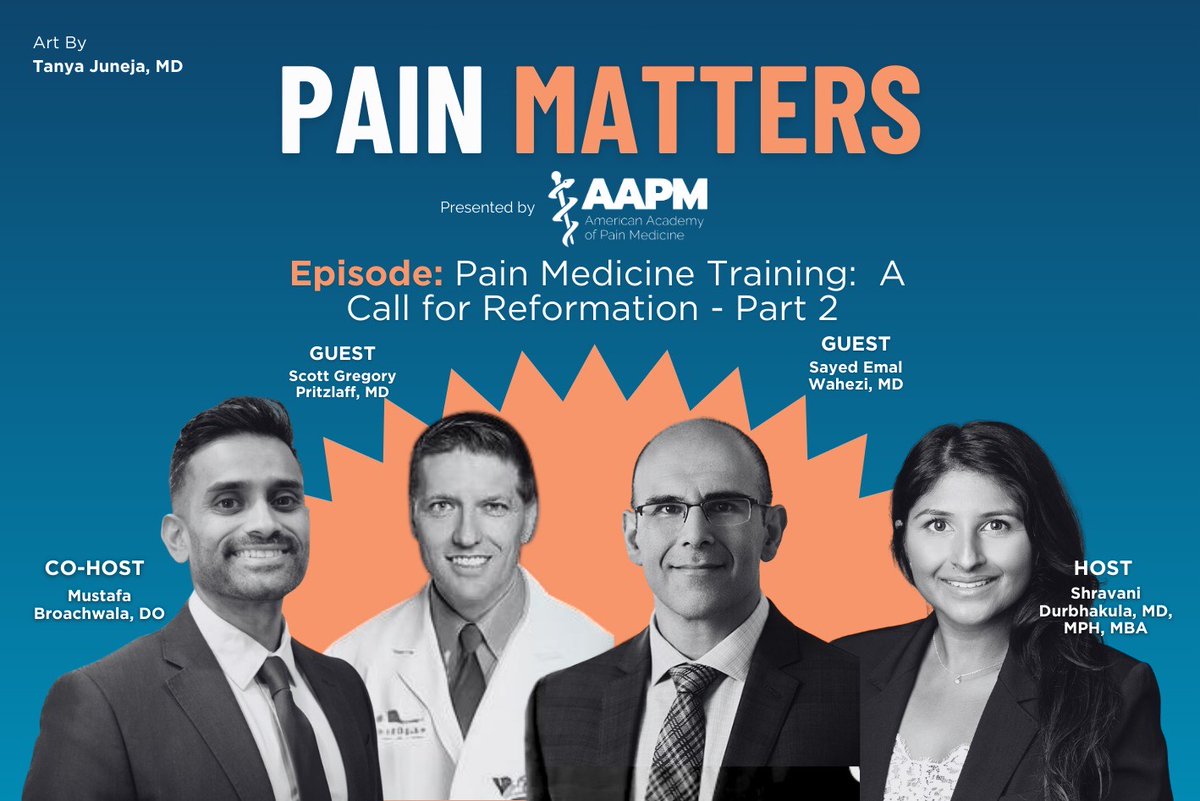
Join us for Part 2 of our Pain Matters discussion on reforming pain medicine training. @ShravaniD_MD & @mbroach4 delve into how extending training can improve patient care with top experts @ScottPritzlaff & Sayed Wahezi, MD.
https://t.co/hYCtYtVhL6
#PainMedicine#Healthcare
@dr_rajgupta@EMARIANOMD@nelkassabany@NarouzeMD For neuromodulation, the rep team is integral in the programming/reprogramming/patient support process. They become extensions of the team, optimizing patient outcomes.
And some devices are too expensive to stock and risk them expiring 🤷🏽♂️