Vetting a LASIK surgeon? Ask:
1. Is vision correction their sole focus?
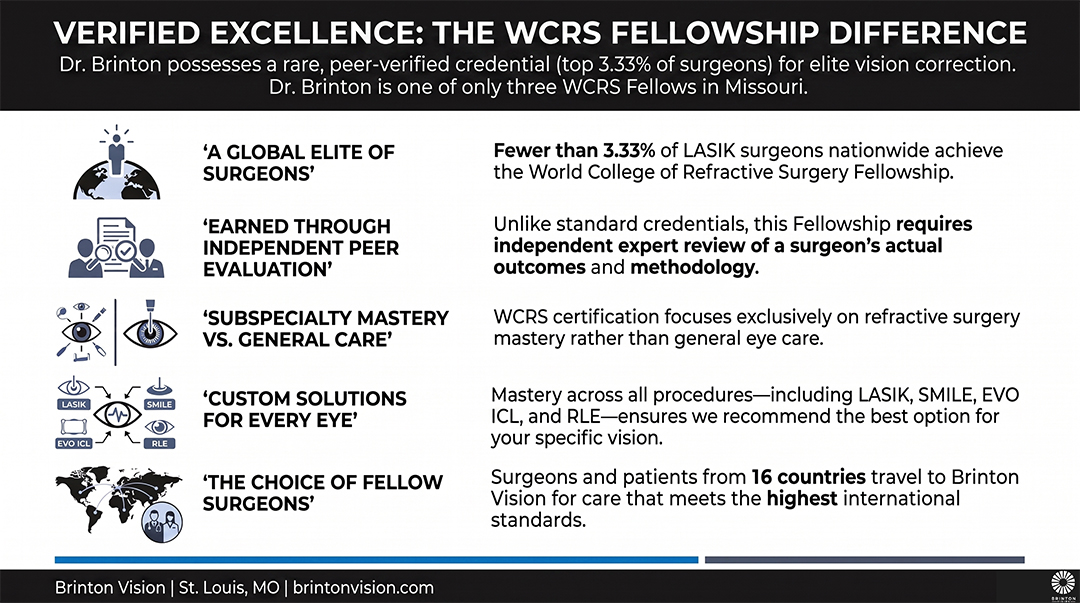
2. Were outcomes independently peer reviewed?
3. Can you verify it in a public directory?
4. Is more than one procedure offered?
Dr. Brinton, a WCRS Fellow in St. Louis, meets all four. What would you add?
Choosing a vision correction surgeon also decides which options you'll hear about.
Dr. Brinton performs LASIK, SMILE, PRK, EVO ICL and Custom Lens Replacement, so the procedure can be matched to your eyes after a full diagnostic exam. What matters most to you in that choice?
The question behind every LASIK consult: how do I know this surgeon is actually good?
Websites can't answer it. Independent credentials can. Dr. Brinton is a WCRS Fellow, earned through peer review of his surgical volume, outcomes and methodology. You can check it yourself.
Custom Lens Replacement isn't just a vision fix — the new lens can't cloud into a cataract later, so it doubles as prevention. Bonus: colors often look brighter afterward too, simply from more light reaching the retina.
Worried vision correction might change how your eyes look? It won't.
Eye color comes from melanin in the iris. LASIK, SMILE, and PRK only reshape the cornea, and lens-based options sit behind the iris. Your eye color stays exactly yours.
Some patients are not hiring vision correction to fix today. They are hiring it to keep tomorrow open.
EVO ICL fits that job: the collamer lens is additive, so it can be removed or exchanged if a prescription shifts, newer lens tech arrives, or cataract surgery comes later.
The question underneath "is EVO ICL right for me" is usually "what if I change my mind."
Fair question. The collamer lens is additive - it sits behind the iris and leaves corneal tissue intact, so a qualified surgeon can remove or exchange it later.