Six iOS apps. One person. No team, no funding.
Four are live on the App Store right now. TimerStack is in beta, and Bark Back ships this week.
I build them solo and post about how each one actually gets made, including the parts that go wrong.
Patrick McKenzie published a piece this week on multiagent coding: orchestrators running anywhere from 2 to 100 agents at once, one project landing 42 pull requests in a day for $823 of inference.
The capability is real. The management question underneath it is not solved.
Anton Zaides wrote about his team making code review optional to move faster. Review fell to roughly 2 percent of pull requests, and weak patterns started getting copied by the next agent that touched the codebase.
Generating code parallelises almost perfectly. Understanding it does not. That ratio is the thing to manage, and it is rarely the thing being measured.
What does your review coverage look like now compared with a year ago?
Sources:
Patrick McKenzie, Multiagent Coding Is the Future: https://t.co/oc5T2knA8v
Anton Zaides, The broken windows theory of coding agents: https://t.co/OkhqxCFr4Z
iOS Safari restricts web animations to 60 FPS on a 120Hz screen.
Someone bypassed it: read scroll straight off the compositor, push frames via an OffscreenCanvas. 118 FPS measured.
Clever work. Some readers complained saying his demo made them feel sick!
It only hits 120 if Low Power Mode and Accessibility > Limit Frame Rate are both off.
So the cap being worked around is the one some people switch on deliberately.
Native is not free either, but it is one check against Reduce Motion.
https://t.co/Rjcdj9hMo1
Antoine benchmarked Xcode's MCP against xcodebuild: 4 to 9 seconds a build.
The Key is MCP replies are under 2 KB but raw xcodebuild logs are 0.8 to 1.6 MB.
For an agent, seconds are cheap and context is the real budget.
A 1000x gap in how much the tool says back is the whole ballgame.
His own caveat: the speed edge vanishes on full test plans. One project, one Mac.
https://t.co/WEyEzbG7SZ
Not a model bug. A permissions default that assumes the file stays local.
Someone rescanned 1,667 of them a week later. 14 had the secret taken out.
Rotate first, then clean up. Git history keeps the old copy either way.
https://t.co/fKzbu4y4hx
I hit "Yes, and don't ask again" in Claude Code several times a day.
It saves the exact command into .claude/settings.local.json. Type a password into that command and the password is now a file.
1,122 public copies of that file on GitHub had secrets in them.
Anthropic lanzó una guía de 37 minutos para construir Agentes de IA que automatizan una empresa entera.
Gratis. De los ingenieros que construyeron Claude.
Agentes que trabajan, se reparten tareas y ejecutan todo solos.
Subtitulado al español.
The hardest part of a privacy tool is deciding what not to delete
Your Mac keeps records of where you’ve been.
The download log. The web address stamped on every file you’ve ever downloaded. Every Wi-Fi network you’ve joined. The email addresses Mail suggests. The sites your browser has marked as secure.
Last month I started building TrailSift to find them.
Finding them took a few evenings. Deciding what the app is allowed to do about them took far longer.
The rules
Files go to the Trash. Never straight to deletion.
Databases are backed up for a week before a row is removed, then compacted. SQLite keeps “deleted” rows readable until you do.
An app’s data is only touched while that app is quit.
Documents and photos are never touched.
The refusals
Safari history? TrailSift sends you to Safari to clear it. Delete it locally and iCloud quietly puts it back.
Notification history? The app reports it and gives you the steps. The system holds that database open, and a broken Notification Centre is worse than an old one.
The proof
The audit is a plain script that only reads. It’s public. Check it before you trust it.
The point
Any software that changes a user’s data makes a promise about what it won’t change. Most of us never write it down.
Writing mine down shaped TrailSift more than any feature did.
What’s on your list?
To be fair to macOS: there is no API for an app to request Full Disk Access. You have to go and grant it yourself.
So Apple is not adding a lock. It is admitting the existing one gets clicked through.
https://t.co/jj6h3xAYPT
Apple is tightening macOS Full Disk Access, and the reason it gives is AI agents.
Went and checked what my own agent setup can actually reach. Turns out pretty much anything.
I granted that in System Settings once and never thought about it again. That is the real problem.
Ran a read-only audit on my own Mac.
952 entries in the macOS download log since Feb 2025.
231 sites in Chrome's secure-site list, untouched by clearing history.
1,733 photos in Documents that say where they were taken.
None of it is browser history. So I built TrailSift. Available to download now.
https://t.co/VW8dmqlCcb
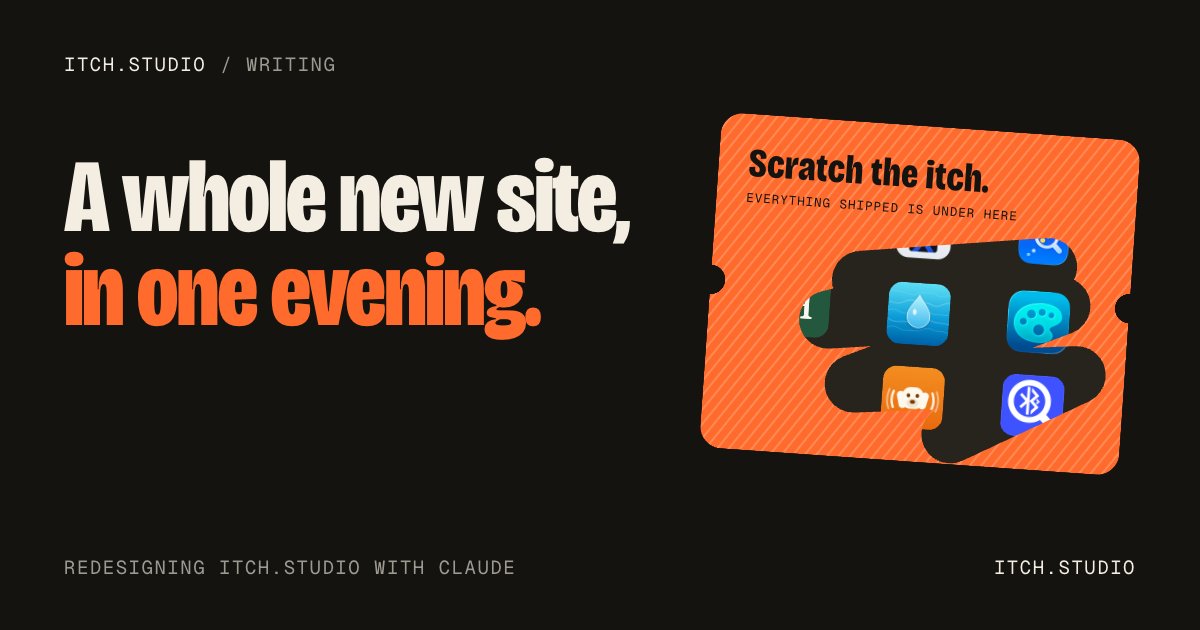
I told Claude my studio site was “a little bit standard and boring”.
An evening later the homepage opens with a scratch card. Scrape off the foil and the nine products I’ve shipped are underneath.
Go on, scratch it: https://t.co/yVNof1gzru
The format, before and after:
https://t.co/qXmEZazLsV
The silent failure:
https://t.co/zDUs4JEWkC
Apple's open-source model of the format:
https://t.co/tONxab9PAU
Xcode 27.2 can store your project as JSON instead of pbxproj. Anyone who has fought a merge conflict on a 24-character hex ID just exhaled.
The catch: every tool that parses pbxproj must learn the new file, and some fail quietly. Capacitor's cap sync logs an error and exits 0.
Germany, France, Italy, Poland and Romania get the new prompt only. The rules on when you must ask have not changed.
https://t.co/neH1EZb4Tb
https://t.co/GGUasQHMZK
Apple is changing the App Tracking Transparency prompt in the EU from iOS 27.2, and one line changes the maths for anyone running ads.
You can re-prompt once a year, whether the user accepted or rejected. Unless they turned off tracking requests at device level.
Apple quietly changed what an indie subscription can be.
In iOS 27 you can bundle your subscription with up to four other developers' as one purchase. Same duration, StoreKit 2, an addendum each.
Two small apps with shared audiences can now sell what neither could alone.