Evolutionary biologist & author. What happens to #sex when evolved minds, old-fashioned #culture and new #tech collide? Read "Artificial Intimacy" out now.
🍰 How do you cut a cake so nobody envies anyone else's slice?
🐢 2016: n^n^n^n^n^n queries. For 5 ppl, the number has more digits than atoms in the universe 🌌
⚡ 2026: O(n⁷ log n)
�� New working paper 👇
https://t.co/swFASFEMgS
My new article in Quillette on : Will We All Go Together When We Go? Intelligence, consciousness, altruism, rationality, and the difference between AI safety and AI doom. https://t.co/22UEfWqqUq
I get why creatives are upset about AI companies training on their work
But it's always been fair use for an intelligent person to read the work of a great artist and be inspired by it. Now we have artificial super intelligence doing that. What's the logical difference?
Should it be ok for an average primary school kid to read a Booker prize-winning novel but not for a Newton or Einstein or Curie?
The world has changed and we have to change with it. And feel the ASI.
https://t.co/uHXaiVQZMj
Evolutionary psychologists shouldn’t always have to repeat this same point - that evolutionary psychology does not deny that environments and situations are very important in shaping social behavior https://t.co/wo9Kdr2djK
During pre-release testing, Claude Fable 5.2 and Claude Mythos 5.2 worked on ambitious projects in many different fields. Here are a few.
From a one-paragraph prompt, Fable 5.2 designed three working electronic devices, including this home voice assistant hub.
@GadSaad@realDonaldTrump Remind us what you did on January 6?
The president shouldn’t get a medal (or a Nobel) for accepting the result of an election. That’s just what we call “normal behaviour”.
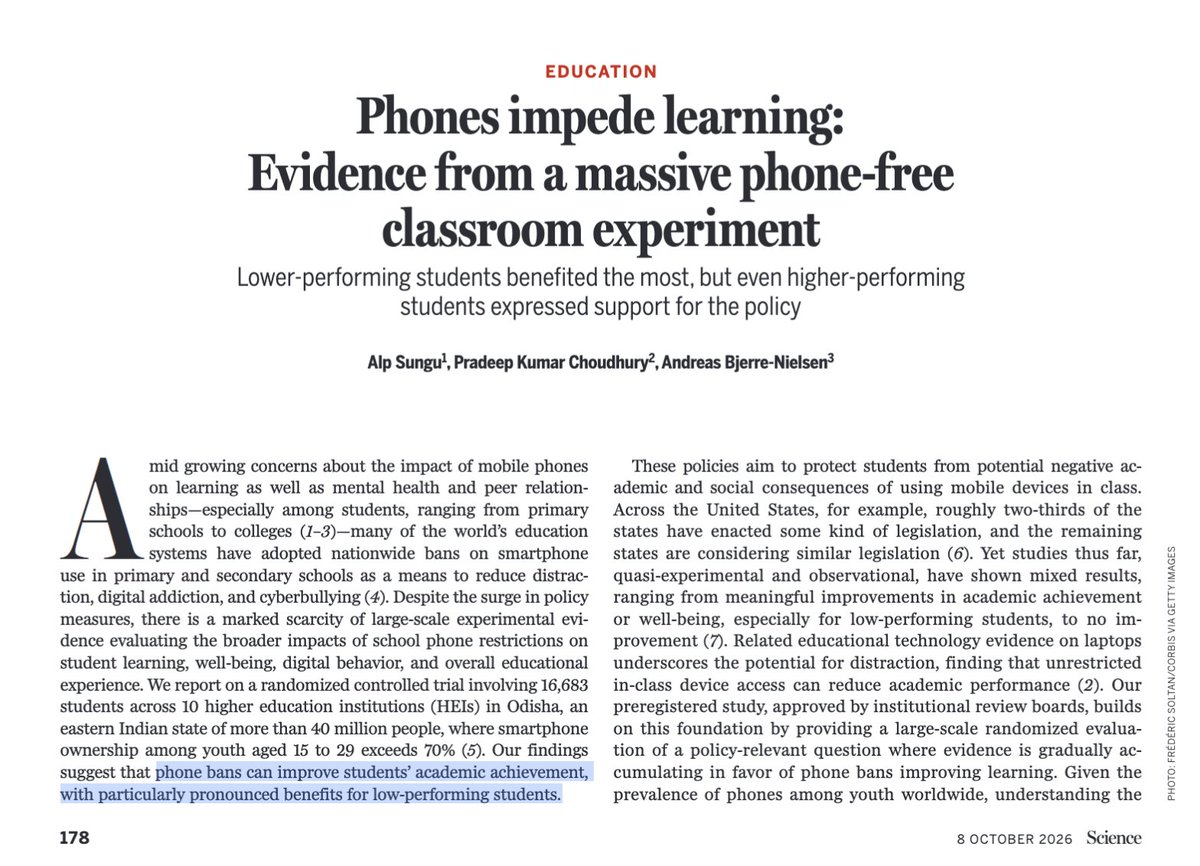
Phones in school impair learning.
The results from a large randomized controlled trial involving 16,683 students across 10 higher education institutions found that phone bans improve students’ academic achievement, with particularly pronounced benefits for low-performing students.
The effect size of removing phones was about one third as big as the effect of changing from an average teacher a very good teacher for an entire academic year.
Students who experienced the in-class phone bans also became significantly more supportive of such restrictions and perceived them as beneficial. https://t.co/JCV6PYDOxF
Most social media research has failed policy-makers
Research on social media use and adolescent mental health has shown mixed results, and has often yielded no evidence of a strong relationship. But such studies have largely ignored the ‘cost of missing out’ — the social cost of not belonging.
Children with higher social media use could be happier than their peers and, at the same time, social media use could cause a decline in collective well-being.
This is why most social media studies are not useful for informing policies.
For example, one cross-sectional study found that digital technology use explains only 0.4% of variation in adolescent well-being, and the authors caution against policy change. Yet this study was conducted entirely under conditions in which social media use is ubiquitous (scenario A). The change in well-being that would follow a move to a situation in which social media use is regulated (scenario B) simply cannot be estimated from such data.
https://t.co/6Q2bVDoetp
Hunter-gatherers are romanticized as naturally generous. But this generosity is the result of repeated resource extraction through forceful demands, complaints, ridicule, gossip and ostracism. Equality emerges from self-interest and coercion.
https://t.co/3VfQsro2VN
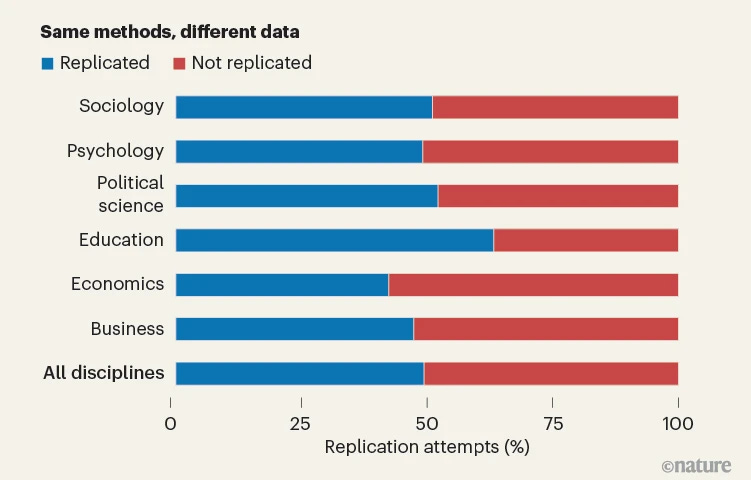
Massive replication study: Only 55% of 274 social-science findings successfully replicated.
Education was in first place, economics last, and psychology somewhere in between.
https://t.co/ZUgYRLW9Qu
Third question on AI.
A question that also remains unasked is whether the AI boom can continue without leading to a massive increase in inequality.
A recent paper by Stijn Van Nieuwerburgh runs the numbers on how much revenue the AI industry needs to generate to recover its massive investment (summary and a link to the paper can be found here: https://t.co/QIGcoObcVc).
Van Nieuwerburgh’s arithmetic should make us more concerned. AI investments will average about 3.6% of GDP annually between 2025 and 2032. Van Nieuwerburgh calculates that, using a 10% rate of return, the industry would need to generate annual revenues of about $3.7 trillion by 2032 to recover these costs (growing from its current levels of about $200 billion or so). That is significantly more than 10% of current US national income, and will likely remain around 10% of national income by 2032, even if GDP growth rose from its current level.
A large fraction of this revenue will go to capital income. That means a massive increase in the share of capital in national income, which has already risen substantially over the last 25 years or so – now standing at an all-time high of about 47% (https://t.co/IuYldl173r).
Capital income is much more unequally distributed than labor income, so a massive increase in the capital share of national income will translate into a very sizable surge in inequality.
The rise in inequality may not stop with the capital share. My work with Pascual Restrepo documents that (automation-driven) increases in the capital share of national income are typically associated with rising labor income inequality as well (see, for example, https://t.co/2D9KUL3QfM). The same may happen in the next several years, boosting inequality further.
What is missing from our current debate is any discussion of a fundamental dilemma these numbers pose: can the AI boom avoid both an economically costly crash and a huge increase in inequality?
If the industry reaches these revenues, inequality surges. If the industry does not become profitable, a crash, with substantial costs in terms of lost output and jobs, becomes likely.
My assessment would be that the industry is unlikely to reach levels of revenue Van Nieuwerburgh calculates. First, diffusion has been and will likely continue to be slow. Second, competition from open-weight models, which are getting better, will limit how much proprietary models can charge. Third, despite important advances, I still believe that AI models will not be able to automate entire occupations anytime soon, thus limiting their value to businesses as cost-saving devices.
Whether this leads to a crash or not is more complicated and will depend on whether various AI companies are bailed out and what kind of support they receive.
Nevertheless, even if revenues fall short of these gargantuan amounts and we avoid a dramatic surge in inequality, I expect that the diffusion of AI will push up inequality between capital and labor and within labor.
If inequality does surge, a further question becomes central: can our democracy survive such astronomical levels of inequality?
Yeah, a passable rock singer in a very limited and of-its-time band has died, but don't let the public songs of praise and obits get away without mentioning he was a racist, bigoted anti-modern Australia thug.
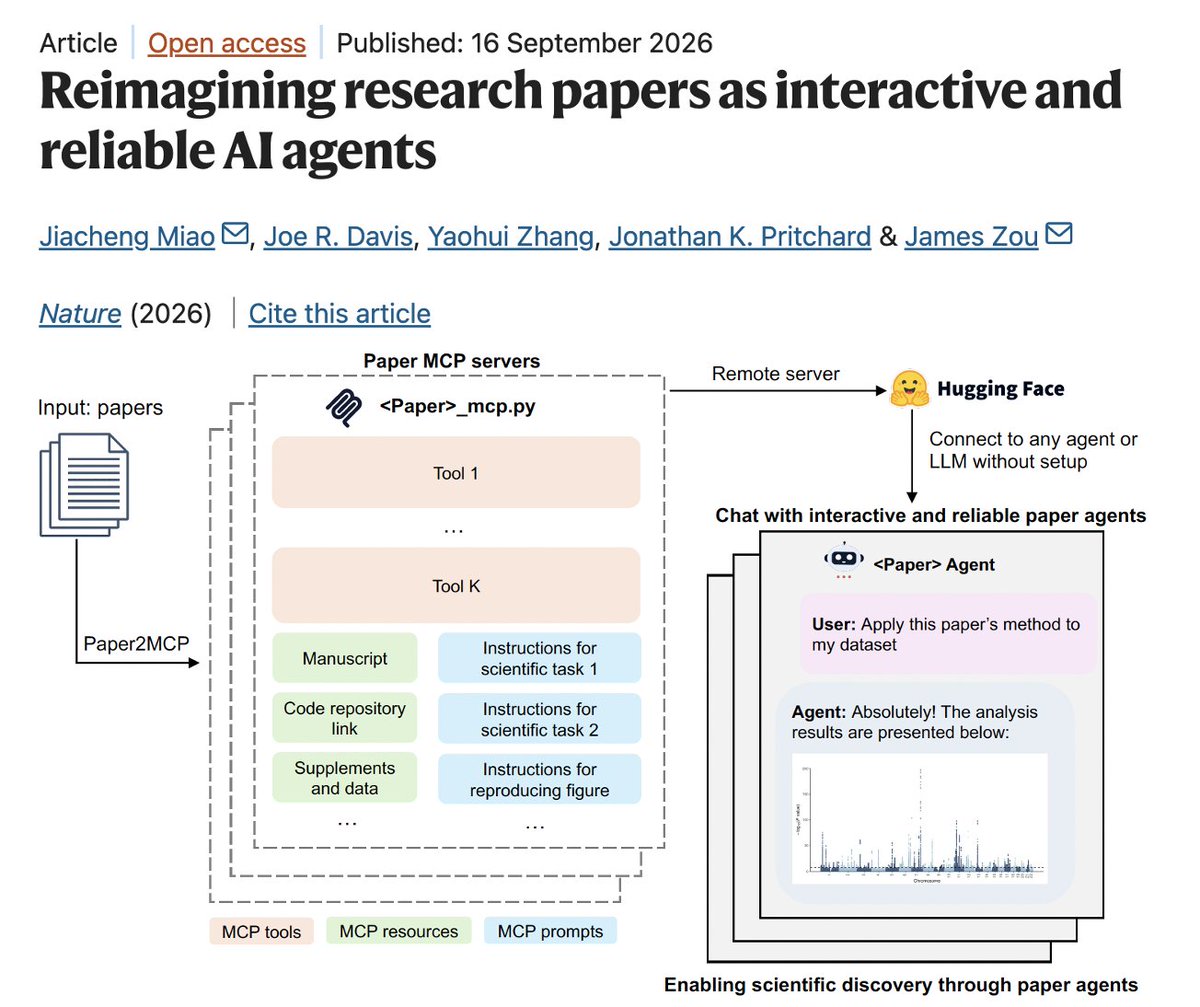
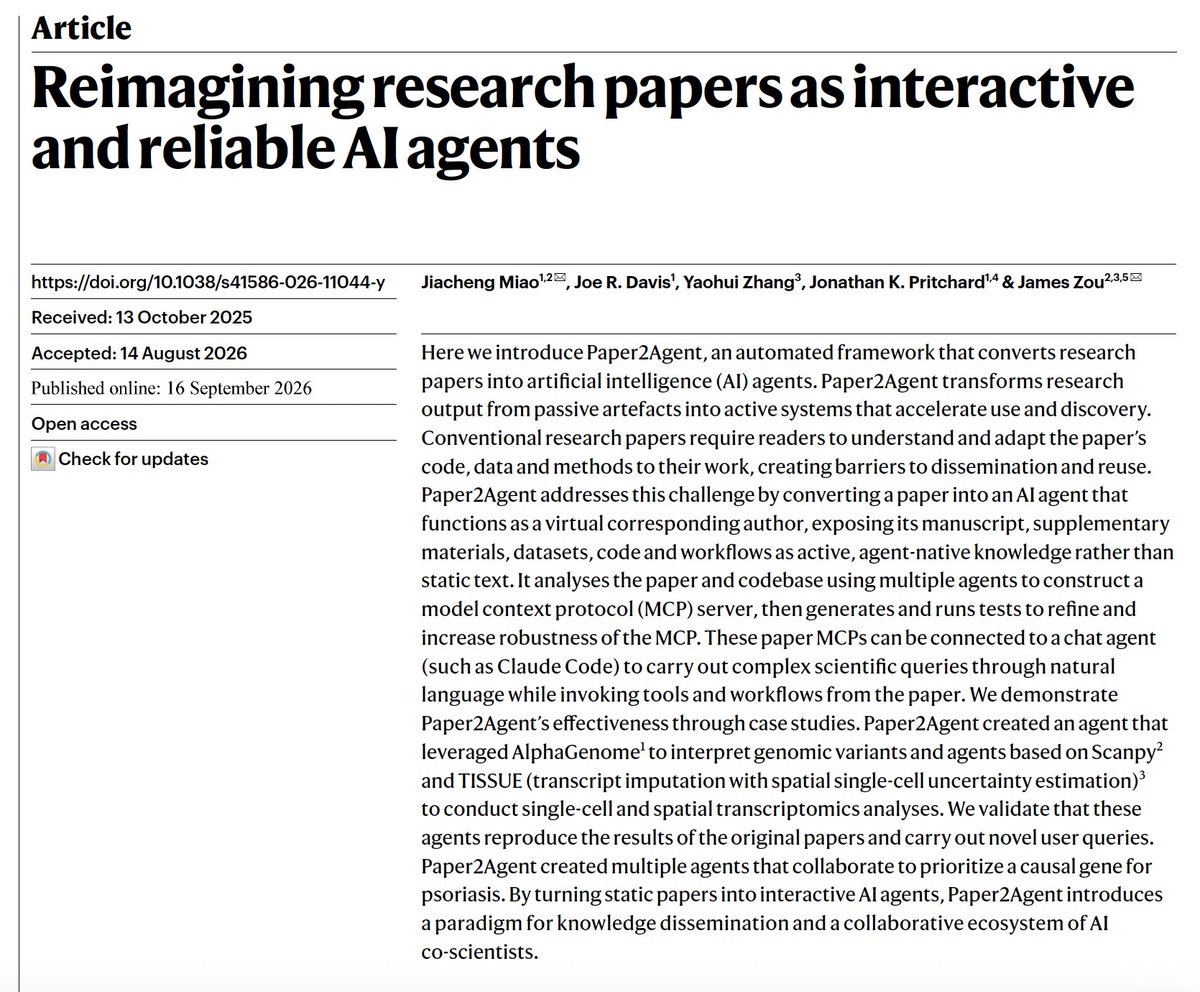
Thrilled that #paper2agent is published in @nature today!
Scientific knowledge is traditionally stored in passive papers. Paper2Agent transforms papers into virtual authors that answer questions, apply its methods and collaborate w/ other paper agents to make new discoveries 🧵
When your research paper can talk to you and interact with other research papers....
Reimagining science publishing and knowledge dissemination with Paper2Agent
https://t.co/zASfwhrdb6
@nature@james_y_zou@Jiacheng_Miao
Issue 20 of Artificial Intimacy News - has been a long time coming, but I'm getting back to regular newsletters.
Covers some incredible natural history of the future.
https://t.co/nhxC6pdCds