My @voxeu piece on exorcising phantom FDI out today! Check important implications on trade tensions, development financing and international tax. #fdi#trade#tax
https://t.co/zKiFCFDrTc
Geopolitics is shifting the investment landscape, and investment promotion must shift with it writes @Bru_Case of @UNCTAD. Tariffs are prompting investors to consider uprooting supply chains, and IPAs must help them navigate these high-stakes decisions https://t.co/VVExp61ulO
Can we use FDI data to gauge multinational production?
Isn't FDI data mostly financial "phantom" investment 👻? Profit-shifting?
In a new paper, we survey recent #FDI data developments that address those questions: https://t.co/ShfqF24P1i
Key messages (below):
At a time when austerity is returning to many countries, policymakers must come to see health spending as a long-term investment – not as a short-term cost, writes @MazzucatoM. https://t.co/JsCAVNiTGR
11/10
Development implications.
Declining manufacturing investment and a shrinking pool of efficiency-seeking are making for less developed countries to climb the GVC development ladder. Fracturing is adding further uncertainty.
9/10.
Trend 9: The sustainability imperative driving new FDI sectors.
FDI in environmental technologies (ET) is the main pocket of growth outside services. While manufacturing FDI stagnated across all industries, number of greenfield projects in ET has steadily increased.
10/10
Trend 10: The increasing concentration of FDI and marginalisation of developing countries.
Amid historical shifts and economic fracturing, the proportion of FDI greenfield projects in smaller developing countries and least developed countries is diminishing.
8/10.
Trend 8: Fracturing along geopolitical lines
Geopolitical differences are causing a fracturing trend in global FDI, with the reduction in investments between geopolitically distant countries highlighting their significant influence on investors’ location choices.
7/10.
Trend 7: Unstable investment relationships.
Heightened geopolitical tensions are increasing the volatility of investment sources and destinations, and the susceptibility of traditional investment links to disruptions.
6/10.
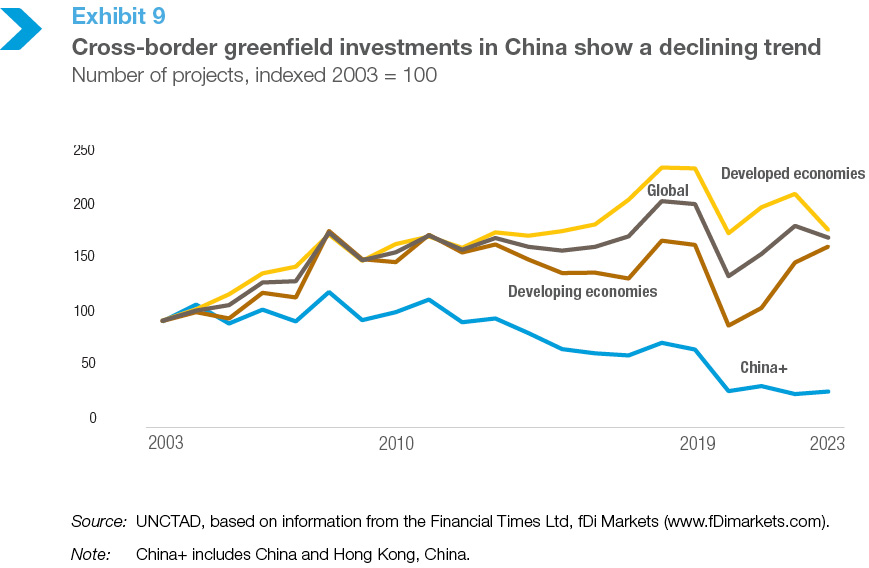
Trend 6: The diminishing role of FDI in China.
Despite a waning interest from MNEs in new investment projects in China, the country continues to maintain a dominant position in global manufacturing and trade, signifying a transformation in its global production model.
5/10.
Trend 5: Convergence of sectoral patterns across regions.
All regions, including developing ones, are feeling the effects of the transition towards services-oriented FDI. Consequently, traditional regional differences in sectoral patterns are increasingly blurring.
4/10
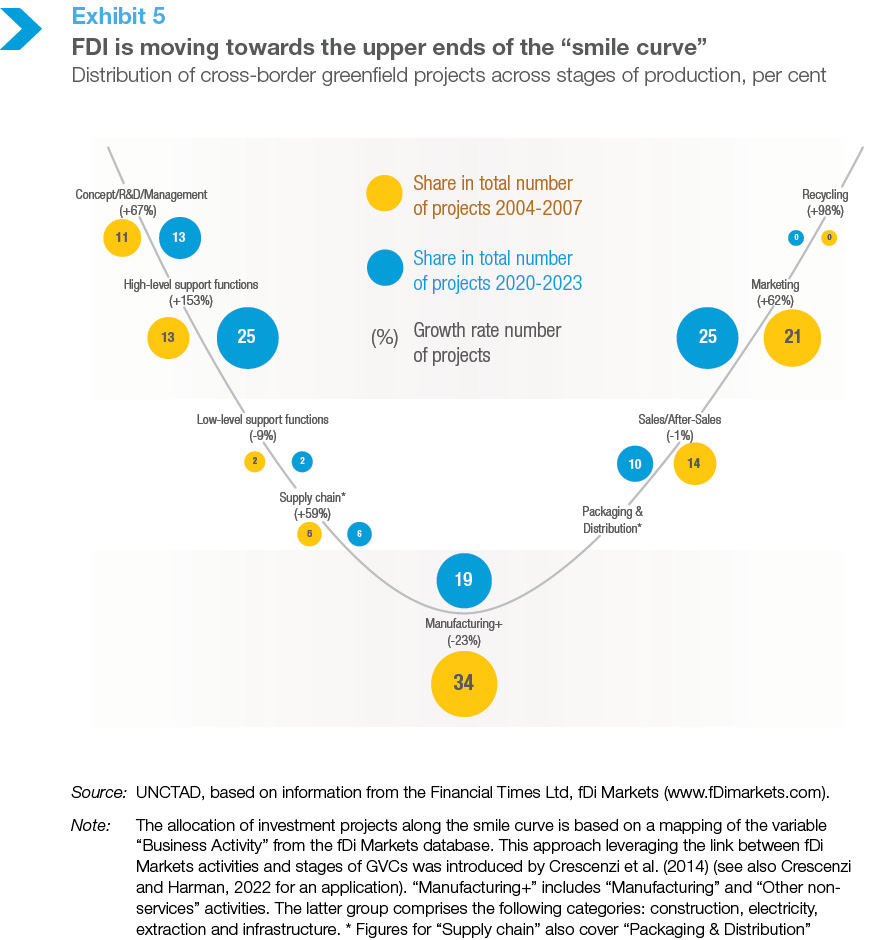
Trend 4: The growing ends of the smile curve.
The transition from manufacturing to services is part of a broader change in the role of FDI in global value creation. Cross-border investment is moving from the centre to the two ends of the smile curve.
3/10
Trend 3: The deglobalisation of manufacturing (from an FDI perspective).
Manufacturing FDI, stagnant for two decades, shows negative growth after the Covid-19. While global manufacturing activity and investment remain robust, their international component is shrinking.
2/10
Trend 2: The increasing weight of services.
The overall stagnation in FDI conceals sectoral differences. Cross-border investment in services flourishes while manufacturing lags. This reflects a global shift towards more services-centric and asset-light investment.
1/10
Trend 1: Long-term FDI stagnation.
The long-term trend in cross-border investment shows that a slowdown in global FDI relative to GDP and trade already started around 2010. Trade within global value chains also slowed, confirming the close link between FDI and GVCs.
Global crises fracturing foreign investment, impacting developing economies.
@UN Trade & Development calls for innovative investment strategies to foster inclusive and sustainable economic growth. https://t.co/NcTDUfsBOy
Fractured future: What shifting investment patterns mean for development.
The #WeeklyTradecast looks at a new report by the @UN on trends in foreign direct investment with Bruno Casella (@Bru_Case), a senior economist at UN Trade & Development (@UNCTAD). https://t.co/fHhRd6N3QG