In our newest ChemRxiv preprint we showed that HFIP can solely mediate a boron-iodane exchange between 1-hydroxybenzoiodoxolones and aryl boronic acids, delivering a set of I(III) reagents.
Link: https://t.co/jAZSaFSA52
@Boron_Chemistry@HyperIodine@UniWarszawski@NCN_PL
@LcsoLab@KabiArup@stefano_crespi@UniWarszawski@Boron_Chemistry We think that an HFIP-based solvent cage, potentially formed around a carboxyl group in BI-Ph, may cause i.e. steric congestion and thereby facilitate the selective formation of one type of aryl radical.
Check out our newest ChemRxiv preprint on the covalent activation of aryl boronic acids via redox inversion strategy enabled by hypervalent iodine chemistry. Congrats to the team! @KabiArup@stefano_crespi@UniWarszawski@Boron_Chemistry
https://t.co/SrVAGEmzyc
We expand the synthetic utility of nitroarenes with a powerful, robust strategy! @J_A_C_S
Congrats @KousikD52228871, @sayonika34 and Eno
Reactivity of Nitroarenes toward Alkyl Radicals Enables Direct C–H Alkylation
https://t.co/HhkHK5UPMA
In our strategy, highly oxidizable aryl boronic acids are transformed in situ into reducible aryl benzoiodoxolones which are photochemically reduced towards aryl radicals. From now, aryl radicals are easily accessible from aryl boronic acids without using strong oxidants!
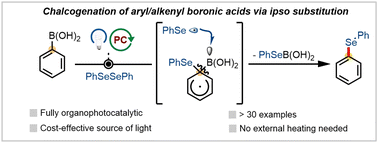
Our paper on organophotocatalytic ipso-chalcogenation of aryl/alkenyl boronic acids has been published in @ChemCommun ! Congratulations to @KabiArup, Renu and Dulal on this contribution to boron chemistry.
Excited to share our latest work is now out on ACS catalysis (@ACSPublications) !!
We report a DR to NIR light-driven Ni-catalyzed C(sp²)–C(sp³) cross-coupling of alkylborons with aryl halides enabled via direct excitation catalysis.
https://t.co/70s9yjjROD
🧪Celebrating Main-Group Chemistry in Europe !
The 2nd Main-Group Elements Reactivity Conference (#MGERC27) will take place at the University of Namur on 8–10 November 2027 🇧🇪.
📍 Namur, Belgium
🗓️ Save the date! Website launching soon — stay tuned! ✨🇪🇺 #MainGroupChemistry
Metal-based catalysts and high temperatures are no longer needed for ipso-chalcogenation of aryl boronic acids! We developed fully organophotocatalytic, milder version of this process. Please check our preprint for more details: https://t.co/aB7jfB7HSC
Two PhD-positions in organic chemistry are available in my research group as a part of MSC-DN ‘Photo-switchable ultra-thin membranes for molecular separation’. Official recruitment will soon be open: https://t.co/JWDuOXE7k4
We have an open PhD position on the study of new photoswitches based on CN and CP bonds, as part of the MSCA-DN LUMIERE 💡
Still 10 days to apply!
Please RT 📣
https://t.co/wwIjLPlZTa
A new article has been published in Scientific Reports in collaboration with Professor Landa's group! This marks the debut publication for the dynamic duo of my young and talented students, Martyna and Klaudiusz. Congratulations!
https://t.co/CHXgbdAkmG
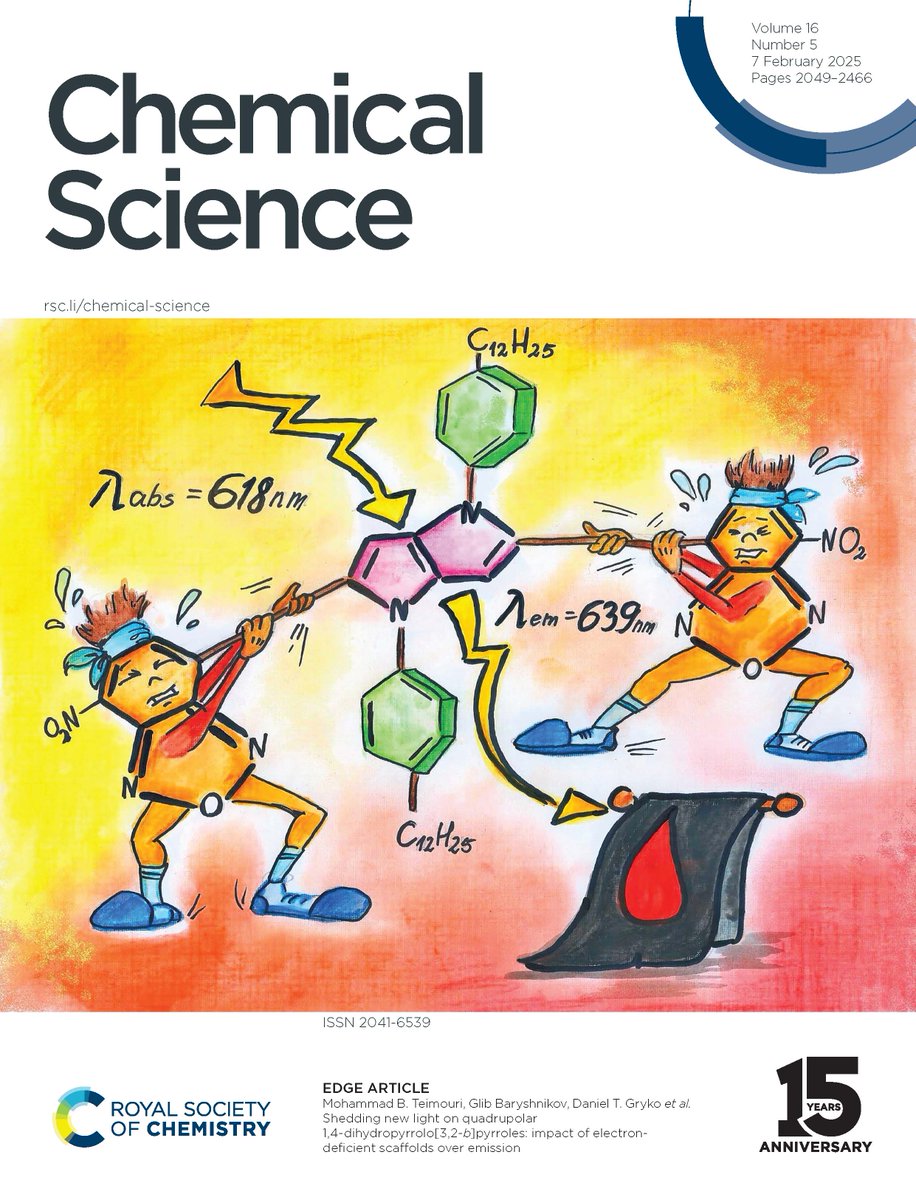
Happy to see this published in Chemical Science as a Perspective. Together with @TGryko we described the history, synthesis and properties of Dipyrrolonaphthyridinedione-based cross-conjugated chromophores. https://t.co/nnTPygn5fi
Keep up to date with new research like 'Realization of nitroaromatic chromophores with intense two-photon brightness' by @Tgryko, Piotr Piątkowski, Mireille Blanchard-Desce and first author Bartłomiej Sadowski.
https://t.co/xtOyQfEFNL
We have another postdoc position available for candidates that are interested in electrochemically-mediated synthesis of radicals. Apply and join us at @UniWarszawski !
Deadline: 4.09.2023
https://t.co/NHnQER3OTR
#chempostdoc
We still have a two-year postdoc position open to scholars that are interested in electrochemically-enabled synthesis of high energy species. Full details in the link below. RTs greatly appreciated :) https://t.co/1P4li9uIs3
#chempostdoc